
日本青少年和年轻成年癌症患者发生重度抑郁症的风险。
Risk of major depressive disorder in adolescent and young adult cancer patients in Japan.
机构信息
Department of Psychiatry and Cognitive-Behavioral Medicine, Nagoya City University Graduate School of Medical Sciences, Nagoya, Japan.
Japan Medical Office, Takeda Pharmaceutical Company Limited, Tokyo, Japan.
出版信息
Psychooncology. 2022 Jun;31(6):929-937. doi: 10.1002/pon.5881. Epub 2022 Jan 20.
OBJECTIVE
To estimate the risk of major depressive disorder (MDD) in adolescent and young adult (AYA) patients with cancer in Japan and identify risk factors for MDD among these patients.
METHODS
This was a matched cohort study using a large claims database in Japan. Included patients were aged 15-39 years, newly diagnosed with cancer during 2012-2017 and assessable for a follow-up period of 12 months. Kaplan-Meier estimates and Cox proportional hazards models were used to calculate hazard ratios (HR) and 95% confidence intervals (CI) for MDD in the AYA patients with cancer versus age-, sex- and working status-matched cancer-free controls. A subgroups analysis of the AYA patients with cancer was performed to explore MDD risk factors.
RESULTS
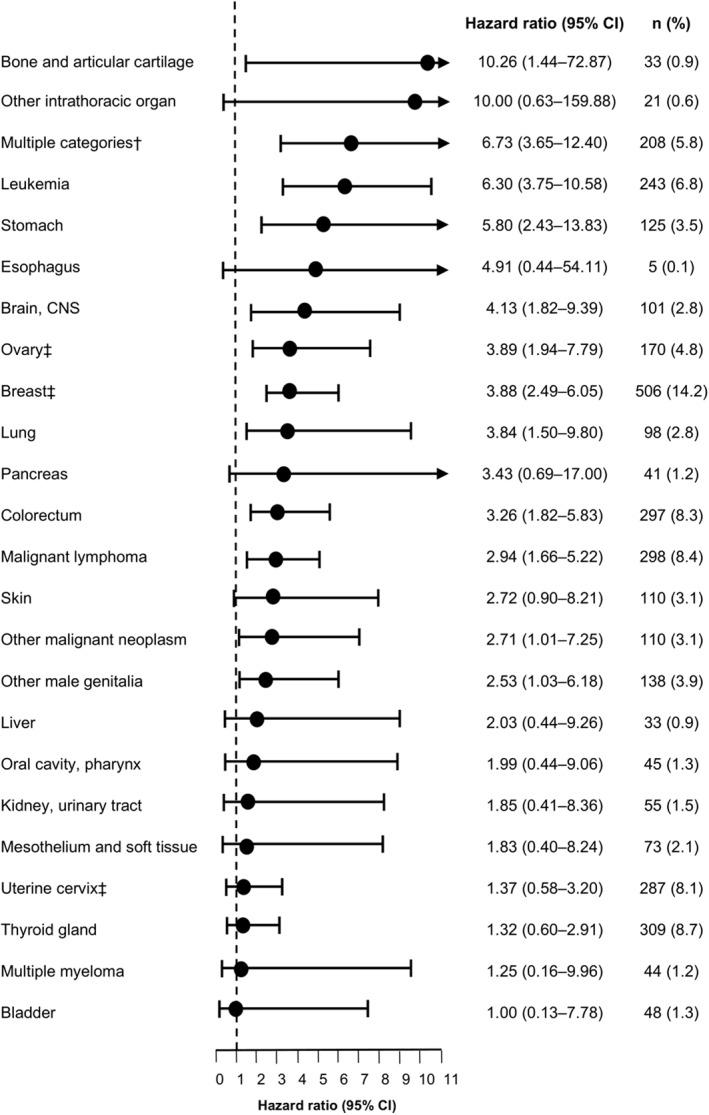
A total of 3559 AYA patients with cancer and 35,590 matched controls were included in the analysis. Adolescent and young adult patients with cancer had a three-fold higher risk for MDD compared with cancer-free controls (HR, 3.12; 95% CI, 2.64-3.70). Among cancer categories with >100 patients, patients with multiple cancer categories, including those with metastatic cancer (HR, 6.73, 95% CI, 3.65-12.40) and leukemia (HR, 6.30; 95% CI, 3.75-10.58), had the greatest MDD risk versus matched controls. Patients who received inpatient chemotherapy as initial treatment had a higher risk for MDD than patients without chemotherapy (HR, 0.43; 95% CI, 0.30-0.62).
CONCLUSIONS
Adolescent and young adult patients in Japan with cancer are at high risk for MDD. Particularly, those with multiple cancer categories, leukemia, and those who receive aggressive anticancer treatments should be monitored closely for symptoms of MDD.
目的
评估日本青少年和年轻成人(AYA)癌症患者发生重度抑郁症(MDD)的风险,并确定这些患者发生 MDD 的危险因素。
方法
这是一项使用日本大型理赔数据库的匹配队列研究。纳入的患者年龄为 15-39 岁,在 2012-2017 年期间确诊为癌症,并可评估 12 个月的随访期。采用 Kaplan-Meier 估计和 Cox 比例风险模型计算癌症青少年和年轻成人患者与年龄、性别和工作状态匹配的无癌症对照患者发生 MDD 的风险比(HR)和 95%置信区间(CI)。对癌症青少年和年轻成人患者进行亚组分析,以探讨 MDD 的危险因素。
结果
共纳入 3559 例癌症青少年和年轻成人患者和 35590 例匹配对照。与无癌症对照患者相比,癌症青少年和年轻成人患者发生 MDD 的风险高 3 倍(HR,3.12;95%CI,2.64-3.70)。在癌症分类中,有>100 例患者的类别中,患有多种癌症类别的患者,包括患有转移性癌症(HR,6.73;95%CI,3.65-12.40)和白血病(HR,6.30;95%CI,3.75-10.58),与匹配对照相比,MDD 风险最大。与无化疗的患者相比,接受住院化疗作为初始治疗的患者发生 MDD 的风险更高(HR,0.43;95%CI,0.30-0.62)。
结论
日本癌症青少年和年轻成人患者发生 MDD 的风险较高。特别是那些患有多种癌症类别、白血病的患者,以及接受积极抗癌治疗的患者,应密切监测 MDD 症状。

 Zotero 插件