
从海洋沉积物中分离和鉴定首例温和噬菌体。
Isolation and Characterization of the First Temperate Virus Infecting from Marine Sediments.
机构信息
State Key Laboratory of Microbial Resources, Institute of Microbiology, Chinese Academy of Sciences, Beijing 100101, China.
College of Life Science, University of Chinese Academy of Sciences, Beijing 100049, China.
出版信息
Viruses. 2022 Jan 8;14(1):108. doi: 10.3390/v14010108.
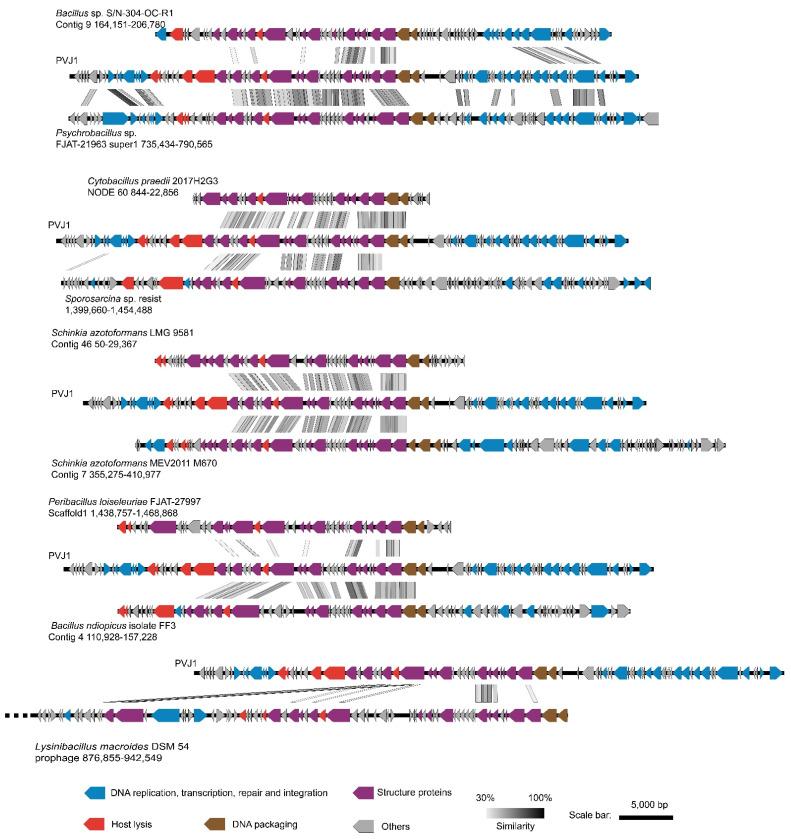
Viruses are far more abundant than cellular microorganisms in the marine ecosystem. However, very few viruses have so far been isolated from marine sediments, especially hydrothermal vent sediments, hindering the understanding of the biology and ecological functions of these tiny organisms. Here, we report the isolation and characterization of a temperate bacteriophage, named PVJ1, which infects from a hydrothermal vent field in Okinawa Trough. PVJ1 belongs to the family of the order . The tailed phage possesses a 53,187 bp linear dsDNA genome, with 84 ORFs encoding structural proteins, genome replication, host lysis, etc. in a modular pattern. The phage genome is integrated into the host chromosome near the 3'-end of , a gene encoding purine nucleoside phosphorylase (PNP). The phage integration does not appear to disrupt the function of PNP. The phage DNA is packaged by the headful mechanism. Release of PVJ1 from the host cell was drastically enhanced by treatment with mitomycin C. Phages encoding an MCP sharing significant similarity (≥70% identical amino acids) with that of PVJ1 are widespread in diverse environments, including marine and freshwater sediments, soils, artificial ecosystems, and animal intestines, and primarily infect Firmicutes. These results are valuable to the understanding of the lifestyle and host interactions of bacterial viruses at the bottom of the ocean.
病毒在海洋生态系统中的丰度远远超过细胞微生物。然而,迄今为止,从海洋沉积物中,特别是从热液喷口沉积物中分离出的病毒很少,这阻碍了人们对这些微小生物的生物学和生态功能的理解。在这里,我们报告了一种温和噬菌体 PVJ1 的分离和特性,它感染了来自冲绳海槽热液喷口的。PVJ1 属于 科的 目。有尾噬菌体具有 53187bp 的线性 dsDNA 基因组,其中 84 个 ORF 以模块化模式编码结构蛋白、基因组复制、宿主裂解等。噬菌体基因组整合到宿主染色体上,位于编码嘌呤核苷磷酸化酶(PNP)的基因的 3'末端附近。噬菌体的整合似乎没有破坏 PNP 的功能。噬菌体 DNA 通过从头包装机制进行包装。用丝裂霉素 C 处理可大大增强 PVJ1 从宿主细胞中的释放。编码与 PVJ1 具有显著相似性(≥70%相同的氨基酸)的 MCP 的噬菌体广泛存在于各种环境中,包括海洋和淡水沉积物、土壤、人工生态系统和动物肠道,主要感染厚壁菌门。这些结果有助于了解海洋底部细菌病毒的生活方式和宿主相互作用。




 Zotero 插件