
CONUT评分可预测肝移植后的早期发病率:一项合作研究。
CONUT Score Predicts Early Morbidity After Liver Transplantation: A Collaborative Study.
作者信息
Spoletini Gabriele, Ferri Flaminia, Mauro Alberto, Mennini Gianluca, Bianco Giuseppe, Cardinale Vincenzo, Agnes Salvatore, Rossi Massimo, Avolio Alfonso Wolfango, Lai Quirino
机构信息
General Surgery and Liver Transplantation, Fondazione Policlinico Universitario Agostino Gemelli IRCCS, Rome, Italy.
General Surgery and Organ Transplantation Unit, Sapienza University of Rome, Rome, Italy.
出版信息
Front Nutr. 2022 Jan 7;8:793885. doi: 10.3389/fnut.2021.793885. eCollection 2021.
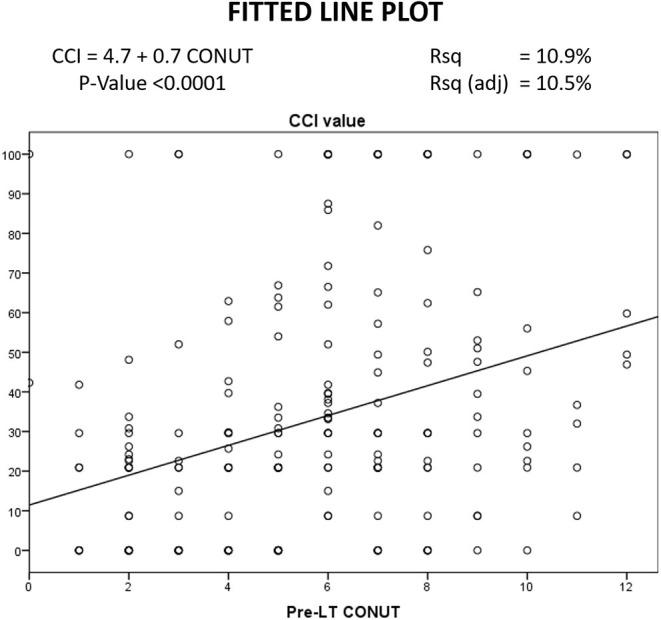
Liver transplantation (LT) is burdened by the risk of post-operative morbidity. Identifying patients at higher risk of developing complications can help allocate resources in the perioperative phase. Controlling Nutritional Status (CONUT) score, based on lymphocyte count, serum albumin, and cholesterol levels, has been applied to various surgical specialties, proving reliable in predicting complications and prognosis. Our study aims to investigate the role of the CONUT score in predicting the development of early complications (within 90 days) after LT. This is a retrospective analysis of 209 patients with a calculable CONUT score within 2 months before LT. The ability of the CONUT score to predict severe complications, defined as a Comprehensive Complication Index (CCI) ≥42.1, was examined. Inverse Probability Treatment Weighting was used to balance the study population against potential confounders. Patients with a CCI ≥42.1 had higher CONUT score values (median: 7 vs. 5, -value < 0.0001). The CONUT score showed a good diagnostic ability regarding post-LT morbidity, with an AUC = 0.72 (95.0%CI = 0.64-0.79; -value < 0.0001). The CONUT score was the only independent risk factor identified for a complicated post-LT course, with an odds ratio = 1.39 (-value < 0.0001). The 90-day survival rate was 98.8% and 87.5% for patients with a CONUT score <8 and ≥8, respectively. Pre-operative CONUT score is a helpful tool to identify patients at increased post-LT morbidity risk. Further refinements in the score composition, specific to the LT population, could be obtained with prospective studies.
肝移植(LT)术后存在发病风险。识别并发症发生风险较高的患者有助于在围手术期合理分配资源。基于淋巴细胞计数、血清白蛋白和胆固醇水平的控制营养状况(CONUT)评分已应用于多个外科专业领域,在预测并发症和预后方面被证明是可靠的。我们的研究旨在探讨CONUT评分在预测肝移植术后90天内早期并发症发生中的作用。这是一项对209例在肝移植前2个月内可计算CONUT评分的患者进行的回顾性分析。研究了CONUT评分预测定义为综合并发症指数(CCI)≥42.1的严重并发症的能力。采用逆概率加权法平衡研究人群以对抗潜在混杂因素。CCI≥42.1的患者CONUT评分值更高(中位数:7对5,P值<0.0001)。CONUT评分在预测肝移植术后发病方面显示出良好的诊断能力,曲线下面积(AUC)=0.72(95.0%置信区间=0.64 - 0.79;P值<0.0001)。CONUT评分是唯一确定的肝移植术后病程复杂的独立危险因素,比值比=1.39(P值<0.0001)。CONUT评分<8和≥8的患者90天生存率分别为98.8%和87.5%。术前CONUT评分是识别肝移植术后发病风险增加患者的有用工具。通过前瞻性研究可对该评分构成进行进一步优化,使其更适用于肝移植人群。



 Zotero 插件