
大量双簧管吹奏者中与演奏相关的肌肉骨骼疾病、风险因素及治疗效果
Playing-Related Musculoskeletal Disorders, Risk Factors, and Treatment Efficacy in a Large Sample of Oboists.
作者信息
Macdonald Heather M, Lavigne Stéphanie K, Reineberg Andrew E, Thaut Michael H
机构信息
Faculty of Music, University of Toronto, Toronto, ON, Canada.
Music and Health Science Research Collaboratory, Faculty of Music, University of Toronto, Toronto, ON, Canada.
出版信息
Front Psychol. 2022 Jan 14;12:772357. doi: 10.3389/fpsyg.2021.772357. eCollection 2021.
OBJECTIVES
During their lifetimes, a majority of musicians experience playing-related musculoskeletal disorders (PRMD). PRMD prevalence is tied to instrument choice, yet most studies examine heterogeneous groups of musicians, leaving some high-risk groups such as oboists understudied. This paper aims to (1) ascertain the prevalence and nature of PRMDs in oboists, (2) determine relevant risk factors, and (3) evaluate the efficacy of treatment methods in preventing and remedying injuries in oboe players.
METHODS
A 10-question online questionnaire on PRMDs and their treatments was completed by 223 oboists. PRMDs were compared across gender, weekly playing hours, career level, age, and years of playing experience.
RESULTS
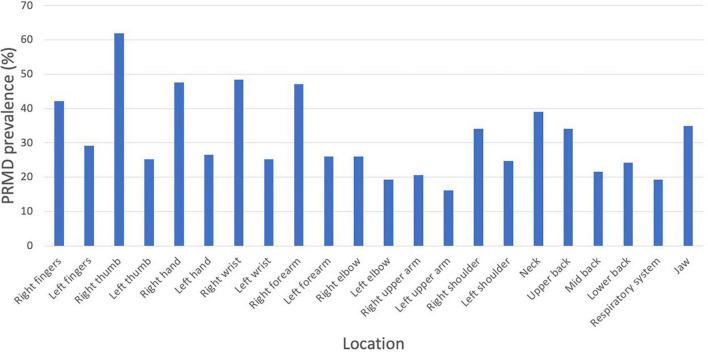
Of all respondents, 74.9% (167/223) reported having had at least one PRMD in their lifetime. A majority of these injuries (61.9% of all respondents) were of moderate to extreme severity (5 or higher on a scale of 1 to 10). Females (mean = 5.88) reported significantly more severe injuries than males. No significant effects of career level (i.e., professional vs. student vs. amateur), age, or years of playing experience were observed. We found significant non-linear relationships between weekly playing hours and PRMD prevalence and severity. Injuries were most commonly on the right side of the body, with the right thumb, wrist, hand, and forearm being most affected in frequency and severity. Of those injuries for which recovery information was provided, only 26.1% of injuries were "completely recovered." The perceived effectiveness of a few treatments (physical therapy, rest, stretching, occupational therapy, massage) tended to be ranked more highly than others.
CONCLUSION
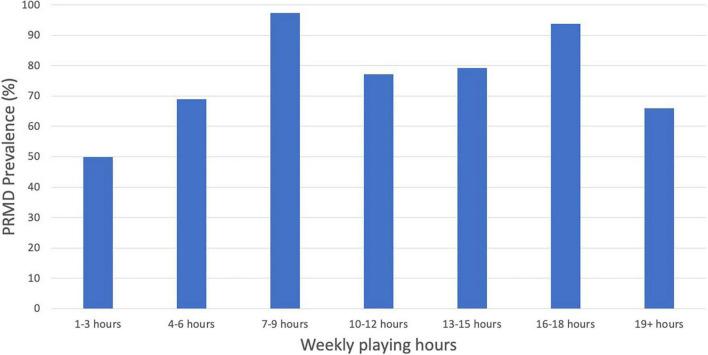
The oboists in this study experienced high rates of PRMD, particularly in the right upper extremities. Females and those playing 7-9 and 16-18 h per week reported a significantly higher severity of injuries than other groups.
目的
大多数音乐家在其职业生涯中会经历与演奏相关的肌肉骨骼疾病(PRMD)。PRMD的患病率与乐器选择有关,但大多数研究调查的是不同类型音乐家的混合群体,导致一些高风险群体,如双簧管演奏者,未得到充分研究。本文旨在:(1)确定双簧管演奏者中PRMD的患病率和性质;(2)确定相关风险因素;(3)评估治疗方法在预防和治疗双簧管演奏者损伤方面的效果。
方法
223名双簧管演奏者完成了一份关于PRMD及其治疗的10题在线问卷。对不同性别、每周演奏时长、职业水平、年龄和演奏经验年限的PRMD情况进行了比较。
结果
在所有受访者中,74.9%(167/223)报告一生中至少患过一种PRMD。这些损伤中的大多数(占所有受访者的61.9%)为中度至重度(在1至10的评分量表上为5分或更高)。女性(平均得分=5.88)报告的损伤明显比男性更严重。未观察到职业水平(即专业、学生或业余)、年龄或演奏经验年限的显著影响。我们发现每周演奏时长与PRMD患病率和严重程度之间存在显著的非线性关系。损伤最常发生在身体右侧,右手拇指、手腕、手部和前臂在频率和严重程度上受影响最大。在提供了恢复信息的损伤中,只有26.1%的损伤“完全恢复”。一些治疗方法(物理治疗、休息、伸展、职业治疗、按摩)的感知效果往往比其他方法排名更高。
结论
本研究中的双簧管演奏者PRMD发生率较高,尤其是在上肢右侧。女性以及每周演奏7 - 9小时和16 - 18小时的人报告的损伤严重程度明显高于其他群体。





 Zotero 插件