
印度南部某部落人群中糖尿病、高血压及其他非传染性疾病的患病率和危险因素
Prevalence and Risk Factors of Diabetes, Hypertension and Other Non-Communicable Diseases in a Tribal Population in South India.
作者信息
Shriraam Vanishree, Mahadevan Shriraam, Arumugam Parandhaman
机构信息
Department of Community Medicine, Sri Ramachandra Institute of Higher Education and Research, Chennai, India.
Endocrinology and Metabolism, Sri Ramachandra Institute of Higher Education and Research, Chennai, India.
出版信息
Indian J Endocrinol Metab. 2021 Jul-Aug;25(4):313-319. doi: 10.4103/ijem.ijem_298_21. Epub 2021 Dec 15.
INTRODUCTION
The prevalence of non-communicable diseases is increasing in tribal areas of India owing to the development and adoption of modern lifestyle. This study was done to assess the prevalence and risk factors of obesity, diabetes and hypertension in a tribal area in South India.
MATERIALS AND METHODS
A cross-sectional study was conducted among all men and women 40 years and above in ten randomly selected villages in three village panchayats located in a hilly area in Vellore district, Tamil Nadu. Minimum sample size calculated was 370. Data collection was done using a pretested questionnaire, clinical examination, and capillary blood glucose measurement. Prevalence and 95% confidence interval were estimated for diabetes and hypertension. By univariate and multivariate logistic regression, the Odds Ratio was calculated to identify the risk factors. SPSS version 16.0 was used. A value of < 0.05 was considered statistically significant.
RESULTS
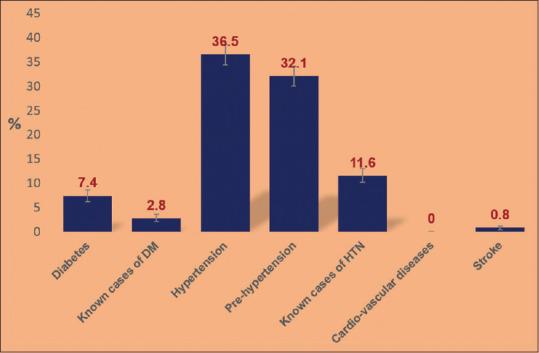
The study included 502 subjects, 212 (42.2%) males and 290 (57.8%) females. The proportion of generalized and abdominal obesity was 21% and 36.5%. The prevalence of diabetes and hypertension among the tribal population was 7.4% and 36.5%. Approximately 62% of diabetes and 68% of hypertension were newly diagnosed during this study. Higher age, female sex, generalized and abdominal obesity, and diabetes were risk factors for hypertension and abdominal obesity and hypertension were risk factors for diabetes.
CONCLUSION
The prevalence of diabetes and hypertension is high with two-thirds being newly diagnosed during study in this tribal population mandating early screening, awareness campaigns for early health-seeking and improvement in health access.
引言
由于现代生活方式的发展和采用,印度部落地区非传染性疾病的患病率正在上升。本研究旨在评估印度南部一个部落地区肥胖、糖尿病和高血压的患病率及危险因素。
材料与方法
在泰米尔纳德邦韦洛尔区一个山区的三个村潘查亚特中随机选取的十个村庄,对所有40岁及以上的男性和女性进行了一项横断面研究。计算得出的最小样本量为370。使用预先测试的问卷、临床检查和毛细血管血糖测量进行数据收集。估计了糖尿病和高血压的患病率及95%置信区间。通过单变量和多变量逻辑回归计算比值比以确定危险因素。使用SPSS 16.0版本。P < 0.05的值被认为具有统计学意义。
结果
该研究纳入了502名受试者,其中男性212名(42.2%),女性290名(57.8%)。全身肥胖和腹型肥胖的比例分别为21%和36.5%。部落人群中糖尿病和高血压的患病率分别为7.4%和36.5%。在本研究期间,约62%的糖尿病和68%的高血压是新诊断出的。年龄较大、女性、全身肥胖和腹型肥胖以及糖尿病是高血压的危险因素,腹型肥胖和高血压是糖尿病的危险因素。
结论
该部落人群中糖尿病和高血压的患病率很高,在研究期间三分之二是新诊断出的,这就要求进行早期筛查、开展提高早期就医意识的宣传活动并改善医疗服务可及性。

 Zotero 插件