
精准医学领域的胰腺癌类器官:关于多指标药物敏感性测试及协同评分的文献综述与经验总结
Pancreatic Cancer Organoids in the Field of Precision Medicine: A Review of Literature and Experience on Drug Sensitivity Testing with Multiple Readouts and Synergy Scoring.
作者信息
Mäkinen Lotta, Vähä-Koskela Markus, Juusola Matilda, Mustonen Harri, Wennerberg Krister, Hagström Jaana, Puolakkainen Pauli, Seppänen Hanna
机构信息
Department of Surgery, Faculty of Medicine, University of Helsinki and Helsinki University Hospital, 00290 Helsinki, Finland.
Translational Cancer Medicine Research Program, Faculty of Medicine, University of Helsinki, 00290 Helsinki, Finland.
出版信息
Cancers (Basel). 2022 Jan 21;14(3):525. doi: 10.3390/cancers14030525.
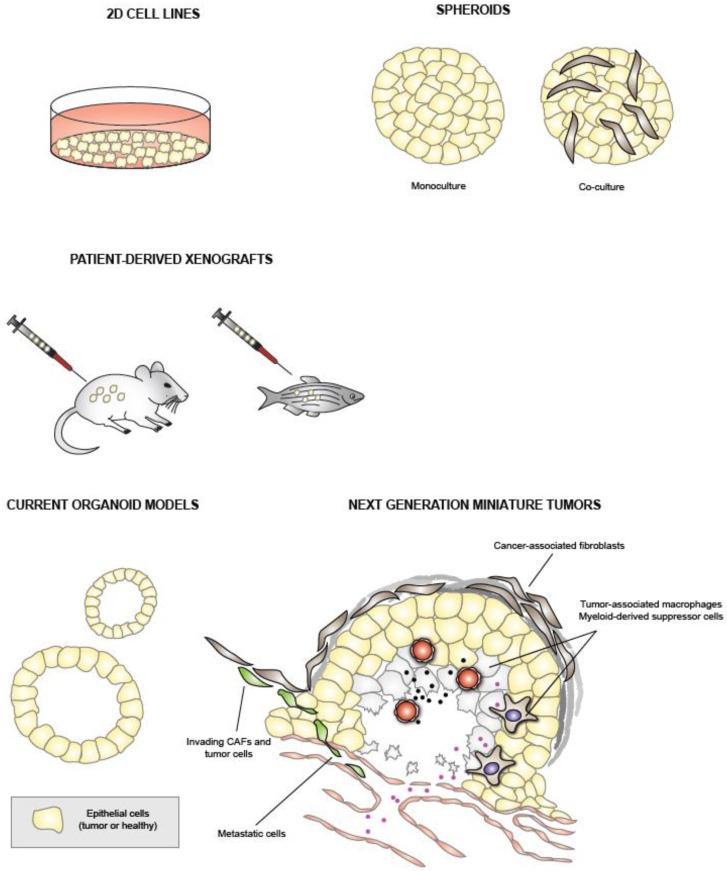
Pancreatic ductal adenocarcinoma (PDAC) is a silent killer, often diagnosed late. However, it is also dishearteningly resistant to nearly all forms of treatment. New therapies are urgently needed, and with the advent of organoid culture for pancreatic cancer, an increasing number of innovative approaches are being tested. Organoids can be derived within a short enough time window to allow testing of several anticancer agents, which opens up the possibility for functional precision medicine for pancreatic cancer. At the same time, organoid model systems are being refined to better mimic the cancer, for example, by incorporation of components of the tumor microenvironment. We review some of the latest developments in pancreatic cancer organoid research and in novel treatment design. We also summarize our own current experiences with pancreatic cancer organoid drug sensitivity and resistance testing (DSRT) in 14 organoids from 11 PDAC patients. Our data show that it may be necessary to include a cell death read-out in ex vivo DSRT assays, as metabolic viability quantitation does not capture actual organoid killing. We also successfully adapted the organoid platform for drug combination synergy discovery. Lastly, live organoid culture 3D confocal microscopy can help identify individual surviving tumor cells escaping cell death even during harsh combination treatments. Taken together, the organoid technology allows the development of novel precision medicine approaches for PDAC, which paves the way for clinical trials and much needed new treatment options for pancreatic cancer patients.
胰腺导管腺癌(PDAC)是一个隐匿的杀手,往往在晚期才被诊断出来。然而,它对几乎所有形式的治疗都令人沮丧地具有抗性。迫切需要新的治疗方法,随着胰腺癌类器官培养技术的出现,越来越多的创新方法正在接受测试。类器官可以在足够短的时间内获得,以便测试多种抗癌药物,这为胰腺癌的功能精准医学开辟了可能性。与此同时,类器官模型系统正在不断完善,以更好地模拟癌症,例如,通过纳入肿瘤微环境的成分。我们综述了胰腺癌类器官研究和新型治疗设计的一些最新进展。我们还总结了我们自己目前对11例PDAC患者的14个类器官进行胰腺癌类器官药物敏感性和抗性测试(DSRT)的经验。我们的数据表明,在体外DSRT分析中可能有必要纳入细胞死亡读数,因为代谢活力定量并不能反映实际的类器官杀伤情况。我们还成功地将类器官平台应用于药物联合协同作用的发现。最后,实时类器官培养3D共聚焦显微镜可以帮助识别即使在苛刻的联合治疗期间仍能逃脱细胞死亡的单个存活肿瘤细胞。综上所述,类器官技术为PDAC开发新型精准医学方法提供了可能,这为临床试验以及为胰腺癌患者提供急需的新治疗选择铺平了道路。


 Zotero 插件