
石墨烯-钛界面的热导率:分子模拟
Thermal Conductance of Graphene-Titanium Interface: A Molecular Simulation.
作者信息
Ou Bingxian, Yan Junxia, Wang Qinsheng, Lu Lixin
机构信息
School of Mechanical Engineering, Jiangnan University, Wuxi 214122, China.
Special Equipment Safety Supervision Inspection Institute of Jiangsu Province, National Graphene Products Quality Inspection and Testing Center (Jiangsu), Wuxi 214174, China.
出版信息
Molecules. 2022 Jan 28;27(3):905. doi: 10.3390/molecules27030905.
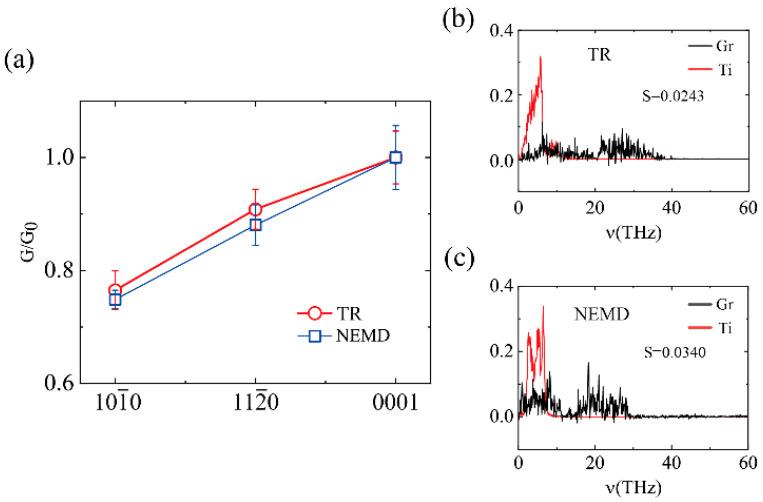
Titanium is a commonly used material in aviation, aerospace, and military applications, due to the outstanding mechanical properties of titanium and its alloys. However, its relatively low thermal conductivity restricts its extended usage. The use of graphene as a filler shows great potential for the enhancement of thermal conductivity in titanium-based metal-matrix composites (MMCs). We used classical molecular dynamics (MD) simulation methods to explore the thermal conductance at the titanium-graphene (Ti/Gr) interface for its thermal boundary conductance, which plays an important role in the thermal properties of Ti-based MMCs. The effects of system size, layer number, temperature, and strain were considered. The results show that the thermal boundary conductance (TBC) decreases with an increasing layer number and reaches a plateau at n = 5. TBC falls under tensile strain and, in turn, it grows with compressive strain. The variation of TBC is explained qualitatively by the interfacial atomic vibration coupling factor. Our findings also provide insights into ways to optimize future thermal management based on Ti-based MMCs materials.
由于钛及其合金具有出色的机械性能,钛是航空、航天和军事应用中常用的材料。然而,其相对较低的热导率限制了其广泛应用。使用石墨烯作为填料在提高钛基金属基复合材料(MMC)的热导率方面显示出巨大潜力。我们使用经典分子动力学(MD)模拟方法来探究钛-石墨烯(Ti/Gr)界面处的热导,因为其热边界电导在钛基MMC的热性能中起着重要作用。考虑了系统尺寸、层数、温度和应变的影响。结果表明,热边界电导(TBC)随着层数的增加而降低,并在n = 5时达到平稳状态。TBC在拉伸应变下下降,而在压缩应变下则增加。通过界面原子振动耦合因子对TBC的变化进行了定性解释。我们的研究结果还为基于钛基MMC材料优化未来热管理的方法提供了见解。




 Zotero 插件