
冷冻电镜揭示端粒酶相关蛋白 1 的结构动力学见解。
Insights into POT1 structural dynamics revealed by cryo-EM.
机构信息
NTU Institute of Structural Biology, Nanyang Technological University, Singapore, Singapore.
School of Biological Sciences, Nanyang Technological University, Singapore, Singapore.
出版信息
PLoS One. 2022 Feb 17;17(2):e0264073. doi: 10.1371/journal.pone.0264073. eCollection 2022.
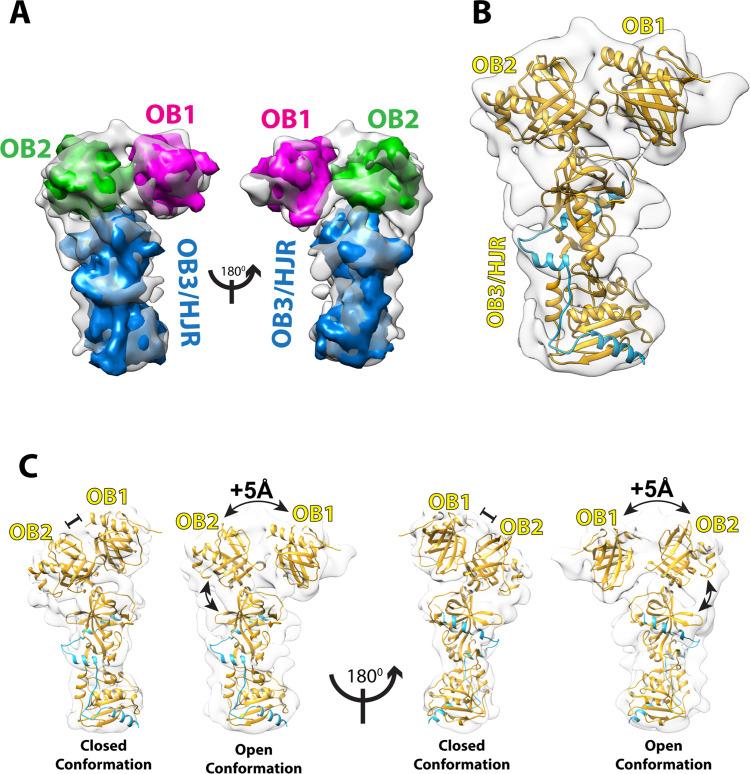
Telomeres are protein-DNA complexes that protect the ends of linear eukaryotic chromosomes. Mammalian telomeric DNA consists of 5'-(TTAGGG)n-3' double-stranded repeats, followed by up to several hundred bases of a 3' single-stranded G-rich overhang. The G-rich overhang is bound by the shelterin component POT1 which interacts with TPP1, the component involved in telomerase recruitment. A previously published crystal structure of the POT1 N-terminal half bound to the high affinity telomeric ligand 5'-TTAGGGTTAG-3' showed that the first six nucleotides, TTAGGG, are bound by the OB1 fold, while the adjacent OB2 binds the last four, TTAG. Here, we report two cryo-EM structures of full-length POT1 bound by the POT1-binding domain of TPP1. The structures differ in the relative orientation of the POT1 OB1 and OB2, suggesting that these two DNA-binding OB folds take up alternative conformations. Supporting DNA binding studies using telomeric ligands in which the OB1 and OB2 binding sites were spaced apart, show that POT1 binds with similar affinities to spaced or contiguous binding sites, suggesting plasticity in DNA binding and a role for the alternative conformations observed. A likely explanation is that the structural flexibility of POT1 enhances binding to the tandemly arranged telomeric repeats and hence increases telomere protection.
端粒是保护线性真核染色体末端的蛋白-DNA 复合物。哺乳动物端粒 DNA 由 5'-(TTAGGG)n-3'双链重复序列组成,其后是多达几百个碱基的 3'单链富含 G 的突出端。富含 G 的突出端由庇护素成分 POT1 结合,POT1 与参与端粒酶招募的 TPP1 成分相互作用。先前发表的 POT1 N 端与高亲和力端粒配体 5'-TTAGGGTTAG-3'结合的晶体结构表明,前六个核苷酸 TTAGGG 由 OB1 折叠结合,而相邻的 OB2 结合最后四个 TTAG。在这里,我们报告了两个全长 POT1 与 TPP1 的 POT1 结合域结合的 cryo-EM 结构。这些结构在 POT1 的 OB1 和 OB2 的相对取向上存在差异,表明这两个 DNA 结合 OB 折叠采用替代构象。使用端粒配体进行的支持 DNA 结合研究表明,OB1 和 OB2 结合位点相隔,表明 POT1 以相似的亲和力结合间隔或连续的结合位点,表明 DNA 结合具有灵活性和观察到的替代构象的作用。一个可能的解释是,POT1 的结构灵活性增强了与串联排列的端粒重复序列的结合,从而增加了端粒的保护。


 Zotero 插件