
基于单类支持向量机的云机器人系统未知物体检测
Unknown Object Detection Using a One-Class Support Vector Machine for a Cloud-Robot System.
机构信息
Department of Computer Science and Engineering, University of Aizu, Aizu-Wakamatsu 965-8580, Japan.
Department of Computer Science and Engineering, University of Asia Pacific, Dhaka 1216, Bangladesh.
出版信息
Sensors (Basel). 2022 Feb 10;22(4):1352. doi: 10.3390/s22041352.
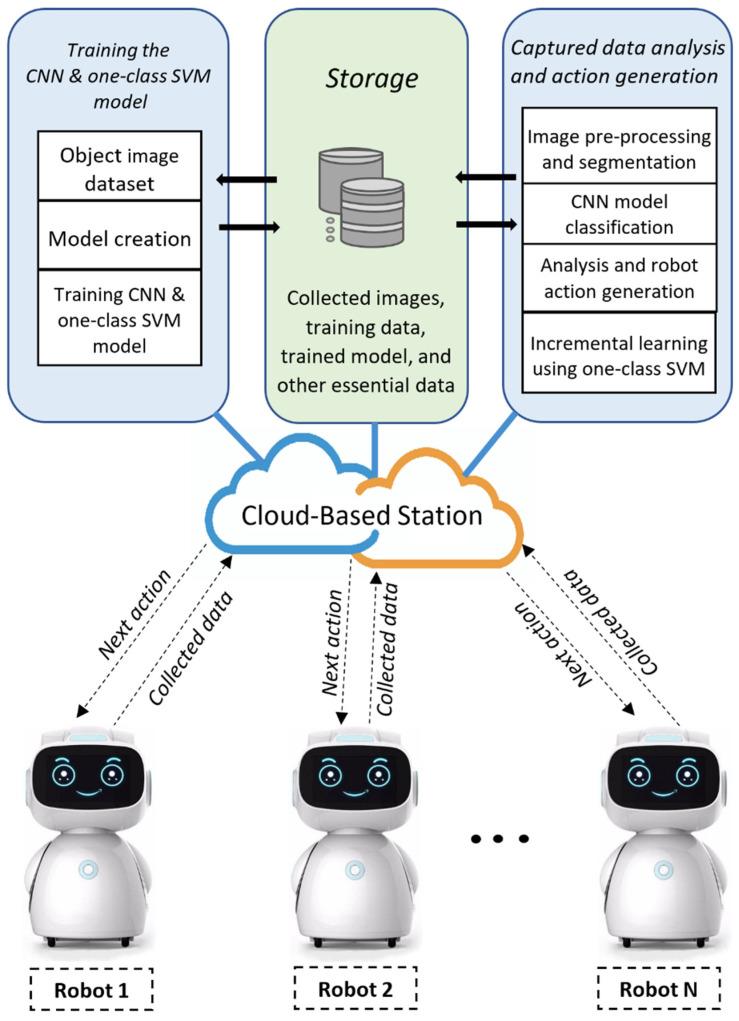
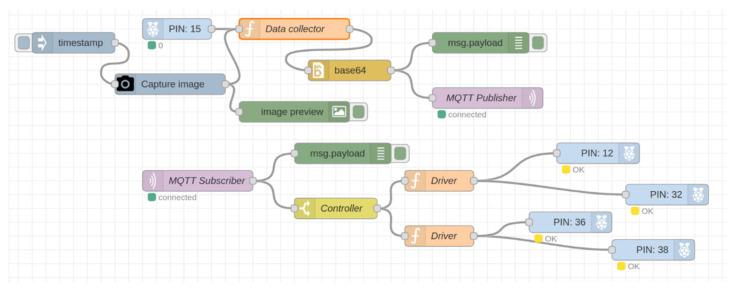
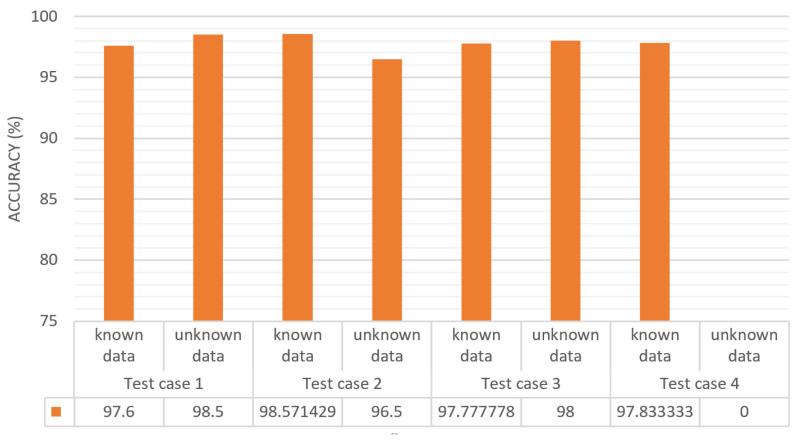
Inter-robot communication and high computational power are challenging issues for deploying indoor mobile robot applications with sensor data processing. Thus, this paper presents an efficient cloud-based multirobot framework with inter-robot communication and high computational power to deploy autonomous mobile robots for indoor applications. Deployment of usable indoor service robots requires uninterrupted movement and enhanced robot vision with a robust classification of objects and obstacles using vision sensor data in the indoor environment. However, state-of-the-art methods face degraded indoor object and obstacle recognition for multiobject vision frames and unknown objects in complex and dynamic environments. From these points of view, this paper proposes a new object segmentation model to separate objects from a multiobject robotic view-frame. In addition, we present a support vector data description (SVDD)-based one-class support vector machine for detecting unknown objects in an outlier detection fashion for the classification model. A cloud-based convolutional neural network (CNN) model with a SoftMax classifier is used for training and identification of objects in the environment, and an incremental learning method is introduced for adding unknown objects to the robot knowledge. A cloud-robot architecture is implemented using a Node-RED environment to validate the proposed model. A benchmarked object image dataset from an open resource repository and images captured from the lab environment were used to train the models. The proposed model showed good object detection and identification results. The performance of the model was compared with three state-of-the-art models and was found to outperform them. Moreover, the usability of the proposed system was enhanced by the unknown object detection, incremental learning, and cloud-based framework.
机器人之间的通信和高计算能力是部署具有传感器数据处理功能的室内移动机器人应用程序的挑战。因此,本文提出了一种高效的基于云的多机器人框架,具有机器人之间的通信和高计算能力,可部署用于室内应用的自主移动机器人。部署可用的室内服务机器人需要不间断的运动,并使用室内环境中的视觉传感器数据增强机器人的视觉,对物体和障碍物进行稳健的分类。然而,最先进的方法在处理多目标视觉帧中的室内物体和障碍物识别以及复杂和动态环境中的未知物体方面存在问题。从这些角度来看,本文提出了一种新的对象分割模型,用于从多目标机器人视图帧中分离对象。此外,我们提出了一种基于支持向量数据描述 (SVDD) 的单类支持向量机,用于以异常值检测的方式检测分类模型中的未知对象。使用基于云的卷积神经网络 (CNN) 模型和 SoftMax 分类器对环境中的对象进行训练和识别,并引入增量学习方法将未知对象添加到机器人知识库中。使用 Node-RED 环境实现了云机器人架构,以验证所提出的模型。使用来自开放资源存储库的基准对象图像数据集和从实验室环境捕获的图像来训练模型。所提出的模型表现出良好的目标检测和识别结果。将模型的性能与三种最先进的模型进行了比较,发现它优于这三种模型。此外,通过未知对象检测、增量学习和基于云的框架提高了所提出系统的可用性。







 Zotero 插件