
捷克和斯洛伐克牙科学生的口腔健康相关知识、态度和行为(KAB):多国横断面研究。
Czech and Slovak Dental Students' Oral Health-Related Knowledge, Attitudes, and Behaviours (KAB): Multi-Country Cross-Sectional Study.
机构信息
Czech National Centre for Evidence-Based Healthcare and Knowledge Translation (Cochrane Czech Republic, Czech EBHC: JBI Centre of Excellence, Masaryk University GRADE Centre), Faculty of Medicine, Institute of Biostatistics and Analyses, Masaryk University, 625 00 Brno, Czech Republic.
Department of Public Health, Faculty of Medicine, Masaryk University, 625 00 Brno, Czech Republic.
出版信息
Int J Environ Res Public Health. 2022 Feb 25;19(5):2717. doi: 10.3390/ijerph19052717.
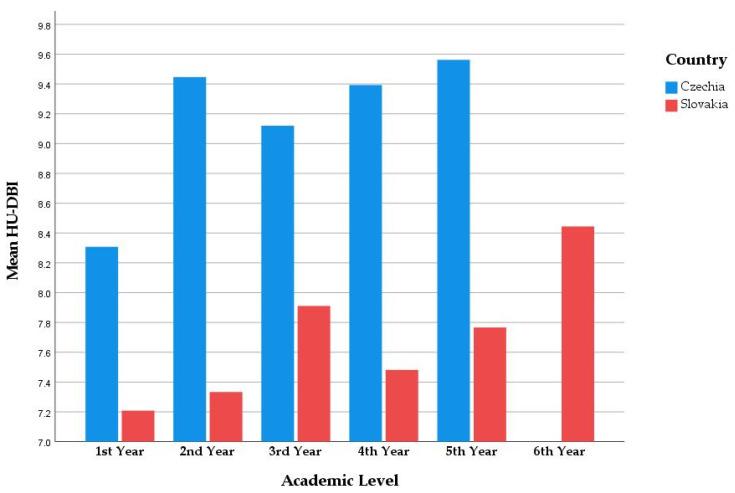
Dentists play a key role in the primary prevention of oral diseases and related systemic complications; therefore, their views on behavioural interventions need to be aligned with the current agendas for oral health. Likewise, dental students' oral health-related knowledge, attitudes, and behaviours (KAB) are of practical importance, as they are the future opinion leaders for oral health in their respective communities. A cross-sectional survey-based study was designed to evaluate the oral health KAB of dental students in both the Czech Republic and Slovakia. The study utilized translated versions of the Hiroshima University Dental Behavioural Inventory (HU-DBI), and it aimed to recruit students from all Czech and Slovak dental schools. A total of 487 students were included in this study, out of which 372 (76.4%) were females, 271 (55.6%) were enrolled in preclinical years, 68 (14%) reported smoking tobacco at least once a week, and 430 (88.3%) reported problematic internet use. The mean HU-DBI score of Czech and Slovak dental students (8.18 ± 1.80) was comparable with the previously reported scores of dental students in Nordic and Western European countries. Czech students (9.34 ± 1.29) had a significantly higher score than their Slovak counterparts (7.56 ± 1.73). In both countries, preclinical students (8.04 vs. 8.35), the students who reported tobacco smoking (7.63 vs. 8.27), and those who reported problematic internet use (8.11 vs. 8.70) had significantly lower HU-DBI scores than their counterparts, respectively. In the Czech Republic, the significant increases in HU-DBI scores occurred after the first academic year when the students received preventive dentistry courses; therefore, one can put forward that early implementation of preventive elements in undergraduate dental curricula may yield better and more sustainable oral health gains for the students. Future research on Czech and Slovak dental curricula need to re-evaluate the oral hygiene and anti-smoking components and their impact on students' views and attitudes.
牙医在口腔疾病和相关系统性并发症的一级预防中发挥着关键作用;因此,他们对行为干预的看法需要与口腔健康的当前议程保持一致。同样,牙科学生的口腔健康相关知识、态度和行为(KAB)具有实际意义,因为他们是各自社区未来的口腔健康意见领袖。本研究采用横断面调查设计,旨在评估捷克共和国和斯洛伐克的牙科学生的口腔健康 KAB。该研究使用了广岛大学口腔行为量表(HU-DBI)的翻译版本,并旨在招募所有捷克和斯洛伐克牙科学校的学生。共有 487 名学生参与了这项研究,其中 372 名(76.4%)为女性,271 名(55.6%)处于临床前阶段,68 名(14%)报告每周至少吸烟一次,430 名(88.3%)报告存在网络使用问题。捷克和斯洛伐克牙科学生的平均 HU-DBI 得分为 8.18 ± 1.80,与北欧和西欧国家之前报道的牙科学生得分相当。捷克学生(9.34 ± 1.29)的得分明显高于斯洛伐克学生(7.56 ± 1.73)。在这两个国家,临床前学生(8.04 比 8.35)、报告吸烟的学生(7.63 比 8.27)以及报告存在网络使用问题的学生(8.11 比 8.70)的 HU-DBI 得分均明显低于各自的对照组。在捷克,当学生开始接受预防牙科课程后,HU-DBI 得分显著增加,这表明在本科牙科课程中尽早实施预防措施可能会为学生带来更好和更可持续的口腔健康收益。未来需要对捷克和斯洛伐克的牙科课程进行研究,重新评估口腔卫生和反吸烟的内容及其对学生观点和态度的影响。



 Zotero 插件