
线性头部加速中的脑沟空洞化:与慢性创伤性脑病的可能关联。
Sulcal Cavitation in Linear Head Acceleration: Possible Correlation With Chronic Traumatic Encephalopathy.
作者信息
Kerwin Joseph, Yücesoy Atacan, Vidhate Suhas, Dávila-Montero Bianca M, Van Orman Jacob L, Pence Thomas J, Tartis Michaelann, Mejía-Alvarez Ricardo, Willis Adam M
机构信息
Department of Mechanical Engineering, Michigan State University, East Lansing, MI, United States.
Department of Neurology, Brooke Army Medical Center, Fort Sam Houston, TX, United States.
出版信息
Front Neurol. 2022 Feb 28;13:832370. doi: 10.3389/fneur.2022.832370. eCollection 2022.
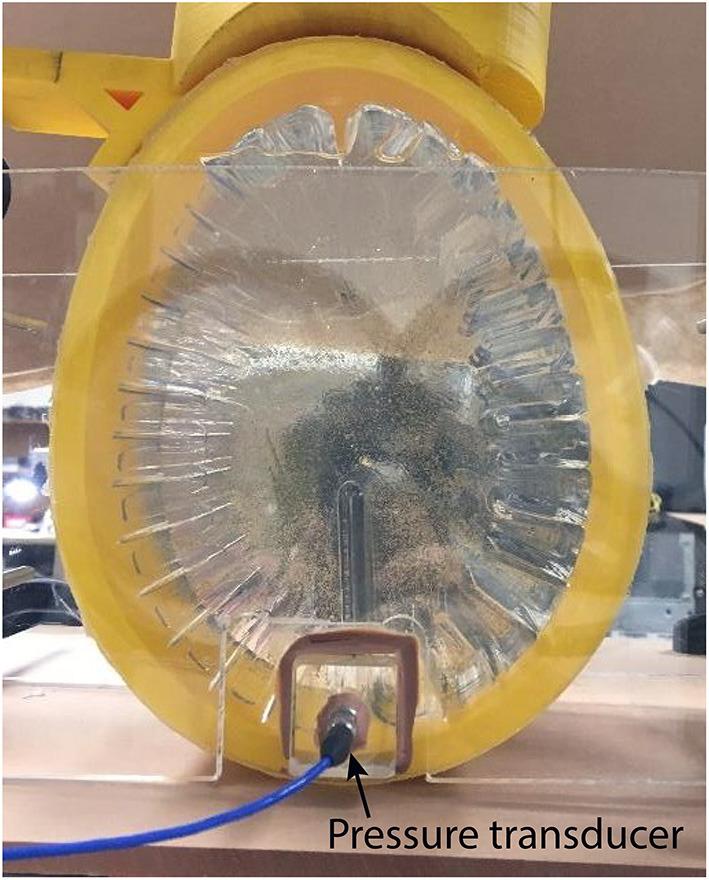
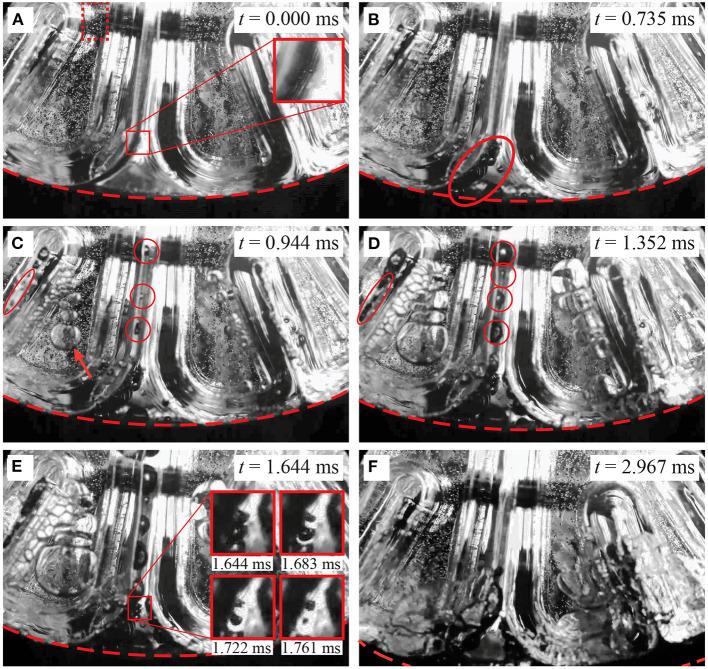
Traumatic Brain Injury (TBI) is a significant public health and financial concern that is affecting tens of thousands of people in the United States annually. There were over a million hospital visits related to TBI in 2017. Along with immediate and short-term morbidity from TBI, chronic traumatic encephalopathy (CTE) can have life-altering, chronic morbidity, yet the direct linkage of how head impacts lead to this pathology remains unknown. A possible clue is that chronic traumatic encephalopathy appears to initiate in the depths of the sulci. The purpose of this study was to isolate the injury mechanism/s associated with blunt force impact events. To this end, drop tower experiments were performed on a human head phantom. Our phantom was fabricated into a three-dimensional extruded ellipsoid geometry made out of Polyacrylamide gelatin that incorporated gyri-sulci interaction. The phantom was assembled into a polylactic acid 3D-printed skull, surrounded with deionized water, and enclosed between two optical windows. The phantom received repetitive low-force impacts on the order of magnitude of an average boxing punch. Intracranial pressure profiles were recorded in conjunction with high-speed imaging, 25 k frames-per-second. Cavitation was observed in all trials. is the spontaneous formation of vapor bubbles in the liquid phase resulting from a pressure drop that reaches the vapor pressure of the liquid. The observed cavitation was predominately located in the contrecoup during negative pressure phases of local intracranial pressure. To further investigate the cavitation interaction with the brain tissue phantom, a 2D plane strain computational model was built to simulate the deformation of gyrated tissue as a result from the initiation of cavitation bubbles seen in the phantom experiments. These computational experiments demonstrated a focusing of strain at the depths of the sulci from bubble expansion. Our results add further evidence that mechanical interactions could contribute to the development of chronic traumatic encephalopathy and also that fluid cavitation may play a role in this interaction.
创伤性脑损伤(TBI)是一个重大的公共卫生和财政问题,每年在美国影响着数万人。2017年,与创伤性脑损伤相关的医院就诊次数超过100万次。除了创伤性脑损伤的即时和短期发病率外,慢性创伤性脑病(CTE)可能会导致改变生活的慢性发病率,但头部撞击如何导致这种病理状况的直接联系仍然未知。一个可能的线索是,慢性创伤性脑病似乎始于脑沟深处。本研究的目的是分离与钝器撞击事件相关的损伤机制。为此,在人体头部模型上进行了落塔实验。我们的模型被制造成由聚丙烯酰胺明胶制成的三维挤压椭球体几何形状,其中包含脑回-脑沟相互作用。该模型被组装到一个聚乳酸3D打印的头骨中,周围环绕着去离子水,并封闭在两个光学窗口之间。该模型受到了平均拳击力量量级的重复性低力撞击。颅内压曲线与每秒25000帧的高速成像同时记录。在所有试验中均观察到了空化现象。空化是指由于压力降至液体蒸气压而在液相中自发形成气泡的现象。观察到的空化主要位于局部颅内压负压期的对冲部位。为了进一步研究空化与脑组织模型的相互作用,建立了一个二维平面应变计算模型,以模拟模型实验中看到的空化气泡引发后旋转组织的变形。这些计算实验表明,由于气泡膨胀,应变集中在脑沟深处。我们的结果进一步证明,机械相互作用可能导致慢性创伤性脑病的发展,而且流体空化可能在这种相互作用中起作用。





 Zotero 插件