
四环素类和β-内酰胺类抗生素残留诱导鸡肉羰基化。
Residues of tetracyclines and β-lactams antibiotics induce carbonylation of chicken breast.
机构信息
Analytical Chemistry and Biomedicine Group, University of Cartagena, Cartagena, Bolívar, 130001, Colombia.
Medical research group (GINUMED), Corporación Universitaria Rafael Núñez, Cartagena, Bolívar, 130001, Colombia.
出版信息
F1000Res. 2021 Jul 15;10:575. doi: 10.12688/f1000research.53863.1. eCollection 2021.
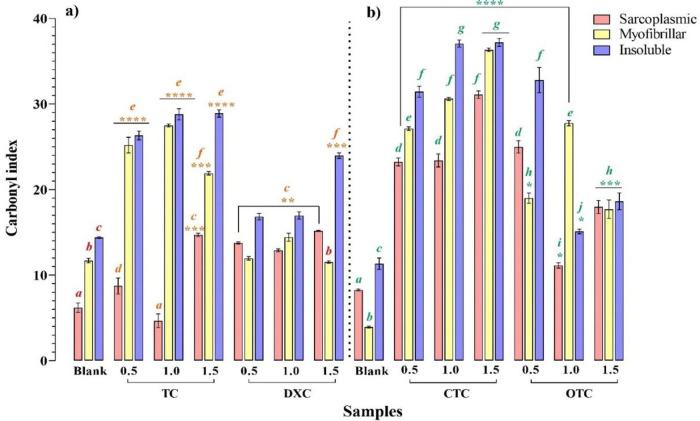
Worldwide, chicken meat is widely consumed due to its low cost, high nutritional value and non-interference with religious or cultural beliefs. However, during animal husbandry chickens are exposed to many chemical substances, including tetracyclines and β-lactams, which are used to prevent and cure several infections. Some residues of these compounds may bioaccumulate and be present in chicken meat after slaughtering, promoting oxidative reactions. In order to evaluate carbonylation induced by tetracyclines and β-lactams residues, a proteomic approach was used. For this, chicken muscle was individually contaminated with tetracyclines (tetracycline, chlortetracycline, oxytetracycline, and doxycycline) and β-lactams (ampicillin, benzathine penicillin, dicloxacillin and oxacillin) at 0.5, 1.0 and 1.5 times their maximum residue level (MRL). Then, sarcoplasmic, myofibrillar and insoluble proteins were extracted and their content were measured using the Bradford method. Protein carbonylation was measured using the 2,4-Dinitrophenylhydrazine alkaline method. Residues of tetracyclines and β-lactams induced carbonylation on sarcoplasmic, myofibrillar and insoluble proteins even at 0.5MRL concentrations ( ). When comparing the carbonylation induced by both antibiotics no differences were found ( ). Variables such as the partition coefficient (log P) and the concentration of these antibiotics showed a high correlation with the oxidative capacity of tetracyclines and β-lactams on chicken breast proteins. : This study shows that the presence of tetracyclines and β-lactams residues at MRLs concentrations promotes carbonylation on chicken breast proteins. Our results provide important insights about the impact of antibiotics on the integrity of meat proteins intended for human consumption.
全世界范围内,由于鸡肉价格低廉、营养价值高且不会干扰宗教或文化信仰,鸡肉得到了广泛的消费。然而,在畜牧业中,鸡会接触到许多化学物质,包括四环素类和β-内酰胺类,这些物质被用于预防和治疗多种感染。这些化合物的一些残留可能会在屠宰后生物积累并存在于鸡肉中,从而促进氧化反应。为了评估四环素类和β-内酰胺类残留引起的羰基化作用,采用了蛋白质组学方法。为此,将鸡肌肉分别用四环素(四环素、土霉素、金霉素和强力霉素)和β-内酰胺类(氨苄西林、苄星青霉素、双氯西林和苯唑西林)以其最大残留限量(MRL)的 0.5、1.0 和 1.5 倍进行污染。然后,提取肌浆、肌原纤维和不溶性蛋白质,并使用 Bradford 法测量其含量。使用 2,4-二硝基苯肼碱性法测量蛋白质羰基化。即使在 0.5MRL 浓度下,四环素类和β-内酰胺类残留也会引起肌浆、肌原纤维和不溶性蛋白质的羰基化()。当比较两种抗生素引起的羰基化时,没有发现差异()。这些抗生素的分配系数(log P)和浓度等变量与四环素类和β-内酰胺类对鸡胸蛋白的氧化能力具有高度相关性。:本研究表明,在 MRL 浓度下存在四环素类和β-内酰胺类残留会促进鸡胸蛋白的羰基化。我们的研究结果提供了有关抗生素对人类食用肉类蛋白质完整性影响的重要见解。




 Zotero 插件