
机器人辅助胆囊切除术后患者出现复发性右肝动脉假性动脉瘤:1 例报告。
Recurrent right hepatic artery pseudoaneurysm after robotic-assisted cholecystectomy in a patient with Mirizzi syndrome: a case report.
机构信息
Department of General Surgery, Keelung Chang Gung Memorial Hospital, Keelung, 204, Taiwan.
Division of Hepato-gastroenterology, Keelung Chang Gung Memorial Hospital, Keelung, 204, Taiwan.
出版信息
BMC Surg. 2022 Mar 23;22(1):112. doi: 10.1186/s12893-021-01438-2.
BACKGROUND
Iatrogenic hepatic artery pseudoaneurysm is a rare complication following laparoscopic cholecystectomy. Trans-arterial embolization (TAE) is an effective way to control bleeding after a ruptured aneurysm. But uncommonly, rebleeding may occur which will require a second embolization or even laparotomy.
CASE PRESENTATION
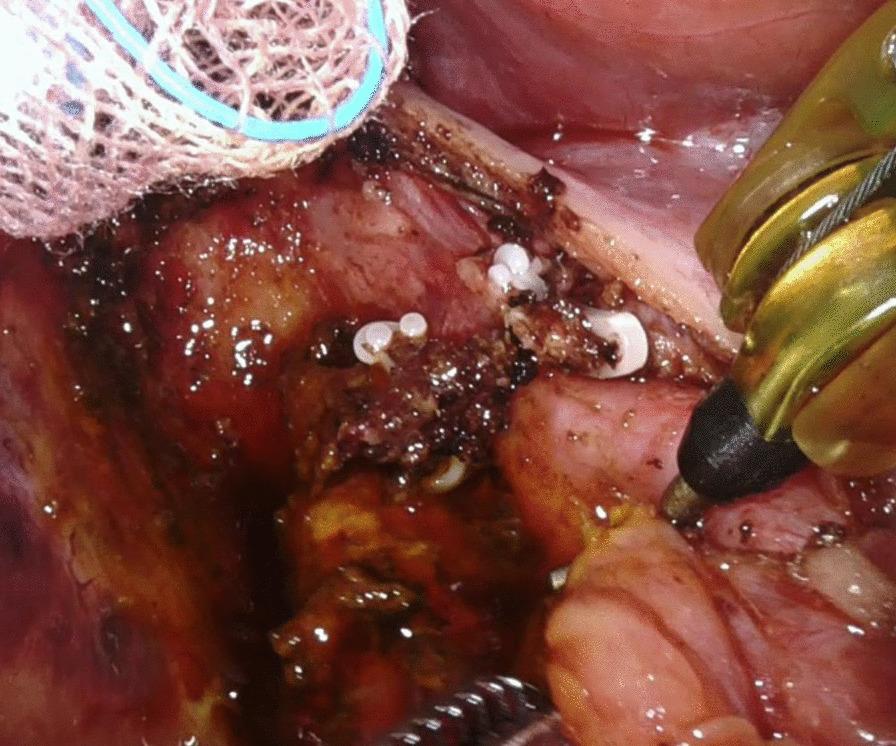
We report a case of a 45-year-old woman who underwent robotic-assisted cholecystectomy after the diagnosis of type II Mirizzi syndrome. During the operation, the anterior branch of the right hepatic artery was damaged and Hem-o-lok clips were applied to control the bleeding. The postoperative course was smooth, and the patient was discharged 6 days after the procedure. However, one week after hospital discharge, she presented to the emergency department with right upper abdominal tenderness, melena, and jaundice. After examination, the computed tomography angiography (CTA) revealed a 3 cm pseudoaneurysm at the distal stump of the right hepatic artery anterior branch. TAE with gelfoam material was performed. Three days later, the patient had an acute onset of abdominal pain. A recurrent pseudoaneurysm was found at the same location. She underwent TAE again but this time with a steel coil. No further complication was noted, and she was discharged one week later.
CONCLUSIONS
Even with the assistance of modern technologies such as the robotic surgery system, one should still take extra caution while handling the vessels. Also, embolization of the pseudoaneurysm with steel coils may be suitable for preventing recurrence.
背景
医源性肝动脉假性动脉瘤是腹腔镜胆囊切除术后罕见的并发症。经动脉栓塞(TAE)是控制破裂性动脉瘤出血的有效方法。但不常见的是,可能会再次发生出血,需要再次栓塞甚至剖腹手术。
病例介绍
我们报告了 1 例 45 岁女性,在诊断为 II 型 Mirizzi 综合征后接受机器人辅助胆囊切除术。手术过程中,损伤了右肝动脉前支,应用 Hem-o-lok 夹控制出血。术后过程顺利,患者在术后 6 天出院。然而,出院后 1 周,她因右上腹压痛、黑便和黄疸就诊于急诊科。检查后,计算机断层血管造影(CTA)显示右肝动脉前支远端残端有 3cm 假性动脉瘤。进行了 TAE 并用明胶海绵材料栓塞。3 天后,患者突发腹痛。在同一部位发现复发性假性动脉瘤。她再次接受 TAE 治疗,但这次使用了钢圈。未再出现并发症,一周后出院。
结论
即使有现代技术(如机器人手术系统)的辅助,在处理血管时仍应格外小心。此外,用钢圈栓塞假性动脉瘤可能适合预防复发。


 Zotero 插件