
预测一个具有潜在高风险的、多样化的、基于社区的女性群体中的乳腺癌风险。
Predicting breast cancer risk in a racially diverse, community-based sample of potentially high-risk women.
机构信息
Center for Epidemiology & Healthcare Delivery Research, JPS Health Network, Fort Worth, Texas, USA.
The Ohio State University, Center for Health Outcomes and Policy Evaluation Studies, College of Public Health, Columbus, Ohio, USA.
出版信息
Cancer Med. 2022 Nov;11(21):4043-4052. doi: 10.1002/cam4.4721. Epub 2022 Apr 6.
BACKGROUND
Identifying women with high risk of breast cancer is necessary to study high-risk experiences and deliver risk-management care. Risk prediction models estimate individuals' lifetime risk but have rarely been applied in community-based settings among women not yet receiving specialized care. Therefore, we aimed: (1) to apply three breast cancer risk prediction models (i.e., Gail, Claus, and IBIS) to a racially diverse, community-based sample of women, and (2) to assess risk prediction estimates using survey data.
METHODS
An online survey was administered to women who were determined by a screening instrument to have potentially high risk for breast cancer. Risk prediction models were applied using their self-reported family and medical history information. Inclusion in the high-risk subsample required ≥20% lifetime risk per ≥1 model. Descriptive statistics were used to compare the proportions of women identified as high risk by each model.
RESULTS
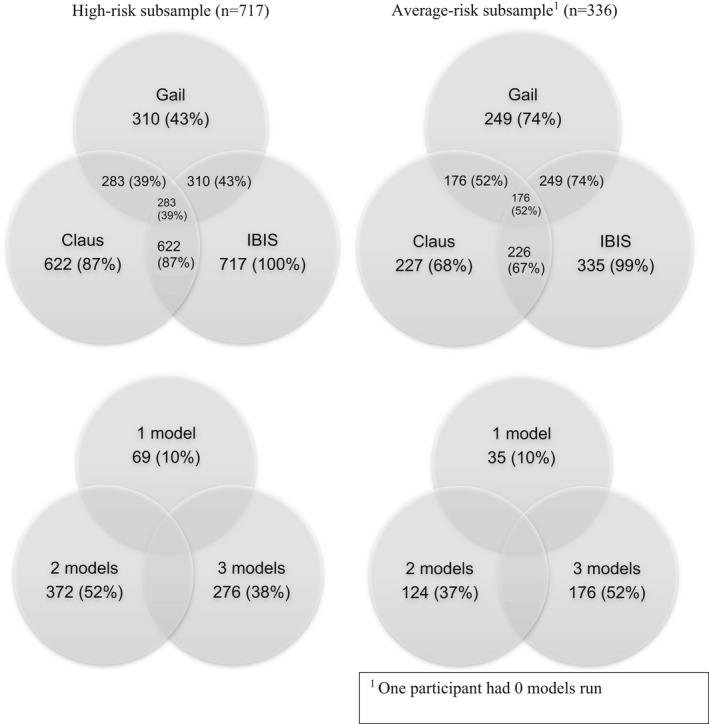
N = 1053 women were initially eligible and completed the survey. All women, except one, self-reported the information necessary to run at least one model; 90% had sufficient information for >1 model. The high-risk subsample included 717 women, of which 75% were identified by one model only; 96% were identified by IBIS, 3% by Claus, <1% by Gail. In the high-risk subsample, 20% were identified by two models and 3% by all three models.
CONCLUSIONS
Assessing breast cancer risk using self-reported data in a community-based sample was feasible. Different models identify substantially different groups of women who may be at high risk for breast cancer; use of multiple models may be beneficial for research and clinical care.
背景
识别患有乳腺癌高风险的女性对于研究高风险经历和提供风险管理护理是必要的。风险预测模型估计个体的终生风险,但很少在尚未接受专门护理的社区人群中应用。因此,我们的目的是:(1)将三种乳腺癌风险预测模型(即 Gail、Claus 和 IBIS)应用于种族多样化的社区基础样本中的女性;(2)使用调查数据评估风险预测估计。
方法
对通过筛查工具确定为患有乳腺癌高风险的女性进行在线调查。使用她们自我报告的家族和医疗史信息来应用风险预测模型。每个模型的高风险亚组的纳入标准为≥20%的终生风险/≥1 个模型。使用描述性统计比较每个模型识别的高风险女性的比例。
结果
共有 1053 名女性最初符合条件并完成了调查。除了一名女性,所有女性都自我报告了运行至少一个模型所需的信息;90%的女性有足够的信息来运行>1 个模型。高风险亚组包括 717 名女性,其中 75%仅由一个模型识别;96%由 IBIS 识别,3%由 Claus 识别,<1%由 Gail 识别。在高风险亚组中,20%由两个模型识别,3%由所有三个模型识别。
结论
使用社区样本中的自我报告数据评估乳腺癌风险是可行的。不同的模型识别出截然不同的高风险女性群体,这可能对乳腺癌的风险评估有帮助;使用多个模型可能对研究和临床护理有益。

 Zotero 插件