
与金纳米颗粒结合可提高KT2肽的稳定性并保持其抗癌特性。
Conjugation with gold nanoparticles improves the stability of the KT2 peptide and maintains its anticancer properties.
作者信息
Maraming Pornsuda, Daduang Jureerut, Kah James Chen Yong
机构信息
Centre for Research and Development of Medical Diagnostic Laboratories, Faculty of Associated Medical Sciences, Khon Kaen University Khon Kaen 40002 Thailand
Department of Biomedical Engineering, National University of Singapore 4 Engineering Drive 3, Blk E4, #04-08 Singapore 117583
出版信息
RSC Adv. 2021 Dec 20;12(1):319-325. doi: 10.1039/d1ra05980g.
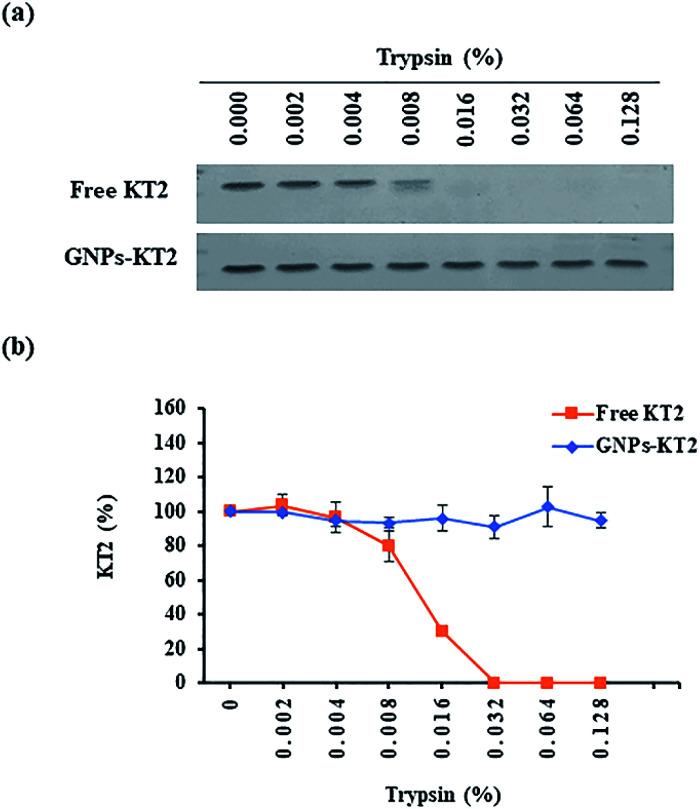
One of the major weaknesses of therapeutic peptides is their sensitivity to degradation by proteolytic enzymes . Gold nanoparticles (GNPs) are a good carrier for therapeutic peptides to improve their stability and cellular uptake and . We conjugated the anticancer KT2 peptide as an anticancer peptide model to PEGylated GNPs (GNPs-PEG) and investigated the peptide stability, cellular uptake and ability of the GNPs-KT2-PEG conjugates to induce MDA-MB-231 human breast cancer cell death. We found that 11 nm GNPs protected the conjugated KT2 peptide from trypsin proteolysis, keeping it stable up to 0.128% trypsin, which is higher than the serum trypsin concentration (range 0.0000285 ± 0.0000125%) reported by Lake-Bakaar, G. , 1979. GNPs significantly enhanced the cellular uptake of KT2 peptides after conjugation. Free KT2 peptides pretreated with trypsin were not able to kill MDA-MB-231 cells due to proteolysis, while GNPs-KT2-PEG was still able to exert effective cancer cell killing after trypsin treatment at levels comparable to GNPs-KT2-PEG without enzyme pretreatment. The outcome of this study highlights the utility of conjugated anticancer peptides on nanoparticles to improve peptide stability and retain anticancer ability.
治疗性肽的主要弱点之一是它们对蛋白水解酶降解的敏感性。金纳米颗粒(GNPs)是治疗性肽的良好载体,可提高其稳定性和细胞摄取。我们将抗癌KT2肽作为抗癌肽模型与聚乙二醇化金纳米颗粒(GNPs-PEG)偶联,并研究了肽的稳定性、细胞摄取以及GNPs-KT2-PEG偶联物诱导MDA-MB-231人乳腺癌细胞死亡的能力。我们发现11纳米的金纳米颗粒可保护偶联的KT2肽不被胰蛋白酶水解,在高达0.128%的胰蛋白酶浓度下仍保持稳定,这高于Lake-Bakaar, G.在1979年报道的血清胰蛋白酶浓度范围(0.0000285 ± 0.0000125%)。偶联后金纳米颗粒显著增强了KT2肽的细胞摄取。经胰蛋白酶预处理的游离KT2肽由于蛋白水解作用无法杀死MDA-MB-231细胞,而GNPs-KT2-PEG在胰蛋白酶处理后仍能发挥有效的癌细胞杀伤作用,其水平与未经酶预处理的GNPs-KT2-PEG相当。这项研究的结果突出了纳米颗粒上偶联抗癌肽在提高肽稳定性和保留抗癌能力方面的效用。



 Zotero 插件