
一项使用尼麦角林预防暂时性阈移的临床试验。
A clinical trial of nicergoline to prevent temporary threshold shift.
作者信息
Klamkam Pana, Pagcharoenpol Rongrat, Treesaranuwattana Treewit, Silpsrikul Pichayen, Jaruchinda Pariyanan, Wasuwat Piyalarp, Suwannahitatorn Picha
机构信息
Department of Otolaryngology Phramongkutklao Hospital, Royal Thai Amy Bangkok Thailand.
Department of Otolaryngology Queen Sirikit Naval Hospital Sattahip Chonburi Thailand.
出版信息
Laryngoscope Investig Otolaryngol. 2022 Jan 25;7(2):515-522. doi: 10.1002/lio2.746. eCollection 2022 Apr.
OBJECTIVE
To evaluate the effectiveness of nicergoline to prevent temporary threshold shift (TTS) in military personnel.
STUDY DESIGN
A randomized control trial.
METHODS
Two hundred and twenty-four participants were enrolled. Nicergoline 30 mg twice daily intake was prescribed to the study group ( = 119) for 3 weeks. The placebo was prescribed to the control group ( = 105) for 3 weeks, as well. Audiometric thresholds were measured at baseline and within 24 h after the participants attended a 1-day weapons firing practice. During the firing practice, all participants had to wear foam earplugs. The TTS was assessed by using a variety of published significant threshold shift (STS) definitions. Additionally, the effects of the treatment group on the magnitude of pre- to postexposure threshold shifts were estimated. Tinnitus and other adverse effects of the medication were recorded.
RESULTS
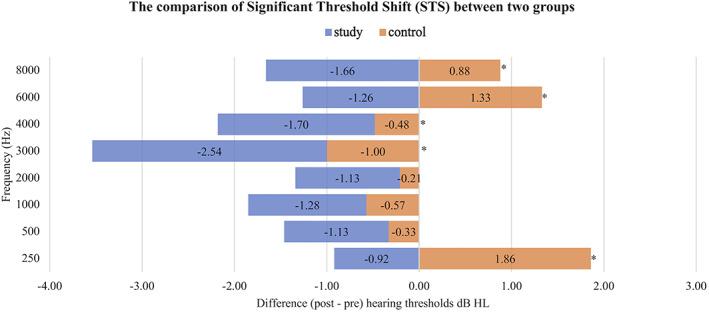
The incidence of STS was 65.4% from the study group and 75% from the control group. The negative STS (thresholds improved) was 68.6% from the study group and 44.7% from the control group. The positive STS (thresholds worsened) from the study group and the control group was 31.4% and 55.3%, respectively. The effect of treatment in participants receiving nicergoline demonstrated significant coefficients (change in dB) in both ears ( = .001). The mean different threshold of participants receiving nicergoline showed negative STS in all tested frequencies without statistical significance. However, the mean different threshold of participants receiving a placebo showed positive STS with statistical significance. Additionally, there were 16 ears detecting a warning sign of permanent hearing loss. These participants from the control group presented a longer duration of tinnitus ( = .042). Moreover, the serious adverse effects of nicergoline were considerably low.
CONCLUSION
The study results suggest that nicergoline may attenuate noise-related TTS and tinnitus, and justify further investigation on the effectiveness of this drug as an otoprotectant.
LEVEL OF EVIDENCE
目的
评估尼麦角林预防军事人员暂时性阈移(TTS)的有效性。
研究设计
一项随机对照试验。
方法
招募了224名参与者。研究组(n = 119)服用尼麦角林30毫克,每日两次,共3周。对照组(n = 105)服用安慰剂,同样为3周。在基线时以及参与者参加为期1天的武器射击训练后24小时内测量听力阈值。在射击训练期间,所有参与者都必须佩戴泡沫耳塞。使用各种已发表的显著阈移(STS)定义来评估TTS。此外,估计了治疗组对暴露前至暴露后阈移幅度的影响。记录耳鸣和药物的其他不良反应。
结果
研究组的STS发生率为65.4%,对照组为75%。研究组的负STS(阈值改善)为68.6%,对照组为44.7%。研究组和对照组的正STS(阈值恶化)分别为31.4%和55.3%。接受尼麦角林治疗的参与者双耳的治疗效果显示出显著系数(dB变化)(P = .001)。接受尼麦角林治疗的参与者的平均差异阈值在所有测试频率下均显示为负STS,但无统计学意义。然而,接受安慰剂治疗的参与者的平均差异阈值显示为正STS,具有统计学意义。此外,有16只耳朵检测到永久性听力损失的警告信号。对照组的这些参与者耳鸣持续时间更长(P = .042)。此外,尼麦角林的严重不良反应相当低。
结论
研究结果表明,尼麦角林可能减轻与噪声相关的TTS和耳鸣,并证明对该药物作为耳保护剂的有效性进行进一步研究是合理的。
证据级别
2级。

 Zotero 插件