
一种非共价SARS-CoV-2主要蛋白酶抑制剂的命中扩展。
Hit Expansion of a Noncovalent SARS-CoV-2 Main Protease Inhibitor.
作者信息
Glaser Jens, Sedova Ada, Galanie Stephanie, Kneller Daniel W, Davidson Russell B, Maradzike Elvis, Del Galdo Sara, Labbé Audrey, Hsu Darren J, Agarwal Rupesh, Bykov Dmytro, Tharrington Arnold, Parks Jerry M, Smith Dayle M A, Daidone Isabella, Coates Leighton, Kovalevsky Andrey, Smith Jeremy C
机构信息
Oak Ridge National Laboratory, 1 Bethel Valley Road, Oak Ridge, Tennessee 37830, United States.
Protein Engineering, Merck, 126 East Lincoln Avenue, RY800-C303, Rahway, New Jersey 07065, United States.
出版信息
ACS Pharmacol Transl Sci. 2022 Apr 4;5(4):255-265. doi: 10.1021/acsptsci.2c00026. eCollection 2022 Apr 8.
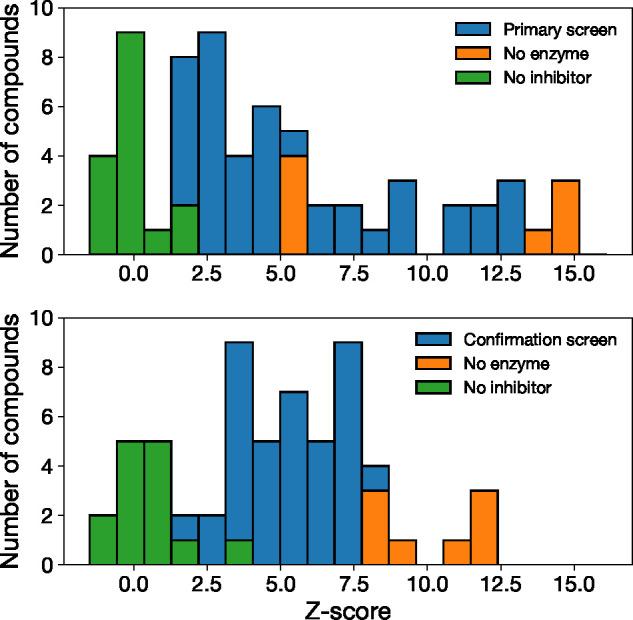
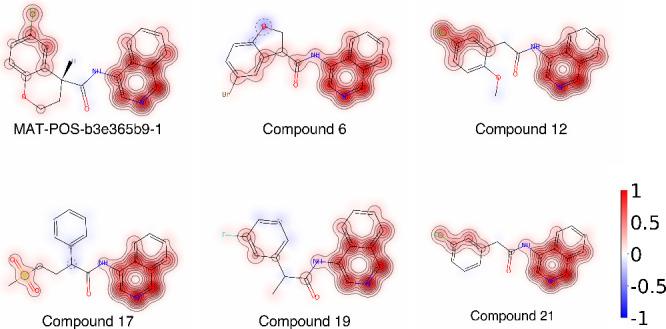
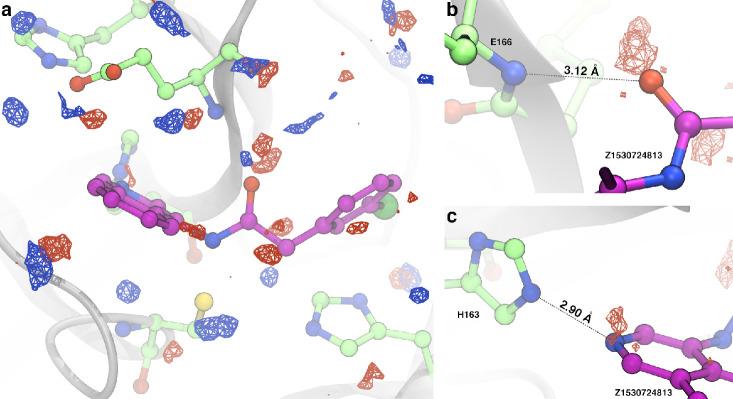
Inhibition of the SARS-CoV-2 main protease (M) is a major focus of drug discovery efforts against COVID-19. Here we report a hit expansion of non-covalent inhibitors of M. Starting from a recently discovered scaffold (The COVID Moonshot Consortium. Open Science Discovery of Oral Non-Covalent SARS-CoV-2 Main Protease Inhibitor Therapeutics. bioRxiv 2020.10.29.339317) represented by an isoquinoline series, we searched a database of over a billion compounds using a cheminformatics molecular fingerprinting approach. We identified and tested 48 compounds in enzyme inhibition assays, of which 21 exhibited inhibitory activity above 50% at 20 μM. Among these, four compounds with IC values around 1 μM were found. Interestingly, despite the large search space, the isoquinolone motif was conserved in each of these four strongest binders. Room-temperature X-ray structures of co-crystallized protein-inhibitor complexes were determined up to 1.9 Å resolution for two of these compounds as well as one of the stronger inhibitors in the original isoquinoline series, revealing essential interactions with the binding site and water molecules. Molecular dynamics simulations and quantum chemical calculations further elucidate the binding interactions as well as electrostatic effects on ligand binding. The results help explain the strength of this new non-covalent scaffold for M inhibition and inform lead optimization efforts for this series, while demonstrating the effectiveness of a high-throughput computational approach to expanding a pharmacophore library.
抑制严重急性呼吸综合征冠状病毒2(SARS-CoV-2)主要蛋白酶(Mpro)是抗2019冠状病毒病(COVID-19)药物研发工作的主要重点。在此,我们报告了Mpro非共价抑制剂的命中物扩展情况。从最近发现的以异喹啉系列为代表的骨架(COVID Moonshot联盟。口服非共价SARS-CoV-2主要蛋白酶抑制剂疗法的开放科学发现。生物预印本2020.10.29.339317)出发,我们使用化学信息学分子指纹方法在超过10亿种化合物的数据库中进行搜索。我们在酶抑制试验中鉴定并测试了48种化合物,其中21种在20μM时表现出高于50%的抑制活性。在这些化合物中,发现了四种IC50值约为1μM的化合物。有趣的是,尽管搜索空间很大,但这四种最强结合物中的每一种都保留了异喹诺酮基序。对于其中两种化合物以及原始异喹啉系列中较强的抑制剂之一,测定了共结晶蛋白质-抑制剂复合物在室温下的X射线结构,分辨率高达1.9Å,揭示了与结合位点和水分子的关键相互作用。分子动力学模拟和量子化学计算进一步阐明了结合相互作用以及对配体结合的静电效应。这些结果有助于解释这种新的非共价骨架对Mpro抑制的强度,并为该系列的先导优化工作提供信息,同时证明了高通量计算方法扩展药效团库的有效性。





 Zotero 插件