
使用可穿戴传感器预测亨廷顿舞蹈症的严重程度。
Predicting Severity of Huntington's Disease With Wearable Sensors.
作者信息
Scheid Brittany H, Aradi Stephen, Pierson Robert M, Baldassano Steven, Tivon Inbar, Litt Brian, Gonzalez-Alegre Pedro
机构信息
Department of Bioengineering, University of Pennsylvania, Philadelphia, PA, United States.
Center for Neuroengineering and Therapeutics, University of Pennsylvania, Philadelphia, PA, United States.
出版信息
Front Digit Health. 2022 Apr 4;4:874208. doi: 10.3389/fdgth.2022.874208. eCollection 2022.
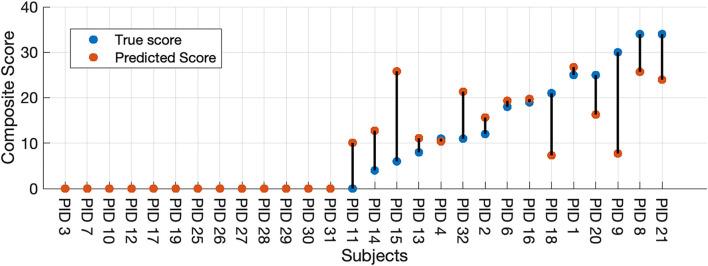
The Unified Huntington's Disease Rating Scale (UHDRS) is the primary clinical assessment tool for rating motor function in patients with Huntington's disease (HD). However, the UHDRS and similar rating scales (e.g., UPDRS) are both subjective and limited to in-office assessments that must be administered by a trained and experienced rater. An objective, automated method of quantifying disease severity would facilitate superior patient care and could be used to better track severity over time. We conducted the present study to evaluate the feasibility of using wearable sensors, coupled with machine learning algorithms, to rate motor function in patients with HD. Fourteen participants with symptomatic HD and 14 healthy controls participated in the study. Each participant wore five adhesive biometric sensors applied to the trunk and each limb while completing brief walking, sitting, and standing tasks during a single office visit. A two-stage machine learning method was employed to classify participants by HD status and to predict UHDRS motor subscores. Linear discriminant analysis correctly classified all participants' HD status except for one control subject with abnormal gait (96.4% accuracy, 92.9% sensitivity, and 100% specificity in leave-one-out cross-validation). Two regression models accurately predicted individual UHDRS subscores for gait, and dystonia within a 10% margin of error. Our regression models also predicted a composite UHDRS score-a sum of left and right arm rigidity, total chorea, total dystonia, bradykinesia, gait, and tandem gait subscores-with an average error below 15%. Machine learning classifiers trained on brief in-office datasets discriminated between controls and participants with HD, and could accurately predict selected motor UHDRS subscores. Our results could enable the future use of biosensors for objective HD assessment in the clinic or remotely and could inform future studies for the use of this technology as a potential endpoint in clinical trials.
统一亨廷顿舞蹈病评定量表(UHDRS)是评定亨廷顿舞蹈病(HD)患者运动功能的主要临床评估工具。然而,UHDRS和类似的评定量表(如UPDRS)都具有主观性,并且仅限于由训练有素且经验丰富的评估者在办公室进行的评估。一种客观、自动化的疾病严重程度量化方法将有助于提供更优质的患者护理,并可用于更好地跟踪疾病严重程度随时间的变化。我们开展了本研究,以评估使用可穿戴传感器结合机器学习算法来评定HD患者运动功能的可行性。14名有症状的HD患者和14名健康对照参与了本研究。每位参与者在一次门诊就诊期间完成简短的行走、坐立和站立任务时,在躯干和四肢上佩戴了五个粘性生物特征传感器。采用两阶段机器学习方法,根据HD状态对参与者进行分类,并预测UHDRS运动子评分。线性判别分析正确分类了所有参与者的HD状态,但有一名步态异常的对照受试者除外(留一法交叉验证的准确率为96.4%,灵敏度为92.9%,特异性为100%)。两个回归模型准确预测了步态和肌张力障碍的个体UHDRS子评分,误差幅度在10%以内。我们的回归模型还预测了UHDRS综合评分(左臂和右臂强直、总舞蹈症、总肌张力障碍、运动迟缓、步态和串联步态子评分之和),平均误差低于15%。基于简短门诊数据集训练的机器学习分类器能够区分对照组和HD患者,并能准确预测选定的UHDRS运动子评分。我们的研究结果可能使生物传感器在未来用于临床或远程的客观HD评估,并可为未来将该技术用作临床试验潜在终点的研究提供参考。


 Zotero 插件