
人工湿地微生物燃料电池中的产电及阳极微生物群落分析
Electricity production and the analysis of the anode microbial community in a constructed wetland-microbial fuel cell.
作者信息
Wang Guozhen, Guo Yating, Cai Jiaying, Wen Hongyu, Mao Zhen, Zhang Hao, Wang Xin, Ma Lei, Zhu Mengqin
机构信息
School of Life Science, Jiangsu Normal University Xuzhou 221116 China
School of Environment Science and Spatial Informatics, China University of Mining and Technology Xuzhou 221116 China.
出版信息
RSC Adv. 2019 Jul 10;9(37):21460-21472. doi: 10.1039/c8ra10130b. eCollection 2019 Jul 5.
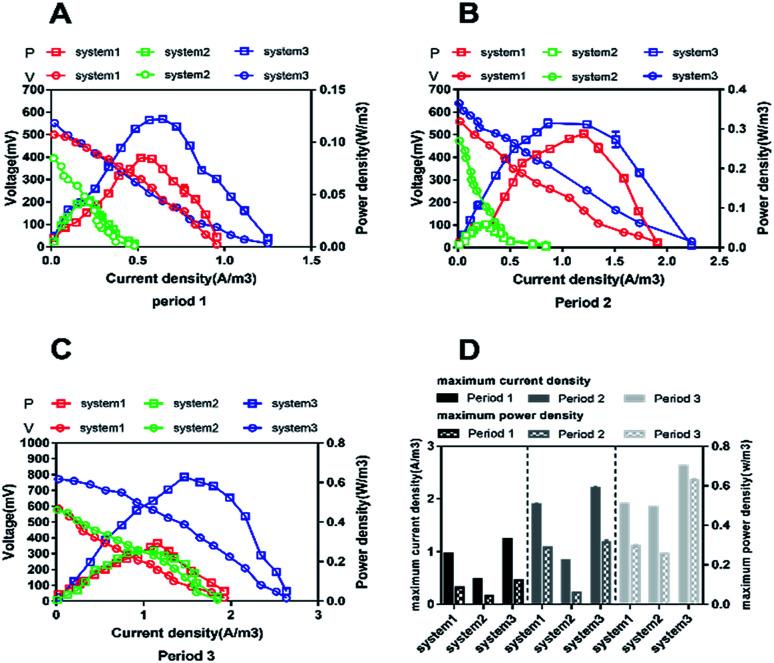
The objective of this study is to assess bioelectricity generation, pollutant removal (COD, ammonium, nitrate) and the bacterial communities on anodes in constructed wetlands coupled with microbial fuel cells (CW-MFCs), through feeding the systems with three different types of synthetic wastewater (system 1: normal wastewater; system 2: ammonium-free wastewater; system 3: nitrate-free wastewater). Three CW-MFCs were operated with different wastewater concentrations and hydraulic retention times (HRTs) over a long time period (6 months). The results indicate that the maximum open circuit voltage (775.63 mV) and maximum power density (0.628 W m) were observed in system 3 (period 3), and that bioenergy production was inhibited in system 2, when feeding with ammonium-free wastewater continuously. COD removal rates in the three systems were similar during each period and ranged from 82.2 ± 6.8% to 98.3 ± 2.2%. Ammonium removal occurred at the air cathode of the CW-MFCs through nitrification, and a higher level of ammonium removal was found in system 1 (period 3) compared with the others. Meanwhile, denitrification occurred at the anaerobic anode of the CW-MFCs, and a large amount of nitrate was removed effectively. The highest nitrate removal rate was 98.8 ± 0.5% in system 2 (period 3). Additionally, four genera related to electricity generation were detected at the anode: ; ; ; and . The relative abundances of , and gradually increased during the three periods in system 3, which might be beneficial for bioelectricity generation. Further investigations are needed to optimize the CW-MFC performance and explain the mechanism behind the pollutant degradation and electron motion in the CW-MFCs.
本研究的目的是通过向构建湿地耦合微生物燃料电池(CW-MFCs)系统投喂三种不同类型的合成废水(系统1:普通废水;系统2:无铵废水;系统3:无硝酸盐废水),评估其生物电产生、污染物去除(化学需氧量、铵、硝酸盐)以及阳极上的细菌群落。三个CW-MFCs在不同废水浓度和水力停留时间(HRTs)下长期运行(6个月)。结果表明,在系统3(第3阶段)观察到最大开路电压(775.63 mV)和最大功率密度(0.628 W m),并且当持续投喂无铵废水时,系统2中的生物能源生产受到抑制。在每个阶段,三个系统中的化学需氧量去除率相似,范围为82.2±6.8%至98.3±2.2%。CW-MFCs的空气阴极通过硝化作用实现铵的去除,与其他系统相比,系统1(第3阶段)的铵去除水平更高。同时,CW-MFCs的厌氧阳极发生反硝化作用,大量硝酸盐被有效去除。系统2(第3阶段)的最高硝酸盐去除率为98.8±0.5%。此外,在阳极检测到四个与发电相关的属:;;;和。在系统3的三个阶段中,、和的相对丰度逐渐增加,这可能有利于生物电的产生。需要进一步研究以优化CW-MFCs的性能,并解释CW-MFCs中污染物降解和电子运动背后的机制。



 Zotero 插件