
不同 CT 切片厚度和对比增强相位在肺腺癌放射组学模型中的差异性能。
Different CT slice thickness and contrast-enhancement phase in radiomics models on the differential performance of lung adenocarcinoma.
机构信息
Department of Radiology, Shandong Provincial Hospital, Shandong University, Jinan, Shandong, China.
Department of Radiology, Shandong Provincial Hospital Affiliated to Shandong First Medical University, Jinan, Shandong, China.
出版信息
Thorac Cancer. 2022 Jun;13(12):1806-1813. doi: 10.1111/1759-7714.14459. Epub 2022 May 11.
BACKGROUND
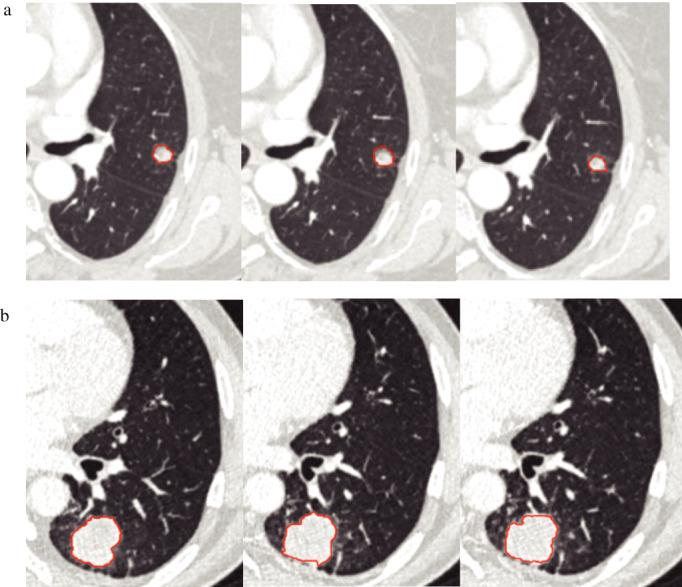
To investigate the effects of computed tomography (CT) reconstruction slice thickness and contrast-enhancement phase on the differential diagnosis performance of radiomic signature in lung adenocarcinoma.
METHODS
A total of 187 patients who had been pathologically confirmed with lung adenocarcinoma and nonadenocarcinoma were divided into a training cohort (n = 149) and validation cohort (n = 38). All the patients underwent contrast-enhanced CT and the images were reconstructed with different slice thickness. The radiomic features were extracted from different slice thickness and scan phase. The logistic regression (LR) algorithm was used to build a machine learning model for each group. The area under the curve (AUC) obtained from the receiver operating characteristic (ROC) curve and DeLong test was used to evaluate its discriminating performance.
RESULTS
Finally, 34 image features and five semantic features were selected to establish a radiomics model. Based on the three contrast-enhanced CT phases and four reconstruction slice thickness, 12 groups of radiomics models showed good discrimination ability with the AUCs range from 0.9287 to 0.9631, sensitivity range from 0.8349 to 0.9083, specificity range from 0.825 to 0.925 in the training group. Similar results were observed in the validation group. However, there was no statistical significance between the different CT scan phase groups and different slice thickness (p > 0.05).
CONCLUSIONS
The radiomic analysis of contrast-enhanced CT can be used for the differential diagnosis of lung adenocarcinoma. Moreover, different slice thickness and contrast-enhanced scan phase did not affect the discriminating ability in the radiomics models.
背景
旨在探究体层摄影术(CT)重建层厚和对比增强相在肺腺癌中对放射组学特征鉴别诊断性能的影响。
方法
共有 187 名经病理证实为肺腺癌和非腺癌的患者被分为训练队列(n=149)和验证队列(n=38)。所有患者均行增强 CT 检查,并以不同层厚进行图像重建。从不同层厚和扫描相位提取放射组学特征。采用逻辑回归(LR)算法分别为每组构建机器学习模型。通过接收者操作特性(ROC)曲线和 DeLong 检验获得的曲线下面积(AUC)来评估其判别性能。
结果
最终,选取 34 个图像特征和 5 个语义特征建立放射组学模型。基于三个增强 CT 相位和四个重建层厚,12 组放射组学模型的 AUC 值范围为 0.9287 至 0.9631,灵敏度范围为 0.8349 至 0.9083,特异度范围为 0.825 至 0.925,在训练组中具有良好的鉴别能力。在验证组中也观察到了类似的结果。然而,不同 CT 扫描相组和不同层厚之间无统计学差异(p>0.05)。
结论
增强 CT 的放射组学分析可用于肺腺癌的鉴别诊断。此外,不同的层厚和对比增强扫描相位不会影响放射组学模型的鉴别能力。


 Zotero 插件