
大结节骨折并非希尔-萨克斯损伤的延续,但它们的病因是否相似呢?
Greater tuberosity fractures are not a continuation of Hill-Sachs lesions, but do they have a similar etiology?
作者信息
Alkaduhimi Hassanin, van der Woude Henk-Jan, Verweij Lukas P E, Janssen Stein J, Willigenburg Nienke W, Chen Neal, van den Bekerom Michel P J
机构信息
Shoulder and Elbow Unit, Joint Research, OLVG, Amsterdam, the Netherlands.
Department of Orthopaedic Surgery, Amsterdam Movement Sciences, Amsterdam UMC, University of Amsterdam, Amsterdam, the Netherlands.
出版信息
JSES Int. 2022 Jan 12;6(3):396-400. doi: 10.1016/j.jseint.2021.11.018. eCollection 2022 May.
BACKGROUND
It is unclear whether greater tuberosity fractures (GTF) in the setting of a shoulder dislocation are due to an avulsion of the rotator cuff or a result of an extensive Hill-Sachs lesion (HSL). To explore whether these lesions have similar etiology, the primary aim of this study is to compare the postinjury morphology of the proximal humerus after GTF and HSL.
METHODS
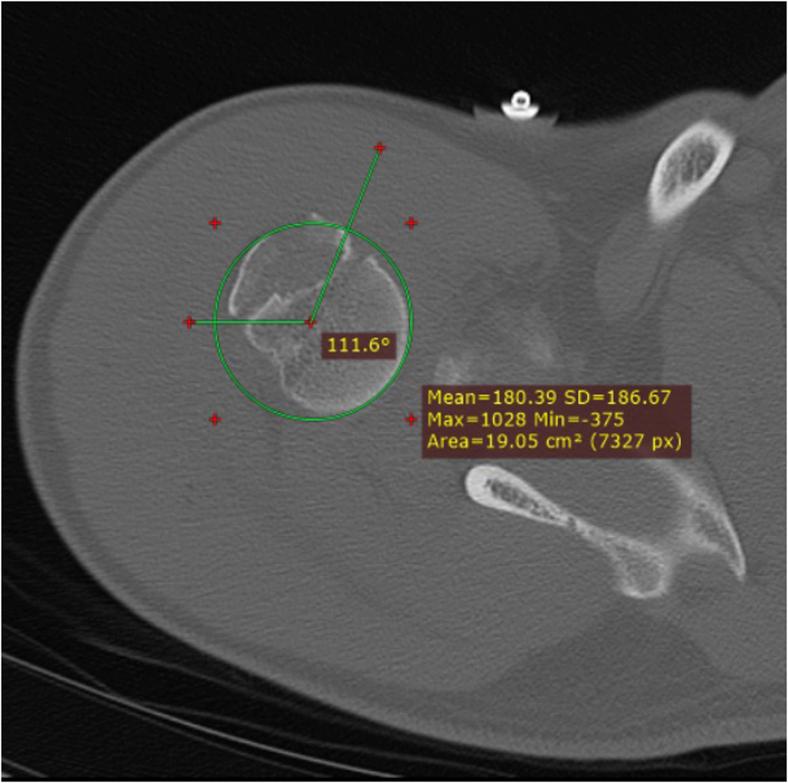
Computed tomography scans of 19 patients with HSL and 18 patients with GTF after first-time shoulder dislocations were analyzed. We assessed the location by measuring height in relation to the highest point of the humerus and angles for the origin (most medial point of lesion), center, and endpoint (most lateral point of lesion) between GTF and HSL and the bicipital groove. For both GTF and HSL, we assessed whether infraspinatus and supraspinatus insertions were involved and whether they were off-track or on-track.
RESULTS
Measured from the bicipital groove, HSLs and GTFs have different origins (153˚ vs. 110˚; < .0001, respectively), centers (125˚ vs. 60˚; < .0001, respectively), and endpoints (92˚ vs. 37˚; < .0001, respectively). HSLs had a higher position (0.76 cm vs. 1.71 cm; < .0001), involved the supraspinatus footprint less often (16% vs. 72%; = .0008), and were less likely to be off-track (31% vs. 94%; = .0002). Half of the GTF were on the lateral side of the glenoid track and thus extra-capsular, versus 0% of HSL.
CONCLUSION
HSLs and GTFs have different anatomical characteristics and thus GTFs are likely to be distinct from extensive HSLs.
背景
目前尚不清楚肩关节脱位时大结节骨折(GTF)是由于肩袖撕脱还是广泛的希尔-萨克斯损伤(HSL)所致。为探究这些损伤是否具有相似的病因,本研究的主要目的是比较GTF和HSL后肱骨近端的损伤后形态。
方法
分析了19例首次肩关节脱位后发生HSL的患者和18例发生GTF的患者的计算机断层扫描图像。我们通过测量相对于肱骨最高点的高度以及GTF和HSL与二头肌沟之间的起点(损伤最内侧点)、中心和终点(损伤最外侧点)的角度来评估位置。对于GTF和HSL,我们评估了冈下肌和冈上肌附着点是否受累以及它们是否偏离轨迹或在轨迹上。
结果
从二头肌沟测量,HSL和GTF的起点不同(分别为153˚和110˚;P <.0001)、中心不同(分别为125˚和60˚;P <.0001)、终点不同(分别为92˚和37˚;P <.0001)。HSL的位置更高(0.76 cm对1.71 cm;P <.0001),较少累及冈上肌附着点(16%对72%;P =.0008),且偏离轨迹的可能性较小(31%对94%;P =.0002)。一半的GTF位于关节盂轨迹的外侧,因此位于关节囊外,而HSL为0%。
结论
HSL和GTF具有不同的解剖学特征,因此GTF可能与广泛的HSL不同。




 Zotero 插件