
应用转录组学在细胞类型水平研究糖基化。
Applying transcriptomics to studyglycosylation at the cell type level.
作者信息
Dworkin Leo Alexander, Clausen Henrik, Joshi Hiren Jitendra
机构信息
Copenhagen Center for Glycomics, Department of Cellular and Molecular Medicine, Faculty of Health Sciences, University of Copenhagen, Blegdamsvej 3, 2200 Copenhagen N, Denmark.
出版信息
iScience. 2022 May 18;25(6):104419. doi: 10.1016/j.isci.2022.104419. eCollection 2022 Jun 17.
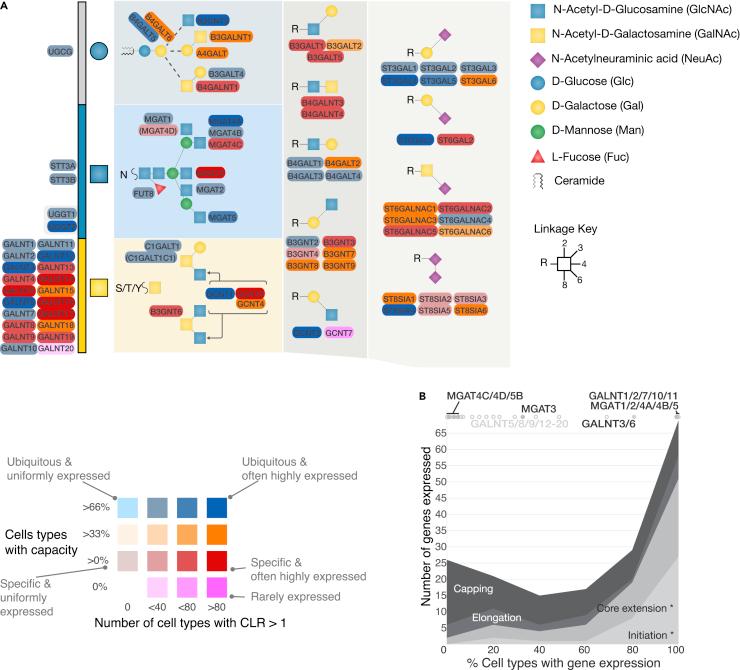
The complex multi-step process of glycosylation occurs in a single cell, yet current analytics generally cannot measure the output (the glycome) of a single cell. Here, we addressed this discordance by investigating how single cell RNA-seq data can be used to characterize the state of the glycosylation machinery and metabolic network in a single cell. The metabolic network involves 214 glycosylation and modification enzymes outlined in our previously built atlas of cellular glycosylation pathways. We studied differential mRNA regulation of enzymes at the organ and single cell level, finding that most of the general protein and lipid oligosaccharide scaffolds are produced by enzymes exhibiting limited transcriptional regulation among cells. We predict key enzymes within different glycosylation pathways to be highly transcriptionally regulated as regulatable hotspots of the cellular glycome. We designed the Glycopacity software that enables investigators to extract and interpret glycosylation information from transcriptome data and define hotspots of regulation.
糖基化这一复杂的多步骤过程发生在单个细胞中,但目前的分析方法通常无法测量单个细胞的输出(糖组)。在此,我们通过研究如何利用单细胞RNA测序数据来表征单个细胞中糖基化机制和代谢网络的状态,解决了这一矛盾。代谢网络涉及我们之前构建的细胞糖基化途径图谱中概述的214种糖基化和修饰酶。我们在器官和单细胞水平上研究了酶的差异mRNA调控,发现大多数通用蛋白质和脂质寡糖支架是由细胞间转录调控有限的酶产生的。我们预测不同糖基化途径中的关键酶会受到高度转录调控,成为细胞糖组的可调控热点。我们设计了Glycopacity软件,使研究人员能够从转录组数据中提取和解释糖基化信息,并定义调控热点。



 Zotero 插件