
婴幼儿先天性瞳孔残膜综合征行穿透性角膜移植术后前粘连
Anterior synechiae after penetrating keratoplasty in infants and children with Peters' anomaly.
机构信息
Department of Ophthalmology and Visual Science, Eye and ENT Hospital of Fudan University, 83 Fenyang Road, Shanghai, 200031, China.
Key Laboratory of Myopia, National Health Commission, Shanghai, China.
出版信息
BMC Ophthalmol. 2022 Jun 9;22(1):259. doi: 10.1186/s12886-022-02473-0.
BACKGROUND
To evaluate anterior synechiae after penetrating keratoplasty (PK) in patients with Peters' anomaly using anterior segment optical coherence tomography (OCT).
METHODS
A retrospective cross-sectional study was performed. The medical records of patients diagnosed with Peters' anomaly who underwent PK between 2013 and 2018 were reviewed. In addition to basic ophthalmic examinations, images of anterior segment structures were obtained via spectral-domain OCT at baseline and during the postoperative follow-up period. The profiles of postoperative anterior synechiae and multiple potential risk factors were analyzed.
RESULTS
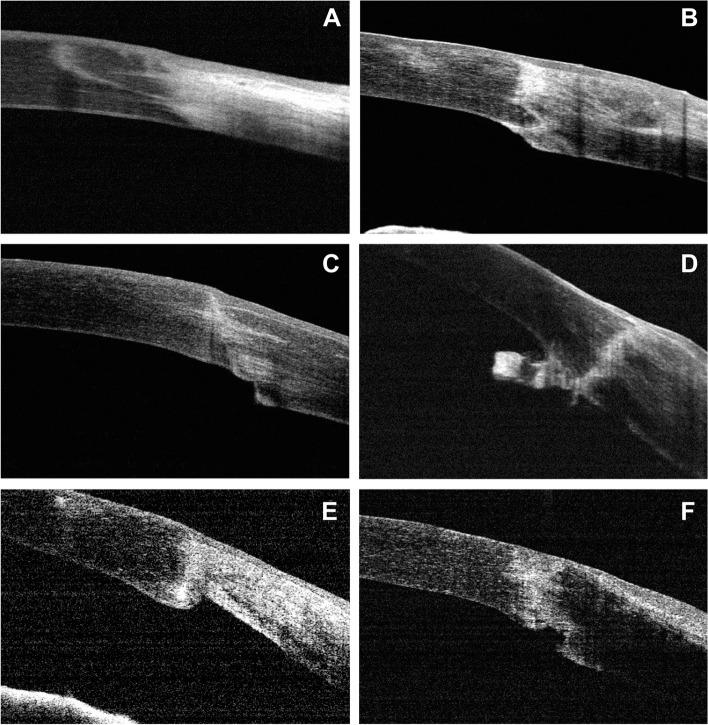
Seventy-one eyes of 58 patients, aged 5 to 23 months, were included. Various extent of postoperative anterior synechiae was observed in 59 eyes (83.1%). OCT findings revealed graft-host junction synechiae, peripheral anterior synechiae, and a combination of both. Disease severity and malposition of the internal graft-host junction were significantly associated with the formation of postoperative synechiae. Multivariate regression analysis found that preexisting iridocorneal adhesion [odds ratio (OR) = 16.639, 95% confidence interval (CI) 1.494-185.294, p = 0.022] was positively correlated with postoperative anterior synechiae, whereas anterior chamber depth (OR = 0.009, 95% CI 0.000-0.360, p = 0.012) and graft size (OR = 0.016, 95% CI 0.000-0.529, p = 0.020) were negatively correlated with postoperative synechiae. In addition, quadrants of preexisting iridocorneal adhesion and width of the host corneal bed were identified as risk factors for increased postoperative anterior synechiae.
CONCLUSIONS
Anterior synechiae following PK is a relatively common occurrence in Peters' anomaly patients and is found to be associated with preexisting iridocorneal adhesion, a shallow anterior chamber, small graft size, graft-host junction malposition, and graft closer to the corneal limbus. These data indicate the need for careful consideration when performing PK on these patients.
背景
应用眼前节光学相干断层扫描(OCT)评估 Peters 异常患者穿透性角膜移植(PKP)术后前粘连。
方法
回顾性横断面研究。纳入 2013 年至 2018 年间行 PKP 术的 Peters 异常患者的病历资料。除基本眼科检查外,还在基线和术后随访期间应用频域 OCT 获得眼前节结构图像。分析术后前粘连的特征及多种潜在的危险因素。
结果
纳入 58 例(71 只眼)年龄 5 至 23 个月的患者。59 只眼(83.1%)观察到不同程度的术后前粘连。OCT 检查结果显示移植片与宿主交界处粘连、周边前粘连或两者并存。疾病严重程度和移植片与宿主交界处的错位与术后粘连的形成显著相关。多变量回归分析发现,术前虹膜角膜粘连(比值比 [OR] = 16.639,95%置信区间 [CI] 1.494-185.294,p = 0.022)与术后前粘连呈正相关,而前房深度(OR = 0.009,95% CI 0.000-0.360,p = 0.012)和移植片大小(OR = 0.016,95% CI 0.000-0.529,p = 0.020)与术后粘连呈负相关。此外,术前虹膜角膜粘连象限和宿主角膜床宽度被确定为增加术后前粘连的危险因素。
结论
Peters 异常患者 PKP 术后前粘连较常见,与术前虹膜角膜粘连、前房浅、移植片小、移植片与宿主交界处错位、移植片更靠近角膜缘有关。这些数据表明,在为这些患者施行 PKP 术时需要仔细考虑。


 Zotero 插件