
用于预测块状金属玻璃玻璃形成能力的热力学引导机器学习建模
Thermodynamically-guided machine learning modelling for predicting the glass-forming ability of bulk metallic glasses.
作者信息
Ghorbani Alireza, Askari Amirhossein, Malekan Mehdi, Nili-Ahmadabadi Mahmoud
机构信息
School of Metallurgy and Materials Engineering, College of Engineering, University of Tehran, Tehran, 11155-4563, Iran.
Computer Engineering Department, Amirkabir University of Technology, Tehran, 15916-34311, Iran.
出版信息
Sci Rep. 2022 Jul 11;12(1):11754. doi: 10.1038/s41598-022-15981-2.
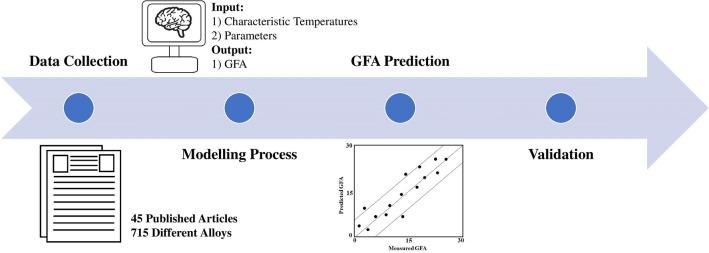
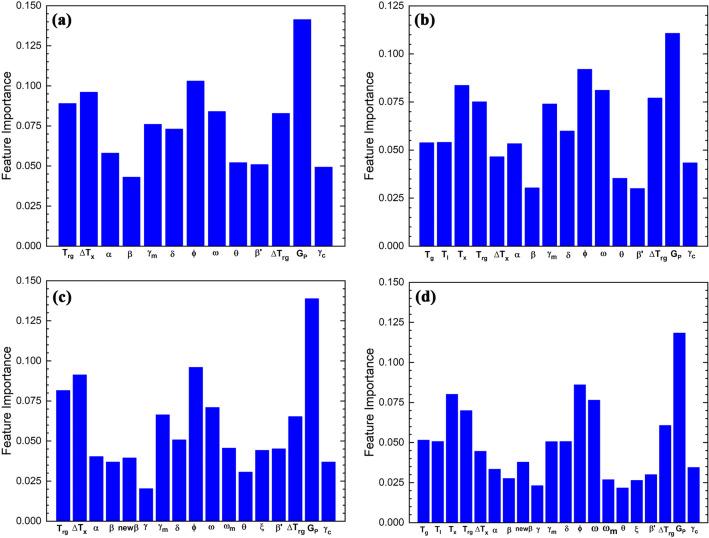
Glass-forming ability (GFA) of bulk metallic glasses (BMGs) is a determinant parameter which has been significantly studied. GFA improvements could be achieved through trial-and-error experiments, as a tedious work, or by using developed predicting tools. Machine-Learning (ML) has been used as a promising method to predict the properties of BMGs by removing the barriers in the way of its alloy design. This article aims to develop a ML-based method for predicting the maximum critical diameter (D) of BMGs as a factor of their glass-forming ability. The main result is that the random forest method can be used as a sustainable model (R = 92%) for predicting glass-forming ability. Also, adding characteristic temperatures to the model will increase the accuracy and efficiency of the developed model. Comparing the measured and predicted values of D for a set of newly developed BMGs indicated that the model is reliable and can be truly used for predicting the GFA of BMGs.
大块金属玻璃(BMG)的玻璃形成能力(GFA)是一个已被大量研究的决定性参数。GFA的提高可以通过反复试验的实验来实现,这是一项繁琐的工作,也可以通过使用已开发的预测工具来实现。机器学习(ML)已被用作一种有前景的方法,通过消除其合金设计中的障碍来预测BMG的性能。本文旨在开发一种基于ML的方法,将BMG的最大临界直径(D)作为其玻璃形成能力的一个因素进行预测。主要结果是随机森林方法可以用作预测玻璃形成能力的可持续模型(R = 92%)。此外,将特征温度添加到模型中将提高所开发模型的准确性和效率。对一组新开发的BMG的D的测量值和预测值进行比较表明,该模型是可靠的,可真正用于预测BMG的GFA。




 Zotero 插件