
辣椒( L.)基因的精细定位与基因分析。
Fine Mapping and Gene Analysis of Gene in Pepper ( L.).
机构信息
Shanghai Key Laboratory of Protected Horticultural Technology, Horticulture Research Institute, Shanghai Academy of Agricultural Sciences, Shanghai 201403, China.
Vegetable Research Institute, Hangzhou Academy of Agricultural Sciences, Hangzhou 310024, China.
出版信息
Int J Mol Sci. 2022 Jul 11;23(14):7633. doi: 10.3390/ijms23147633.
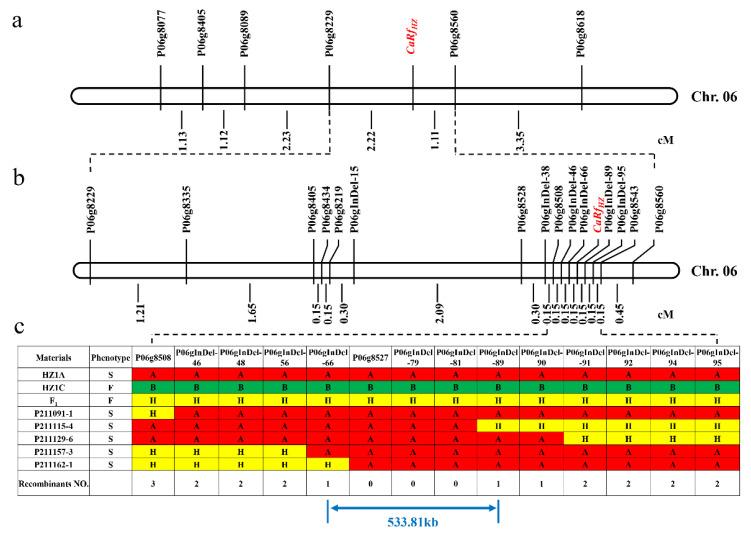
Cytoplasmic male sterility (CMS) is a common biological phenomenon used in hybrid production of peppers ( L.). Although several () genes of pepper CMS lines have been mapped, there is no report that the gene with clear gene function has been isolated. Here, pepper CMS line HZ1A and its restorer line HZ1C were used to construct (HZ1A × HZ1C) F populations and map the gene. A single dominant gene conferred male fertility according to inheritance analysis. Using sterile plants from (HZ1A × HZ1C) F populations and bulked segregant analysis (BSA), the gene was mapped between P06gInDel-66 and P06gInDel-89 on chromosome 6. This region spans 533.81 kb, where four genes are annotated according to Zunla-1 V2.0 gene models. Based on the analysis of genomic DNA sequences, gene expressions, and protein structures, was proposed as the strongest candidate for the gene. Our results may help with hybrid pepper breeding and to elucidate the mechanism of male fertility restoration in peppers.
细胞质雄性不育(CMS)是辣椒杂种生产中常用的一种常见生物学现象。尽管已经定位了几个辣椒 CMS 系的()基因,但尚未有报道分离出具有明确基因功能的基因。在这里,使用辣椒 CMS 系 HZ1A 和其恢复系 HZ1C 构建了(HZ1A×HZ1C)F1 群体,并对该基因进行了定位。根据遗传分析,一个显性单基因赋予雄性可育性。利用(HZ1A×HZ1C)F1 群体中的不育植株和混池分离分析法(BSA),将基因定位在 6 号染色体上的 P06gInDel-66 和 P06gInDel-89 之间。该区域跨越 533.81kb,根据 Zunla-1 V2.0 基因模型注释了四个基因。基于对基因组 DNA 序列、基因表达和蛋白质结构的分析,提出作为基因的最强候选基因。我们的结果可能有助于杂交辣椒的培育,并阐明辣椒雄性育性恢复的机制。

 Zotero 插件