
成人隐匿性自身免疫性糖尿病(LADA):从免疫发病机制到免疫治疗。
Latent Autoimmune Diabetes in Adults (LADA): From Immunopathogenesis to Immunotherapy.
机构信息
National Clinical Research Center for Metabolic Diseases, Key Laboratory of Diabetes Immunology, Ministry of Education, Department of Metabolism and Endocrinology, The Second Xiangya Hospital of Central South University, Changsha, China.
出版信息
Front Endocrinol (Lausanne). 2022 Jul 21;13:917169. doi: 10.3389/fendo.2022.917169. eCollection 2022.
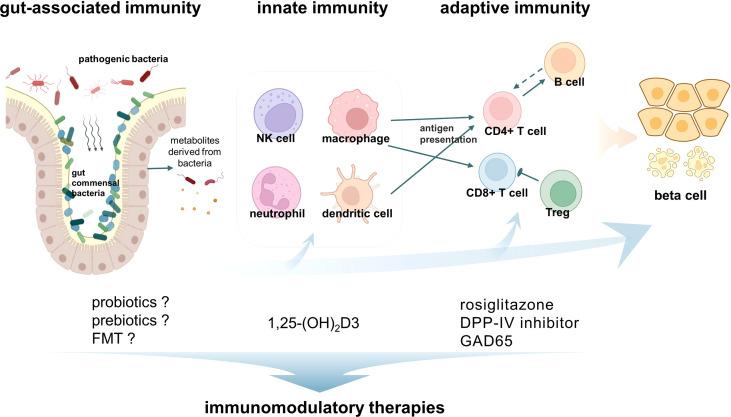
Latent autoimmune diabetes in adults (LADA) is a type of diabetes characterized by slow autoimmune damage of pancreatic β cells without insulin treatment in the early clinical stage. There are differences between LADA and classical type 1 diabetes (T1D) and type 2 diabetes (T2D) in genetic background, autoimmune response, rate of islet function decline, clinical metabolic characteristics, and so on. The disease progression and drug response of patients with LADA are closely related to the level of islet autoimmunity, thus exploring the pathogenesis of LADA is of great significance for its prevention and treatment. Previous studies reported that adaptive immunity and innate immunity play a critical role in the etiology of LADA. Recent studies have shown that the intestinal microbiota which impacts host immunity hugely, participates in the pathogenesis of LADA. In addition, the progression of autoimmune pancreatic β cell destruction in LADA is slower than in classical T1D, providing a wider window of opportunities for intervention. Therefore, therapies including antidiabetic drugs with immune-regulation effects and immunomodulators could contribute to promising interventions for LADA. We also shed light on potential interventions targeting the gut microbiota and gut-associated immunity, which may be envisaged to halt or delay the process of autoimmunity in LADA.
成人隐匿性自身免疫性糖尿病(LADA)是一种在临床早期未经胰岛素治疗即可出现胰岛β细胞进行性自身免疫损伤的糖尿病类型。LADA 在遗传背景、自身免疫反应、胰岛功能下降速率、临床代谢特征等方面与经典 1 型糖尿病(T1D)和 2 型糖尿病(T2D)存在差异。LADA 患者的疾病进展和药物反应与胰岛自身免疫水平密切相关,因此探讨 LADA 的发病机制对于其防治具有重要意义。既往研究表明,适应性免疫和固有免疫在 LADA 的发病机制中起关键作用。最近的研究表明,对宿主免疫有巨大影响的肠道微生物群参与了 LADA 的发病机制。此外,LADA 中自身免疫性胰岛β细胞破坏的进展较经典 T1D 更缓慢,为干预提供了更广泛的机会窗口。因此,包括具有免疫调节作用的降糖药物和免疫调节剂在内的治疗方法可能有助于为 LADA 提供有前景的干预措施。我们还探讨了针对肠道菌群和肠道相关免疫的潜在干预措施,这些措施可能被设想用于阻止或延缓 LADA 中的自身免疫过程。
 Zotero 插件