
代谢不灵活性作为心房颤动的发病基础。
Metabolic Inflexibility as a Pathogenic Basis for Atrial Fibrillation.
机构信息
Xi'an Key Laboratory of Special Medicine and Health Engineering, School of Life Sciences, Northwestern Polytechnical University, Xi'an 710072, China.
Department of Cardiology, The Second Affiliated Hospital of Xi'an Jiaotong University, Xi'an 710004, China.
出版信息
Int J Mol Sci. 2022 Jul 27;23(15):8291. doi: 10.3390/ijms23158291.
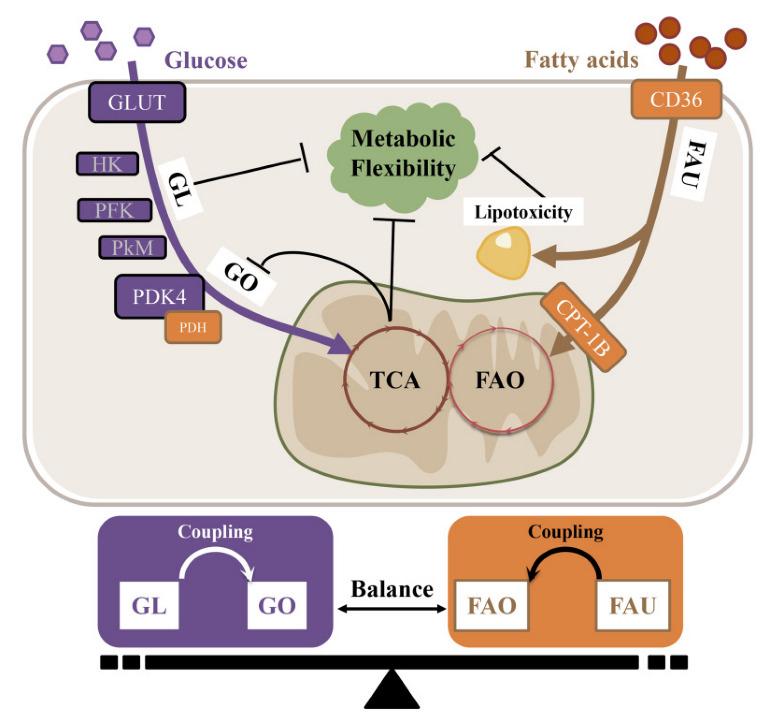
Atrial fibrillation (AF), the most common sustained arrhythmia, is closely intertwined with metabolic abnormalities. Recently, a metabolic paradox in AF pathogenesis has been suggested: under different forms of pathogenesis, the metabolic balance shifts either towards (e.g., obesity and diabetes) or away from (e.g., aging, heart failure, and hypertension) fatty acid oxidation, yet they all increase the risk of AF. This has raised the urgent need for a general consensus regarding the metabolic changes that predispose patients to AF. "Metabolic flexibility" aptly describes switches between substrates (fatty acids, glucose, amino acids, and ketones) in response to various energy stresses depending on availability and requirements. AF, characterized by irregular high-frequency excitation and the contraction of the atria, is an energy challenge and triggers a metabolic switch from preferential fatty acid utilization to glucose metabolism to increase the efficiency of ATP produced in relation to oxygen consumed. Therefore, the heart needs metabolic flexibility. In this review, we will briefly discuss (1) the current understanding of cardiac metabolic flexibility with an emphasis on the specificity of atrial metabolic characteristics; (2) metabolic heterogeneity among AF pathogenesis and metabolic inflexibility as a common pathological basis for AF; and (3) the substrate-metabolism mechanism underlying metabolic inflexibility in AF pathogenesis.
心房颤动(AF)是最常见的持续性心律失常,与代谢异常密切相关。最近,有人提出 AF 发病机制中的代谢悖论:在不同形式的发病机制下,代谢平衡要么向(如肥胖和糖尿病)或远离(如衰老、心力衰竭和高血压)脂肪酸氧化转移,但它们都增加了 AF 的风险。这就迫切需要就使患者易患 AF 的代谢变化达成普遍共识。“代谢灵活性”恰当地描述了根据可用性和需求,在各种能量应激下,对底物(脂肪酸、葡萄糖、氨基酸和酮体)之间的切换。AF 的特征是不规则的高频兴奋和心房收缩,是一种能量挑战,会引发从优先利用脂肪酸到葡萄糖代谢的代谢转换,以提高与消耗的氧气相关的 ATP 产生效率。因此,心脏需要代谢灵活性。在这篇综述中,我们将简要讨论(1)目前对心脏代谢灵活性的理解,重点是心房代谢特征的特异性;(2)AF 发病机制中的代谢异质性和代谢不灵活性作为 AF 的共同病理基础;以及(3)AF 发病机制中代谢不灵活性的底物代谢机制。


 Zotero 插件