
激光靶蒸发法制备γ-FeO 磁性纳米颗粒的生物学效应:聚焦于磁性生物传感器应用。
Biological Impact of γ-FeO Magnetic Nanoparticles Obtained by Laser Target Evaporation: Focus on Magnetic Biosensor Applications.
机构信息
Department of Biomedical Physics and Engineering, Ural State Medical University, 620028 Ekaterinburg, Russia.
Institute of Medical Cell Technologies, 620026 Ekaterinburg, Russia.
出版信息
Biosensors (Basel). 2022 Aug 11;12(8):627. doi: 10.3390/bios12080627.
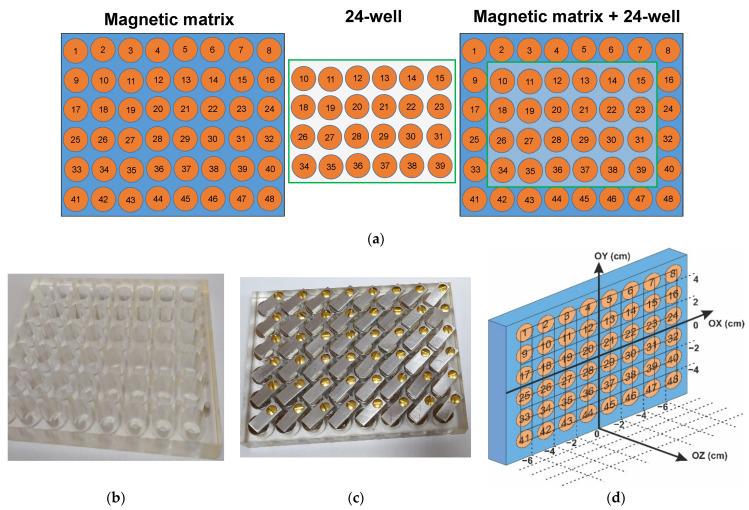
The biological activity of γ-FeO magnetic nanoparticles (MNPs), obtained by the laser target evaporation technique, was studied, with a focus on their possible use in biosensor applications. The biological effect of the MNPs was investigated in vitro on the primary cultures of human dermal fibroblasts. The effects of the MNPs contained in culture medium or MNPs already uptaken by cells were evaluated for the cases of the fibroblast's proliferation and secretion of cytokines and collagen. For the tests related to the contribution of the constant magnetic field to the biological activity of MNPs, a magnetic system for the creation of the external magnetic field (having no commercial analogues) was designed, calibrated, and used. It was adapted to the size of standard 24-well cell culture plates. At low concentrations of MNPs, uptake by fibroblasts had stimulated their proliferation. Extracellular MNPs stimulated the release of pro-inflammatory cytokines (Interleukin-6 (IL-6) and Interleukin-8 (IL-8) or chemokine (C-X-C motif) ligand 8 (CXCL8)) in a concentration-dependent manner. However, the presence of MNPs did not increase the collagen secretion. The exposure to the uniform constant magnetic field (H ≈ 630 or 320 Oe), oriented in the plane of the well, did not cause considerable changes in fibroblasts proliferation and secretion, regardless of presence of MNPs. Statistically significant differences were detected only in the levels of IL-8/CXCL8 release.
研究了通过激光靶蒸发技术获得的γ-FeO 磁性纳米颗粒 (MNPs) 的生物活性,重点研究了它们在生物传感器应用中的可能用途。在体外,我们在人真皮成纤维细胞的原代培养物上研究了 MNPs 的生物效应。评估了细胞内摄取的 MNPs 和培养基中 MNPs 对细胞增殖、细胞因子和胶原蛋白分泌的影响。为了测试恒定磁场对 MNPs 生物活性的贡献,我们设计、校准并使用了一个用于产生外加磁场的磁系统(没有商业类似物)。它适用于标准的 24 孔细胞培养板的尺寸。在 MNPs 的低浓度下,成纤维细胞摄取 MNPs 刺激了其增殖。细胞外 MNPs 以浓度依赖的方式刺激促炎细胞因子(白细胞介素 6 (IL-6) 和白细胞介素 8 (IL-8) 或趋化因子 (C-X-C 基序) 配体 8 (CXCL8)) 的释放。然而,MNPs 的存在并没有增加胶原蛋白的分泌。暴露于均匀的恒定磁场 (H ≈ 630 或 320 Oe),磁场方向与培养板平面平行,无论是否存在 MNPs,都不会引起成纤维细胞增殖和分泌的显著变化。仅在 IL-8/CXCL8 释放水平检测到统计学上的显著差异。



 Zotero 插件