
肾素-血管紧张素系统阻滞剂与慢性阻塞性肺疾病急性加重合并急性呼吸衰竭患者死亡率的相关性:一项回顾性队列研究。
The Association of Renin-Angiotensin System Blockades and Mortality in Patients with Acute Exacerbation of Chronic Obstructive Pulmonary Disease and Acute Respiratory Failure: A Retrospective Cohort Study.
机构信息
The First Clinical College, Shandong Chinese Medical University, Ji Nan, People's Republic of China.
Affiliated Hospital of Shandong University of Traditional Chinese Medicine, Ji Nan, People's Republic of China.
出版信息
Int J Chron Obstruct Pulmon Dis. 2022 Sep 1;17:2001-2011. doi: 10.2147/COPD.S370817. eCollection 2022.
BACKGROUND
Acute respiratory failure (ARF) is a common cause of admission to the intensive care unit (ICU) for patients with acute exacerbation of chronic obstructive pulmonary disease (AECOPD). There is still a lack of effective interventions and treatments. ACE inhibitors (ACEI)/ angiotensin II receptor blockers (ARB) were effective in COPD patients. We aimed to study the effect of ACEI/ARB use on AECOPD combined with ARF and evaluate the effect of in-hospital continuation of medication.
METHODS
We included patients with AECOPD and ARF from the Medical Information Bank for Intensive Care (MIMIC-III) database. MIMIC III is a large cohort database from Boston, USA. Patients were divided into two groups according to the use of ACEI/ARB before admission. Propensity score matching (PSM) was used to reduce potential bias between the two groups. Cox regression and Kaplan-Meier curves compared 30-day mortality in ACEI/ARB users and non-users. We also defined and analyzed the use of in-hospital ACEI/ARB. Multiple models were used to ensure the robustness of the findings. Subgroup analysis was used to analyze the variability between groups.
RESULTS
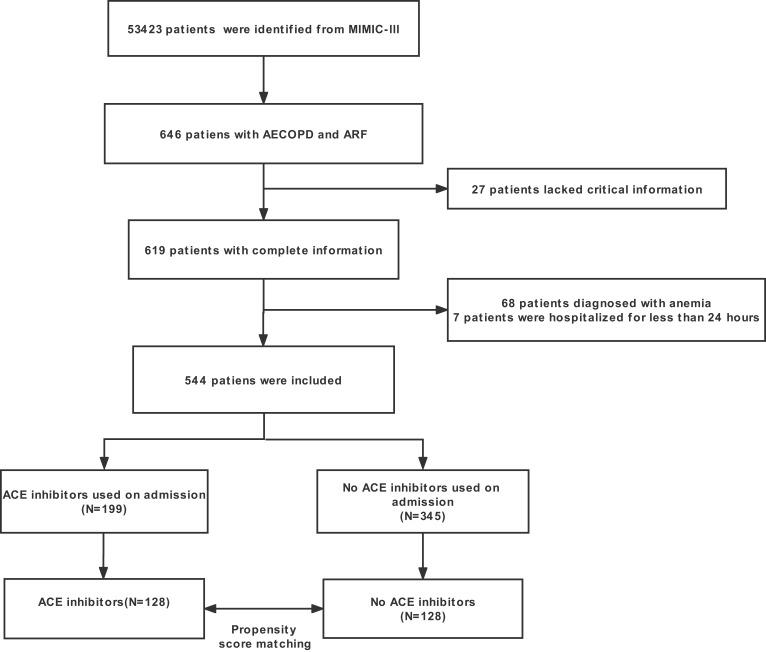
A total of 544 patients were included in the original study. After PSM, 256 patients were included in the matched cohort. Multivariate Cox regression showed 30-day mortality was significantly lower in ACEI/ARB users compared with controls (HR = 0.50, 95% CI: 0.29-0.86, = 0.013). In PSM and inverse probability-weighted models, the results are stable Continued in-hospital use of ACEI/ARB remains effective (HR 0.40, 95% CI 0.22-0.74, = 0.003). Kaplan-Meier showed a significant difference in survival between the two groups.
CONCLUSION
This study found that pre-hospital ACEI/ARB use was associated with reduced mortality in patients with AECOPD and ARF.
背景
急性呼吸衰竭(ARF)是慢性阻塞性肺疾病(COPD)急性加重患者入住重症监护病房(ICU)的常见原因。目前仍然缺乏有效的干预和治疗措施。血管紧张素转换酶抑制剂(ACEI)/血管紧张素 II 受体阻滞剂(ARB)对 COPD 患者有效。我们旨在研究 ACEI/ARB 使用对 AECOPD 合并 ARF 的影响,并评估住院期间继续用药的效果。
方法
我们从美国波士顿的大型队列数据库 Medical Information Bank for Intensive Care(MIMIC-III)数据库中纳入 AECOPD 和 ARF 患者。患者根据入院前是否使用 ACEI/ARB 分为两组。采用倾向评分匹配(PSM)减少两组间的潜在偏倚。Cox 回归和 Kaplan-Meier 曲线比较 ACEI/ARB 使用者和非使用者 30 天死亡率。我们还定义和分析了住院期间 ACEI/ARB 的使用。采用多种模型确保结果的稳健性。进行亚组分析以分析组间的变异性。
结果
共有 544 名患者纳入原始研究。经过 PSM,256 名患者纳入匹配队列。多变量 Cox 回归显示,ACEI/ARB 使用者与对照组相比,30 天死亡率显著降低(HR=0.50,95%CI:0.29-0.86,=0.013)。在 PSM 和逆概率加权模型中,结果均稳定。住院期间继续使用 ACEI/ARB 仍然有效(HR 0.40,95%CI 0.22-0.74,=0.003)。Kaplan-Meier 显示两组间生存存在显著差异。
结论
本研究发现,入院前 ACEI/ARB 的使用与 AECOPD 和 ARF 患者的死亡率降低相关。

 Zotero 插件