
患者特异性胶质母细胞瘤干细胞培养物的功能替莫唑胺敏感性测试可预测临床结果。
Functional temozolomide sensitivity testing of patient-specific glioblastoma stem cell cultures is predictive of clinical outcome.
作者信息
Skaga Erlend, Kulesskiy Evgeny, Potdar Swapnil, Panagopoulos Ioannis, Micci Francesca, Langmoen Iver A, Sandberg Cecilie J, Vik-Mo Einar O
机构信息
Vilhelm Magnus Lab, Institute for Surgical Research and Department of Neurosurgery, Oslo University Hospital, P.O. Box 4950 Nydalen, 0424, Oslo, Norway.
Institute for Molecular Medicine Finland, FIMM, University of Helsinki, Tukholmankatu 8, 00290, Helsinki, Finland.
出版信息
Transl Oncol. 2022 Dec;26:101535. doi: 10.1016/j.tranon.2022.101535. Epub 2022 Sep 15.
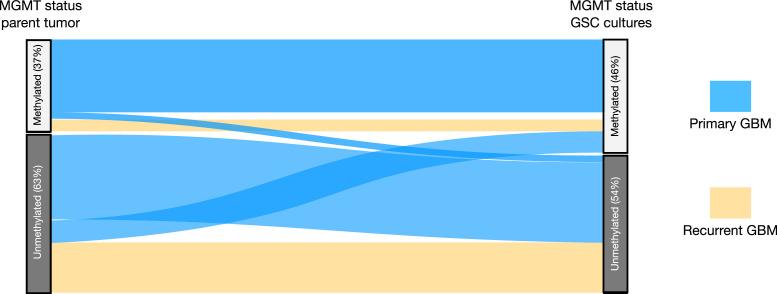
Serum-free culturing of patient-derived glioblastoma biopsies enrich for glioblastoma stem cells (GSCs) and is recognized as a disease-relevant model system in glioblastoma (GBM). We hypothesized that the temozolomide (TMZ) drug sensitivity of patient-derived GSC cultures correlates to clinical sensitivity patterns and has clinical predictive value in a cohort of GBM patients. To this aim, we established 51 individual GSC cultures from surgical biopsies from both treatment-naïve primary and pretreated recurrent GBM patients. The cultures were evaluated for sensitivity to TMZ over a dosing range achievable in normal clinical practice. Drug efficacy was quantified by the drug sensitivity score. MGMT-methylation status was investigated by pyrosequencing. Correlative, contingency, and survival analyses were performed for associations between experimental and clinical data. We found a heterogeneous response to temozolomide in the GSC culture cohort. There were significant differences in the sensitivity to TMZ between the newly diagnosed and the TMZ-treated recurrent disease (p <0.01). There was a moderate correlation between MGMT-status and sensitivity to TMZ (r=0.459, p=0.0009). The relationship between MGMT status and TMZ efficacy was statistically significant on multivariate analyses (p=0.0051). We found a predictive value of TMZ sensitivity in individual GSC cultures to patient survival (p=0.0089). We conclude that GSC-enriched cultures hold clinical and translational relevance by their ability to reflect the clinical heterogeneity in TMZ-sensitivity, substantiate the association between TMZ-sensitivity and MGMT-promotor methylation status and appear to have a stronger predictive value than MGMT-promotor methylation on clinical responses to TMZ.
对患者来源的胶质母细胞瘤活检组织进行无血清培养可富集胶质母细胞瘤干细胞(GSCs),并且被认为是胶质母细胞瘤(GBM)中与疾病相关的模型系统。我们假设患者来源的GSC培养物对替莫唑胺(TMZ)的药物敏感性与临床敏感性模式相关,并且在一组GBM患者中具有临床预测价值。为此,我们从未经治疗的原发性和预处理的复发性GBM患者的手术活检组织中建立了51个单独的GSC培养物。在正常临床实践可达到的剂量范围内评估这些培养物对TMZ的敏感性。通过药物敏感性评分对药物疗效进行量化。通过焦磷酸测序研究MGMT甲基化状态。对实验数据和临床数据之间的关联进行相关性、列联性和生存分析。我们发现GSC培养物队列对替莫唑胺有不同的反应。新诊断的疾病和经TMZ治疗的复发性疾病对TMZ的敏感性存在显著差异(p<0.01)。MGMT状态与对TMZ的敏感性之间存在中度相关性(r=0.459,p=0.0009)。在多变量分析中,MGMT状态与TMZ疗效之间的关系具有统计学意义(p=0.0051)。我们发现个体GSC培养物中TMZ敏感性对患者生存具有预测价值(p=0.0089)。我们得出结论,富含GSC的培养物通过其反映TMZ敏感性临床异质性的能力具有临床和转化相关性,证实了TMZ敏感性与MGMT启动子甲基化状态之间的关联,并且在对TMZ的临床反应方面似乎比MGMT启动子甲基化具有更强的预测价值。



 Zotero 插件