
长链非编码RNA TP73-AS1通过调控miR-125a-3p介导的ACTN4加重非小细胞肺癌进程。
LncRNA TP73-AS1 Exacerbates the Non-Small-Cell Lung Cancer (NSCLC) Process via Regulating miR-125a-3p-Mediated ACTN4.
作者信息
Tong Yueyang, Feng Zhemin, Li Yaqian, Yan Chenxi, He Wenbo, Chen Xueyuan
机构信息
Department of Respiratory and Critical Care Medicine, The Affiliated Hospital of Hangzhou Normal University, Hangzhou 310015, Zhejiang, 126 Wenzhou Road, China.
出版信息
Evid Based Complement Alternat Med. 2022 Sep 9;2022:4098271. doi: 10.1155/2022/4098271. eCollection 2022.
BACKGROUND
LncRNA TP73-AS1 has been revealed to exert a noteworthy impact on the occurrence and advancement of different cancers. In this study, we explored the function of TP73-AS1 in tumor growth, cell progression as well as the relevant molecular mechanism in non-small-cell lung cancer (NSCLC).
METHODS
QRT-PCR was employed to assess the expression of TP73-AS1, miR-125a-3p, and actinin alpha 4 (ACTN4) in NSCLC cells. The biological effect of TP73-AS1 on NSCLC cells was assessed by cell transfection, CCK8, and transwell experiments. We further predicted the interaction among RNAs (TP73-AS1, miR-125a-3p, and ACTN4) through bioinformatics online tools and verified via luciferase reporter, RNA immunoprecipitation, and qRT-PCR assays. Xenograft models of SPC-A1 cells were conducted to test how TP73-AS1 regulates tumorigenesis. Western blot, as well as the immunohistochemistry (IHC) assays, was utilized to measure the expression levels. Functions of TP73-AS1 in NSCLC progression through the miR-125a-3p/ACTN4 axis were investigated by rescue experiments.
RESULTS
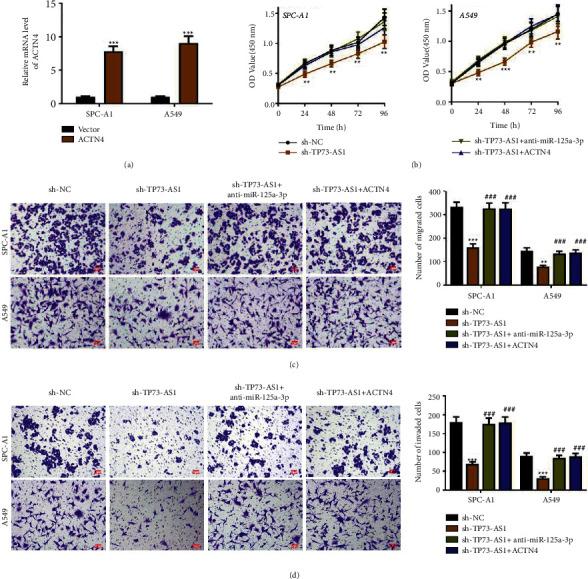
Knockdown of TP73-AS1 suppressed the growth and simultaneously attenuated the migration and invasion ability of NSCLC SPC-A1 and A549 cells. Bioinformatics and molecular mechanism assays demonstrated that TP73-AS1 could bind to miR-125a-3p/ACTN4 and regulate their expression. Moreover, the rescued-function experiment demonstrated that suppressing miR-125a-3p or elevating ACTN4 turned around the suppression effect of sh-TP73-AS1 on NSCLC progression. TP73-AS1 inhibition could also inhibit the NSCLC tumor growth and correspondingly regulated the expression of miR-125a-3p and ACTN4 in the tumor xenograft model.
CONCLUSION
The present study indicated that TP73-AS1 affects NSCLC progression through a new competitive RNA (ceRNA) regulatory network of miR-125a-3p/ACTN4, providing an underlying target for NSCLC treatment in the future.
背景
长链非编码RNA(lncRNA)TP73-AS1已被证实对不同癌症的发生和发展具有显著影响。在本研究中,我们探讨了TP73-AS1在非小细胞肺癌(NSCLC)肿瘤生长、细胞进展以及相关分子机制中的作用。
方法
采用实时定量逆转录聚合酶链反应(QRT-PCR)评估NSCLC细胞中TP73-AS1、微小RNA-125a-3p(miR-125a-3p)和辅肌动蛋白α4(ACTN4)的表达。通过细胞转染、细胞计数试剂盒8(CCK8)和Transwell实验评估TP73-AS1对NSCLC细胞的生物学效应。我们进一步通过生物信息学在线工具预测RNA(TP73-AS1、miR-125a-3p和ACTN4)之间的相互作用,并通过荧光素酶报告基因、RNA免疫沉淀和qRT-PCR实验进行验证。建立SPC-A1细胞异种移植模型,以测试TP73-AS1如何调节肿瘤发生。利用蛋白质免疫印迹法以及免疫组织化学(IHC)实验检测表达水平。通过挽救实验研究TP73-AS1在NSCLC进展中通过miR-125a-3p/ACTN4轴的作用。
结果
敲低TP73-AS1可抑制NSCLC细胞系SPC-A1和A549细胞的生长,同时减弱其迁移和侵袭能力。生物信息学和分子机制实验表明,TP73-AS1可与miR-125a-3p/ACTN4结合并调节它们的表达。此外,挽救功能实验表明,抑制miR-125a-3p或提高ACTN4可逆转sh-TP73-AS1对NSCLC进展的抑制作用。在肿瘤异种移植模型中,抑制TP73-AS1也可抑制NSCLC肿瘤生长,并相应调节miR-125a-3p和ACTN4的表达。
结论
本研究表明,TP73-AS1通过miR-125a-3p/ACTN4这一新的竞争性RNA(ceRNA)调控网络影响NSCLC进展,为未来NSCLC治疗提供了潜在靶点。


 Zotero 插件