
COL4A3、COL4A4 和 COL4A5 基因的遗传变异导致散发性 IgA 肾病患者肾小球基底膜变薄病变。
Genetic Variants of the COL4A3 , COL4A4 , and COL4A5 Genes Contribute to Thinned Glomerular Basement Membrane Lesions in Sporadic IgA Nephropathy Patients.
机构信息
Renal Division, Department of Medicine, Peking University First Hospital, Beijing, China.
Key Laboratory of Renal Disease (Peking University), National Health Commission, Beijing, China.
出版信息
J Am Soc Nephrol. 2023 Jan 1;34(1):132-144. doi: 10.1681/ASN.2021111447. Epub 2022 Oct 5.
BACKGROUND
Thinned glomerular basement membrane (tGBM) lesions are not uncommon in IgA nephropathy (IgAN). Type IV collagen-built of α 3, α 4, and α 5 chains, encoded by COL4A3 / COL4A4 / COL4A5 genes-is the major component of glomerular basement membrane (GBM). In recent years, mutations in type IV collagen-encoding genes were also reported in patients with a histologic diagnosis of FSGS. Pathogenic COL4A3 / COL4A4 / COL4A5 variants were recently identified in familial cases of IgAN, but the contribution of these variants to sporadic IgAN is still unclear.
METHODS
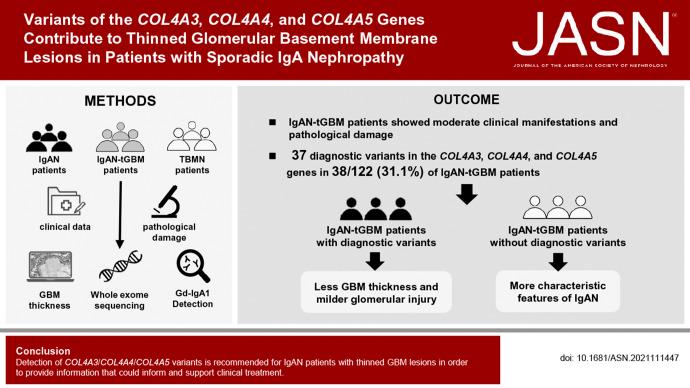
We compared 161 patients with sporadic IgAN with tGBM lesions (IgAN-tGBM) to matched patients with IgAN without tGBM lesions and matched patients with thin basement membrane nephropathy (TBMN). Variants of COL4A3 / COL4A4 / COL4A5 genes were screened and evaluated after whole-exome sequencing. GBM thickness was measured, and levels of circulating galactose-deficient IgA1 (Gd-IgA1) were assessed by ELISA.
RESULTS
The patients with IgAN-tGBM manifested milder disease than did patients with IgAN without tGBM but had more severe features than the patients with TBMN. Exome sequence analysis of the 122 patients with IgAN-tGBM identified 37 diagnostic variants of the COL4A3 / COL4A4 / COL4A5 genes among 38 patients (31.1%). Furthermore, patients with IgAN-tGBM who had diagnostic variants had higher proportions of GBM thickness <250 nm and milder glomerular injury, whereas patients with IgAN-tGBM who did not have diagnostic variants showed more characteristic features of IgAN, including higher intensity of glomerular IgA deposits and elevated Gd-IgA1 levels. These findings suggest different mechanisms in patients with versus without diagnostic variants of these collagen genes.
CONCLUSIONS
COL4A3 / COL4A4 / COL4A5 variant detection is essential in evaluating patients with sporadic IgAN with tGBM lesions.
背景
在 IgA 肾病 (IgAN) 中,薄基底膜病变并不少见。IV 型胶原由α3、α4 和α5 链组成,由 COL4A3/COL4A4/COL4A5 基因编码,是肾小球基底膜 (GBM) 的主要成分。近年来,在组织学诊断为 FSGS 的患者中也报道了 IV 型胶原编码基因突变。在家族性 IgAN 病例中,最近发现了致病性 COL4A3/COL4A4/COL4A5 变异体,但这些变异体对散发性 IgAN 的贡献仍不清楚。
方法
我们比较了 161 例伴薄基底膜病变的散发性 IgAN 患者(IgAN-tGBM)与匹配的无 tGBM 病变的 IgAN 患者和匹配的薄基底膜肾病(TBMN)患者。对 COL4A3/COL4A4/COL4A5 基因进行了全外显子测序,并筛选和评估了变异体。通过 ELISA 评估 GBM 厚度和循环半乳糖缺乏 IgA1(Gd-IgA1)水平。
结果
与无 tGBM 病变的 IgAN 患者相比,IgAN-tGBM 患者的疾病表现较轻,但与 TBMN 患者相比,其表现更为严重。对 122 例 IgAN-tGBM 患者的外显子组分析发现,38 例患者中有 37 例 COL4A3/COL4A4/COL4A5 基因的诊断性变异(31.1%)。此外,携带诊断性变异的 IgAN-tGBM 患者的 GBM 厚度<250nm 的比例更高,肾小球损伤较轻,而无诊断性变异的 IgAN-tGBM 患者则表现出更多典型的 IgAN 特征,包括更强烈的肾小球 IgA 沉积和升高的 Gd-IgA1 水平。这些发现表明,携带和不携带这些胶原基因的诊断性变异的患者的发病机制不同。
结论
在评估伴有薄基底膜病变的散发性 IgAN 患者时,检测 COL4A3/COL4A4/COL4A5 变异体至关重要。
 Zotero 插件