
基于双金属金属-有机骨架的创新水散分子印迹聚合物电化学传感法检测法匹拉韦:形态效应比较。
Electrochemical Sensing of Favipiravir with an Innovative Water-Dispersible Molecularly Imprinted Polymer Based on the Bimetallic Metal-Organic Framework: Comparison of Morphological Effects.
机构信息
Department of Analytical Chemistry, Faculty of Pharmacy, Ankara University, Ankara 06560, Turkey.
Department of Chemistry, Faculty of Sciences, Erciyes University, Kayseri 38039, Turkey.
出版信息
Biosensors (Basel). 2022 Sep 19;12(9):769. doi: 10.3390/bios12090769.
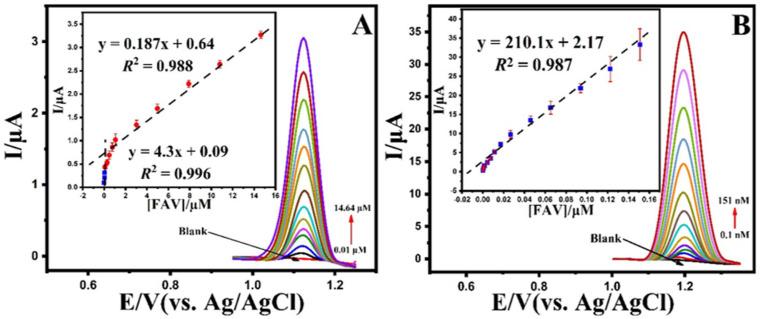
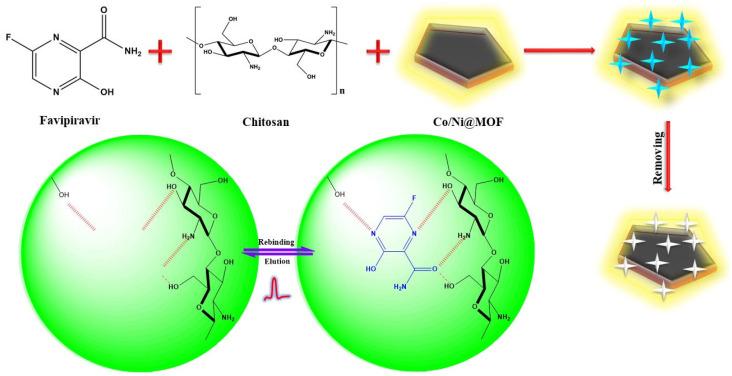
Molecularly imprinted polymers (MIPs) are widely used as modifiers in electrochemical sensors due to their high sensitivity and promise of inexpensive mass manufacturing. Here, we propose and demonstrate a novel MIP-sensor that can measure the electrochemical activity of favipiravir (FAV) as an antiviral drug, thereby enabling quantification of the concentration of FAV in biological and river water samples and in real-time. MOF nanoparticles’ application with various shapes to determine FAV at nanomolar concentrations was described. Two different MOF nanoparticle shapes (dodecahedron and sheets) were systematically compared to evaluate the electrochemical performance of FAV. After carefully examining two different morphologies of MIP-Co-Ni@MOF, the nanosheet form showed a higher performance and efficiency than the nanododecahedron. When MIP-Co/Ni@MOF-based and NIP-Co/Ni@MOF electrodes (nanosheets) were used instead, the minimum target concentrations detected were 7.5 × 10⁻¹¹ (MIP-Co-Ni@MOF) and 8.17 × 10⁻⁹ M (NIP-Co-Ni@MOF), respectively. This is a significant improvement (>102), which is assigned to the large active surface area and high fraction of surface atoms, increasing the amount of greater analyte adsorption during binding. Therefore, water-dispersible MIP-Co-Ni@MOF nanosheets were successfully applied for trace-level determination of FAV in biological and water samples. Our findings seem to provide useful guidance in the molecularly imprinted polymer design of MOF-based materials to help establish quantitative rules in designing MOF-based sensors for point of care (POC) systems.
分子印迹聚合物(MIPs)由于其高灵敏度和廉价大规模制造的潜力,被广泛用作电化学传感器的修饰物。在这里,我们提出并展示了一种新型的 MIP 传感器,它可以测量抗病毒药物法匹拉韦(FAV)的电化学活性,从而能够定量检测生物和河水样品以及实时检测 FAV 的浓度。描述了应用具有各种形状的 MOF 纳米粒子来测定纳摩尔浓度下的 FAV。系统地比较了两种不同的 MOF 纳米粒子形状(十二面体和薄片),以评估 FAV 的电化学性能。在仔细研究了两种不同形态的 MIP-Co-Ni@MOF 之后,纳米片形式表现出比纳米十二面体更高的性能和效率。当使用基于 MIP-Co/Ni@MOF 和 NIP-Co/Ni@MOF 的电极(纳米片)时,检测到的最小目标浓度分别为 7.5×10⁻¹¹(MIP-Co-Ni@MOF)和 8.17×10⁻⁹ M(NIP-Co-Ni@MOF)。这是一个显著的改进(>102),这归因于较大的活性表面积和高比例的表面原子,在结合过程中增加了更多分析物的吸附量。因此,水可分散的 MIP-Co-Ni@MOF 纳米片成功地应用于生物和水样中 FAV 的痕量测定。我们的发现似乎为基于 MOF 的分子印迹聚合物设计提供了有用的指导,有助于建立用于即时护理(POC)系统的基于 MOF 的传感器的定量规则。




 Zotero 插件