
基于 NDVI 的气候变化和人类活动对不同退化草地的影响。
Impacts of climate change and human activities on different degraded grassland based on NDVI.
机构信息
College of Grassland Science, Gansu Agricultural University/Key Laboratory of Grassland Ecosystem (Gansu Agricultural University), Ministry of Education/Sino-U.S. Center for Grassland Ecosystem Sustainability/Pratacultural Engineering Laboratory of Gansu Province, Lanzhou, 730070, China.
College of Natural Resources and Environment, Northwest A&F University, Yangling, 712100, China.
出版信息
Sci Rep. 2022 Sep 23;12(1):15918. doi: 10.1038/s41598-022-19943-6.
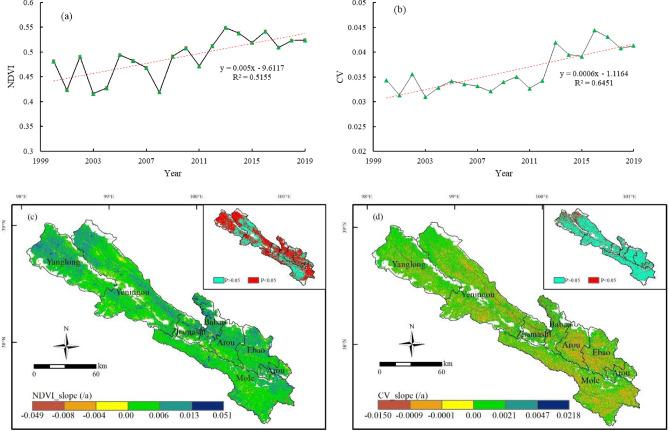
Grassland degradation has emerged as a serious socio-economic and ecological problem, endangering both long-term usage and the regional biogeochemical cycle. Climate change and human activities are the two leading factors leading to grassland degradation. However, it is unclear what the degradation level caused by these two factors is. Using the normalized difference vegetation index (NDVI) and coefficient of variation of NDVI (CV), the spatial distribution features of grassland degradation or restoration were analyzed in Qilian County in the northeast of the Qinghai-Tibet Plateau. The dominant climate variables affecting NDVI variation were selected through the combination of random forest model and stepwise regression method to improve the residual trend analysis, and on this basis, twelve possible scenarios were established to evaluate the driving factors of different degraded grasslands. Finally, used the Hurst index to forecast the trend of grassland degradation or restoration. The results showed that approximately 55.0% of the grassland had been degraded between 2000 and 2019, and the area of slight degradation (NDVI > 0; CV > 0; NDVI > 0.2) accounted for 48.6%. These regions were centered in the northwest of Qilian County. Climate and human activities had a joint impact on grassland restoration or degradation. Human activities played a leading role in grassland restoration, while climate change was primarily a driver of grassland degradation. The regions with slight degradation or re-growing (NDVI > 0; CV > 0), moderate degradation (NDVI < 0; CV > 0), and severe degradation or desertification (NDVI < 0; CV < 0) were dominated by the joint effects of climate and anthropogenic activity accounted for 34.3%, 3.3%, and 1.3%, respectively, of the total grassland area. Grasslands in most areas of Qilian County are forecasted to continue to degrade, including the previously degraded areas, with continuous degradation areas accounting for 54.78%. Accurately identifying the driving factors of different degraded grassland and predicting the dynamic change trend of grassland in the future is the key to understand the mechanism of grassland degradation and prevent grassland degradation. The findings offer a reference for accurately identifying the driving forces in grassland degradation, as well as providing a scientific basis for the policy-making of grassland ecological management.
草原退化已成为一个严重的社会经济和生态问题,不仅威胁到草原的长期利用,也影响到区域生物地球化学循环。气候变化和人类活动是导致草原退化的两个主要因素。然而,这两个因素导致的退化程度尚不清楚。本研究利用归一化植被指数(NDVI)和 NDVI 变化系数(CV),分析了青藏高原东北部祁连县草原退化或恢复的空间分布特征。采用随机森林模型和逐步回归方法相结合的方法,选择了影响 NDVI 变化的主导气候变量,以改进残差趋势分析,并在此基础上建立了 12 种可能的情景,以评估不同退化草地的驱动因素。最后,利用赫斯特指数预测草原退化或恢复的趋势。结果表明,2000-2019 年期间,约有 55.0%的草地发生退化,轻度退化(NDVI>0;CV>0;NDVI>0.2)面积占 48.6%。这些地区集中在祁连县的西北部。气候和人类活动对草原恢复或退化有共同影响。人类活动对草原恢复起主导作用,而气候变化则是草原退化的主要驱动因素。轻度退化或再生(NDVI>0;CV>0)、中度退化(NDVI<0;CV>0)和重度退化或荒漠化(NDVI<0;CV<0)的区域主要受气候和人为活动的共同影响,占总草地面积的 34.3%、3.3%和 1.3%。祁连县大部分地区的草地预计将继续退化,包括以前退化的地区,持续退化的地区占 54.78%。准确识别不同退化草地的驱动因素,预测未来草地的动态变化趋势,是理解草地退化机制和防止草地退化的关键。本研究结果为准确识别草地退化的驱动因素提供了参考,并为草地生态管理政策制定提供了科学依据。




 Zotero 插件