
国家优先事项设定伙伴关系使用德尔菲共识过程来制定适合英国实践改变随机试验的新生儿研究问题。
National priority setting partnership using a Delphi consensus process to develop neonatal research questions suitable for practice-changing randomised trials in the United Kingdom.
机构信息
Neonatal Medicine, School of Public Health, Faculty of Medicine, Imperial College London, London, UK.
MRC Centre for Reproductive Health, The University of Edinburgh, Edinburgh, UK.
出版信息
BMJ Open. 2022 Sep 28;12(9):e061330. doi: 10.1136/bmjopen-2022-061330.
INTRODUCTION
Methodologically robust clinical trials are required to improve neonatal care and reduce unwanted variations in practice. Previous neonatal research prioritisation processes have identified important research themes rather than specific research questions amenable to clinical trials. Practice-changing trials require well-defined research questions, commonly organised using the Population, Intervention, Comparison, Outcome (PICO) structure. By narrowing the scope of research priorities to those which can be answered in clinical trials and by involving a wide range of different stakeholders, we aim to provide a robust and transparent process to identify and prioritise research questions answerable within the National Healthcare System to inform future practice-changing clinical trials.
METHODS AND ANALYSIS
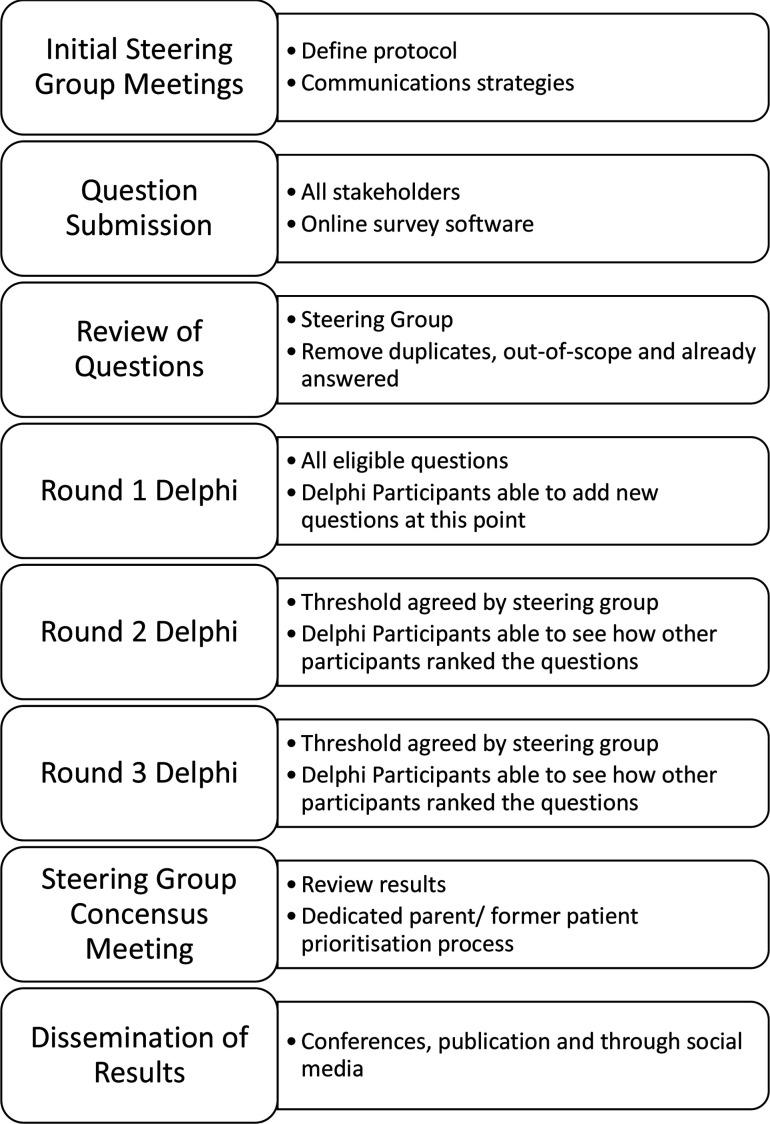
A steering group comprising parents, doctors, nurses, allied health professionals, researchers and representatives from key organisations (Neonatal Society, British Association of Perinatal Medicine, Neonatal Nurses Association and Royal College of Paediatrics and Child Health) was identified to oversee this project. We will invite submissions of research questions formatted using the PICO structure from the following stakeholder groups using an online questionnaire: parents, patients, healthcare professionals and academic researchers. Unanswered, non-duplicate research questions will be entered into a three-round eDelphi survey of all stakeholder groups. Research questions will be ranked by mean aggregate scores.
ETHICS AND DISSEMINATION
The final list of prioritised research questions will be disseminated through traditional academic channels, directly to key stakeholder groups through representative organisations and on social media. The outcome of the project will be shared with key research organisations such as the National Institute for Health Research. Research ethics committee approval is not required.
简介
为了改善新生儿护理并减少实践中的不必要差异,需要进行方法学上稳健的临床试验。先前的新生儿研究优先级确定过程已经确定了重要的研究主题,而不是适合临床试验的具体研究问题。改变实践的试验需要明确界定的研究问题,通常使用人群、干预、比较、结果 (PICO) 结构进行组织。通过将研究重点范围缩小到那些可以通过临床试验回答的问题,并让广泛的不同利益相关者参与其中,我们旨在提供一个稳健透明的过程,以确定和确定可以在国家医疗保健系统内回答的研究问题,为未来改变实践的临床试验提供信息。
方法和分析
一个由父母、医生、护士、联合健康专业人员、研究人员和关键组织(新生儿学会、英国围产医学协会、新生儿护士协会和皇家儿科学会)的代表组成的指导小组将被确定来监督这个项目。我们将邀请以下利益相关者群体使用在线问卷提交使用 PICO 结构格式化的研究问题:父母、患者、医疗保健专业人员和学术研究人员。未回答的、非重复的研究问题将被输入到所有利益相关者群体的三轮电子德尔菲调查中。研究问题将根据平均综合得分进行排名。
伦理和传播
优先研究问题的最终清单将通过传统的学术渠道传播,直接通过代表组织向关键利益相关者群体传播,并在社交媒体上传播。该项目的结果将与国家卫生研究院等关键研究组织共享。不需要研究伦理委员会的批准。


 Zotero 插件