
基于丹磺酰基的荧光席夫碱配体与 Cu(I)离子和 CuO NPs 的相互作用的实验和计算研究。
Experimental and Computational Studies on the Interaction of a Dansyl-Based Fluorescent Schiff Base Ligand with Cu Ions and CuO NPs.
机构信息
Coordination and Supramolecular Chemistry Group (SupraMetal), Institute of Materials (iMATUS), Department of Inorganic Chemistry, Faculty of Chemistry, Universidade de Santiago de Compostela, Avenida das Ciencias s/n, 15782 Santiago de Compostela, Spain.
Trace Element, Speciation and Spectroscopy Group (GETEE), Institute of Materials (iMATUS), Department of Analytical Chemistry, Nutrition and Bromatology, Faculty of Chemistry, Universidade de Santiago de Compostela, Avenida das Ciencias s/n, 15782 Santiago de Compostela, Spain.
出版信息
Int J Mol Sci. 2022 Sep 30;23(19):11565. doi: 10.3390/ijms231911565.
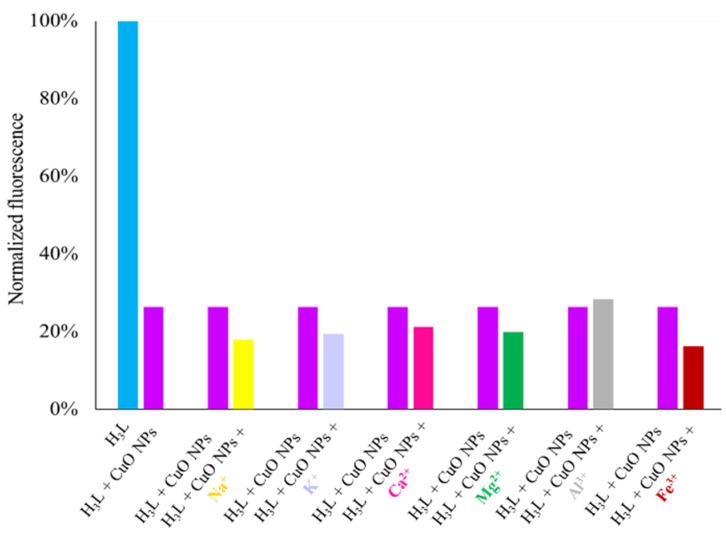
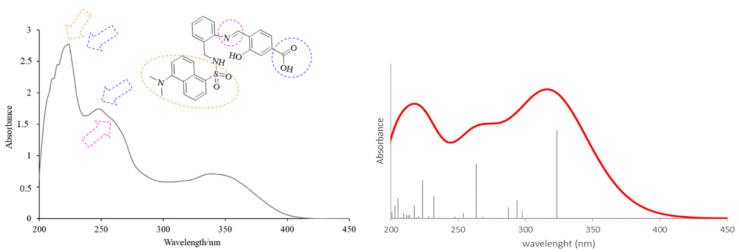
We studied the interaction of Cu ions and CuO nanoparticles with the fluorescent Schiff base ligand HL, which derives from the condensation of 4-formyl-3-hydroxybenzoic acid with -(2-aminobenzyl)-5-(dimethylamino)naphthalene-1-sulfonamide (DsA). A detailed assignment of the most significant bands of the electronic and infrared spectra of HL and DsA was performed using DFT methods, based on both crystal structures. The affinity of HL to react with Cu ions in solution (K = 9.01 10 L mol) is similar to that found for the Cu ions present on the surface of CuO NPs (K = 9.84 10 L mol). Fluorescence spectroscopic measurements suggest five binding sites for HL on the surface of the CuO NPs used. The µ-XRF analysis indicates that a polycrystalline sample of CuO-HL NPs contains 15:1 Cu:S molar ratio (CuO:HL). ATR-FTIR spectroscopy, supported by DFT calculations, showed that the HL (as a phenolate and sulfonamide anion) is coordinated to superficial Cu ions of the CuO NPs through their azomethine, sulphonamide, and phenolic groups. A solution of HL (126 ppb) shows sensitive responses to CuO NPs, with a limit of detection (LOD) of 330 ppb. The working range for detection of CuO NPs with [HL] = 126 ppb was 1.1-9.5 ppm. Common metal ions in water, such as Na, K, Mg, Ca, Fe, and Al species, do not interfere significantly with the detection of CuO NPs.
我们研究了 Cu 离子和 CuO 纳米粒子与荧光希夫碱配体 HL 的相互作用,HL 由 4-甲酰基-3-羟基苯甲酸与 -(2-氨甲基)-5-(二甲基氨基)萘-1-磺酰胺 (DsA) 缩合而成。使用基于晶体结构的 DFT 方法对 HL 和 DsA 的电子和红外光谱的最重要谱带进行了详细的归属。HL 在溶液中与 Cu 离子反应的亲和力(K = 9.01 10 L mol)与存在于 CuO NPs 表面的 Cu 离子相似(K = 9.84 10 L mol)。荧光光谱测量表明,HL 在使用的 CuO NPs 表面上有五个结合位点。µ-XRF 分析表明,CuO-HL NPs 的多晶样品含有 15:1 的 Cu:S 摩尔比(CuO:HL)。ATR-FTIR 光谱结合 DFT 计算表明,HL(作为酚盐和磺酰胺阴离子)通过其亚甲胺、磺酰胺和酚基团与 CuO NPs 的表面 Cu 离子配位。HL(126 ppb)溶液对 CuO NPs 表现出敏感的响应,检测限(LOD)为 330 ppb。当 [HL] = 126 ppb 时,检测 CuO NPs 的工作范围为 1.1-9.5 ppm。水中常见的金属离子,如 Na、K、Mg、Ca、Fe 和 Al 物种,对 CuO NPs 的检测没有明显干扰。




 Zotero 插件