
改良肺免疫预后指数在骨肉瘤患者中的预后意义
Prognostic significance of modified lung immune prognostic index in osteosarcoma patients.
作者信息
He Xuanhong, Tang Fan, Zou Chang, Li Longqing, Wang Yang, Kenmegne Guy Romeo, Zhou Yong, Lu Minxun, Min Li, Luo Yi, Tu Chongqi
机构信息
Department of Orthopedics, Orthopedic Research Institute, West China Hospital, Sichuan University, Chengdu, China.
出版信息
Front Genet. 2022 Oct 11;13:972352. doi: 10.3389/fgene.2022.972352. eCollection 2022.
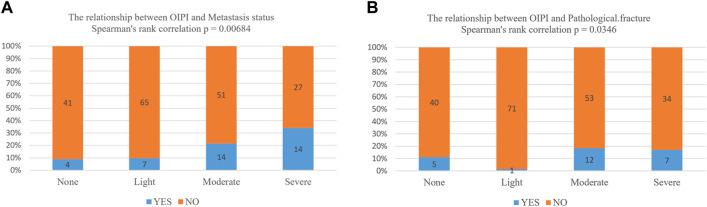
Osteosarcoma is the most common primary malignancy of bone with a dismal prognosis for patients with pulmonary metastases. Evaluation of osteosarcoma prognosis would facilitate the prognosis consultation as well as the development of personalized treatment decisions. However, there is limited effective prognostic predictor at present. Lung Immune Prognostic Index (LIPI) is a novel prognostic factor in pulmonary cancers, whereas, the prognostic significance of LIPI in osteosarcoma has not yet been well clarified. In this study, we firstly explore the prognostic role of LIPI and further modify this predictive model in osteosarcoma. A retrospectively study was conducted at Musculoskeletal Tumor Center of West China Hospital between January 2016 and January 2021. Hematological factors and clinical features of osteosarcoma patients were collected and analyzed. The area under curve (AUC) and optimal cuff-off of each single hematological factor was calculated. In this study, lactate dehydrogenase (LDH), derived neurtrophil to lymphocyte ratio (dNLR), and Hydroxybutyrate dehydrogenase (HBDH) have higher AUC values. LIPI was composed of LDH and dNLR and was further modified by combing the HBDH, forming the osteosarcoma immune prognostic index (OIPI). OIPI divided 223 osteosarcoma patients divided into four groups, none, light, moderate, and severe ( < 0.0001). OIPI has a higher AUC value than LIPI and other hematological indexes in t-ROC curve. According to the univariate and multivariate analysis, pathological fracture, metastasis, NLR, platelet-lymphocyte ratio (PLR), and OIPI were associated with the prognosis; and metastasis and OIPI were independent prognostic factors of osteosarcoma patients. An OIPI-based nomogram was also established and could predict the 3-year and 5-year overall survival. In addition, OIPI was also revealed correlated with metastasis and pathological fracture in osteosarcoma. This study first explore the prognostic significance of LIPI in osteosarcoma patients. In addition, we developed a modified LIPI, the OIPI, for osteosarcoma patients. Both the LIPI and OIPI could predict the overall survival of osteosarcoma patients well, while OIPI may be more suitable for osteosarcoma patients. In particular, OIPI may have the ability to identify some high-risk patients from clinically low-risk patients.
骨肉瘤是最常见的原发性骨恶性肿瘤,对于发生肺转移的患者预后不佳。评估骨肉瘤预后将有助于预后咨询以及制定个性化治疗决策。然而,目前有效的预后预测指标有限。肺免疫预后指数(LIPI)是肺癌中的一种新型预后因素,而LIPI在骨肉瘤中的预后意义尚未得到充分阐明。在本研究中,我们首先探讨LIPI在骨肉瘤中的预后作用,并进一步改进骨肉瘤的预测模型。对2016年1月至2021年1月期间在华西医院肌肉骨骼肿瘤中心进行了一项回顾性研究。收集并分析骨肉瘤患者的血液学因素和临床特征。计算每个单一血液学因素的曲线下面积(AUC)和最佳截断值。在本研究中,乳酸脱氢酶(LDH)、衍生中性粒细胞与淋巴细胞比值(dNLR)和羟丁酸脱氢酶(HBDH)具有较高的AUC值。LIPI由LDH和dNLR组成,并通过结合HBDH进一步改进,形成骨肉瘤免疫预后指数(OIPI)。OIPI将223例骨肉瘤患者分为四组,无、轻、中、重(<0.0001)。在t-ROC曲线中,OIPI的AUC值高于LIPI和其他血液学指标。根据单因素和多因素分析,病理性骨折、转移、NLR、血小板淋巴细胞比值(PLR)和OIPI与预后相关;转移和OIPI是骨肉瘤患者的独立预后因素。还建立了基于OIPI的列线图,可预测3年和5年总生存率。此外,OIPI还与骨肉瘤的转移和病理性骨折相关。本研究首次探讨了LIPI在骨肉瘤患者中的预后意义。此外,我们为骨肉瘤患者开发了一种改进的LIPI,即OIPI。LIPI和OIPI都能很好地预测骨肉瘤患者的总生存率,而OIPI可能更适合骨肉瘤患者。特别是,OIPI可能有能力从临床低风险患者中识别出一些高风险患者。


 Zotero 插件