
移民对津巴布韦低收入城市人群的社会和经济健康的影响
Emigration as a social and economic determinant of health in low-income urban Zimbabwe.
机构信息
Centre for Population Studies, University of Zimbabwe, Harare, Zimbabwe.
出版信息
J Health Popul Nutr. 2022 Nov 5;41(1):49. doi: 10.1186/s41043-022-00330-w.
BACKGROUND
The negative consequences of medical professionals' emigration on the health systems of nations are well documented in the literature. However, there is a dearth of evidence on the impact of emigration in general, on sending households' welfare, health in particular. This study compared socio-economic characteristics, including health, of emigrants' households with those of non-emigrants' households in an urban setting in Harare, Zimbabwe.
METHODS
A cross-sectional survey and focus group discussions were used to collect quantitative and qualitative data, respectively. Concurrent and retrospective data were collected using an interviewer-administered questionnaire. The target population were households, both emigrants' households and non-emigrants' households, and the interviewees were de facto heads of the respective households.
RESULTS
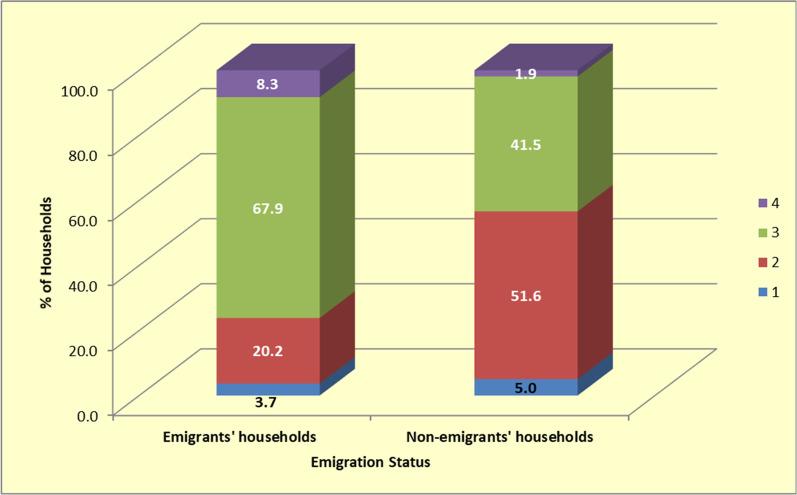
A sample of 279 households was determined; however, 268 heads of households, a response rate of 96%, were achieved. The majority of the respondents were females (52%). Emigrants' households were more likely to access private compared to government health care facilities, than non-emigrants' households [P = 0.001]. Emigrants' households were also more likely to report higher incomes than non-emigrants' households [P < 0.05] and were having more meals per day and better access to education. Emigrants' households were also more likely to report positive lifestyles than non-emigrants' households. Only 13.8% of emigrants' households reported a negative shift in lifestyle, compared to 25.2% non-emigrants' households.
CONCLUSIONS
Emigration was found to have a positive relationship with health seeking, income, education, and number of meals a household had. It is clear from the findings that emigration during the hard economic times in Zimbabwe is beneficial; it cushions households from the ravages of poverty. Yet emigration robs the nation of its professional able-bodied people. It is, therefore, recommended that the government optimises the reported positive effects, whilst expeditiously working on improving the economy with the view of reversing the observed migration streams.
背景
医学专业人员移民对各国卫生系统造成的负面影响在文献中已有充分记录。然而,关于移民对家庭福利,特别是健康的总体影响的证据却很少。本研究比较了津巴布韦哈拉雷市一个城市环境中移民家庭和非移民家庭的社会经济特征,包括健康状况。
方法
使用横断面调查和焦点小组讨论分别收集定量和定性数据。使用访谈者管理的问卷同时收集同期和回顾性数据。目标人群是家庭,包括移民家庭和非移民家庭,受访者是各自家庭的实际户主。
结果
确定了一个 279 户的样本,但仅获得了 268 户户主的回应,回应率为 96%。大多数受访者为女性(52%)。与非移民家庭相比,移民家庭更有可能获得私人而非政府医疗保健设施[P=0.001]。移民家庭也更有可能报告收入高于非移民家庭[P<0.05],并且每天用餐次数更多,获得教育的机会更好。移民家庭也更有可能报告积极的生活方式,而非移民家庭。只有 13.8%的移民家庭报告生活方式出现负面转变,而非移民家庭为 25.2%。
结论
研究发现,移民与寻求医疗、收入、教育和家庭用餐次数之间存在正相关关系。研究结果清楚表明,在津巴布韦经济困难时期移民是有益的;它使家庭免受贫困的蹂躏。然而,移民使国家失去了有能力的专业人员。因此,建议政府优化报告的积极影响,同时加紧改善经济,以期扭转观察到的移民流。


 Zotero 插件