
通过引入石墨控制苯乙烯嵌段共聚物的介电和机械性能
Control of Dielectric and Mechanical Properties of Styrenic Block Copolymer by Graphite Incorporation.
作者信息
Ciuprina Florin, Panaitescu Denis Mihaela, Enache Laura, Damian Celina Maria, Grigorescu Ramona Marina, Gabor Augusta Raluca, Nicolae Cristian Andi, Nistor Cristina Lavinia, Trusca Roxana
机构信息
ELMAT Laboratory, Faculty of Electrical Engineering, University Politehnica of Bucharest, 313 Splaiul Independentei, 060042 Bucharest, Romania.
Polymer Department, National Institute for Research and Development in Chemistry and Petrochemistry, 202 Splaiul Independentei, 060021 Bucharest, Romania.
出版信息
Materials (Basel). 2022 Oct 28;15(21):7577. doi: 10.3390/ma15217577.
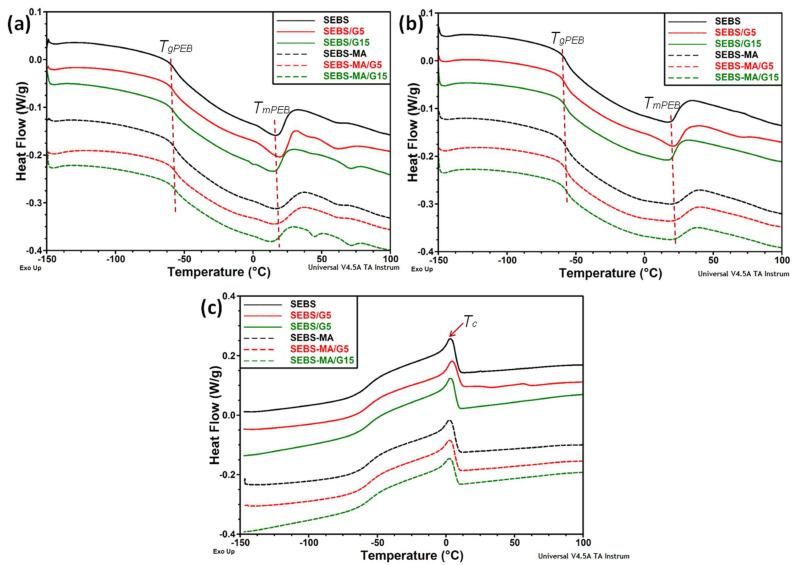
The structure-property relationship of dielectric elastomers, as well as the methods of improving the control of this relationship, has been widely studied over the last few years, including in some of our previous works. In this paper, we study the control, improvement, and correlation, for a significant range of temperatures, of the mechanical and dielectric properties of polystyrene-b-(ethylene-co-butylene)-b-styrene (SEBS) and maleic-anhydride-grafted SEBS (SEBS-MA) by using graphite (G) as filler in various concentrations. The aim is to analyze the suitability of these composites for converting electrical energy into mechanical energy or vice versa. The dielectric spectroscopy analysis performed in the frequency range of 10 to 1 MHz and at temperatures between 27 and 77 °C emphasized an exponential increase in real permittivity with G concentration, a low level of dielectric losses (≈10), as well as the stability of dielectric losses with temperature for high G content. These results correlate well with the increase in mechanical stiffness with an increase in G content for both SEBS/G and SEBS-MA/G composites. The activation energies for the dielectric relaxation processes detected in SEBS/G and SEBS-MA/G composites were also determined and discussed in connection with the mechanical, thermal, and structural properties resulting from thermogravimetric analysis, differential scanning calorimetry, Fourier-transform infrared spectroscopy and X-ray photoelectron spectroscopy analyses.
在过去几年中,包括我们之前的一些工作在内,人们对介电弹性体的结构 - 性能关系以及改善这种关系控制的方法进行了广泛研究。在本文中,我们通过使用不同浓度的石墨(G)作为填料,研究了聚苯乙烯 - b -(乙烯 - 共 - 丁烯) - b - 苯乙烯(SEBS)和马来酸酐接枝SEBS(SEBS - MA)在很宽温度范围内的力学和介电性能的控制、改善及其相关性。目的是分析这些复合材料将电能转化为机械能或反之的适用性。在10至1 MHz频率范围以及27至77°C温度下进行的介电谱分析强调,实介电常数随G浓度呈指数增加,介电损耗水平较低(≈10),并且对于高G含量,介电损耗随温度具有稳定性。这些结果与SEBS / G和SEBS - MA / G复合材料中G含量增加时机械刚度的增加密切相关。还确定了在SEBS / G和SEBS - MA / G复合材料中检测到的介电弛豫过程的活化能,并结合热重分析、差示扫描量热法、傅里叶变换红外光谱和X射线光电子能谱分析得出的力学、热学和结构性能进行了讨论。




 Zotero 插件