
与CAD/CAM复合材料的粘结:可靠长期粘结的因果因素
Adhesion to a CAD/CAM Composite: Causal Factors for a Reliable Long-Term Bond.
作者信息
Duma Sandra M, Ilie Nicoleta
机构信息
Department of Conservative Dentistry and Periodontology, University Hospital, Ludwig Maximilians University (LMU), 80336 Munich, Germany.
出版信息
J Funct Biomater. 2022 Nov 3;13(4):217. doi: 10.3390/jfb13040217.
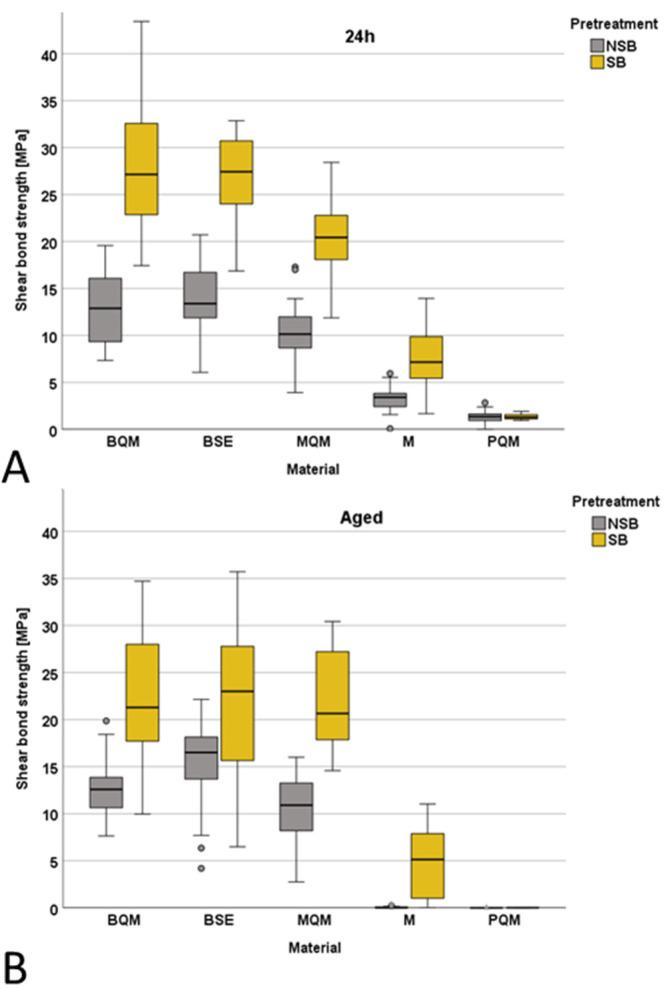
Computer aided design/manufacturing (CAD/CAM) technology has become an increasingly popular part of dentistry, which today also includes CAD/CAM resin-based composite (RBC) applications. Because CAD/CAM RBCs are much more difficult to bond, many methods and attachment materials are still being proposed, while the best application method is still a matter of debate. The present study therefore evaluates causal factors for a reliable long-term bond, which includes the surface preparation of the CAD/CAM RBC, aging and the type of luting material. The reliability of the bond was calculated, and supplemented by fractography to identify fracture mechanisms. Five categories of luting materials were used: (1) temporary zinc phosphate cement, (2) glass ionomer cement (GIC), (3) resin-modified GIC, (4) conventional adhesive resin cement (ARC), and (5) self-adhesive RC. Half of the CAD/CAM RBC surfaces ( = 200) were sandblasted (SB) with 50 µm aluminum oxide, while the other half remained untreated. Bond strength measurements of the 400 resulting specimens were carried out after 24 h ( = 200) or after additional aging (10,000 thermo-cycles between 5 and 55 °C) ( = 200). The data were statistically analyzed using one- and three-way ANOVA followed by Games-Howell post-hoc test (α = 0.05) and Weibull analysis. Aging resulted in a significant decrease in bond strength primarily for the conventional cements. The highest bond strengths and reliabilities were recorded for both ARCs. SB caused a significant increase in bond strength for most luting materials, but also caused microcracks in the CAD/CAM RBC. These microcracks might compromise the long-term reliability of the bond in vivo.
计算机辅助设计/制造(CAD/CAM)技术已日益成为牙科领域中流行的一部分,如今还包括基于CAD/CAM的树脂基复合材料(RBC)应用。由于CAD/CAM RBCs的粘结难度大得多,目前仍在提出许多方法和粘结材料,而最佳应用方法仍存在争议。因此,本研究评估了可靠长期粘结的因果因素,包括CAD/CAM RBC的表面处理、老化和粘结材料类型。计算了粘结的可靠性,并通过断口分析来确定断裂机制。使用了五类粘结材料:(1)临时磷酸锌水门汀,(2)玻璃离子水门汀(GIC),(3)树脂改性GIC,(4)传统粘结树脂水门汀(ARC),以及(5)自粘结树脂水门汀。一半的CAD/CAM RBC表面( = 200)用50 µm氧化铝进行喷砂处理(SB),而另一半保持未处理状态。对400个所得样本在24小时后( = 200)或经过额外老化(在5至55°C之间进行10,000次热循环)( = 200)后进行粘结强度测量。使用单因素和三因素方差分析,随后进行Games-Howell事后检验(α = 0.05)和威布尔分析对数据进行统计分析。老化主要导致传统水门汀的粘结强度显著降低。两种ARC的粘结强度和可靠性最高。对于大多数粘结材料,SB导致粘结强度显著增加,但也在CAD/CAM RBC中产生了微裂纹。这些微裂纹可能会损害体内粘结的长期可靠性。




 Zotero 插件