
青藏高原高寒草原时间稳定性、抗性和恢复力之间的联系日益增强。
Increasing connections among temporal invariability, resistance and resilience of alpine grasslands on the Tibetan Plateau.
作者信息
Yang Yuting, Sun Yi, Niu Ben, Feng Yunfei, Han Fusong, Li Meng
机构信息
School of Geographic Sciences, Nantong University, Nantong, China.
Lhasa National Ecological Research Station, Key Laboratory of Ecosystem Network Observation and Modelling, Institute of Geographic Sciences and Natural Resources Research, Chinese Academy of Sciences, Beijing, China.
出版信息
Front Plant Sci. 2022 Nov 9;13:1026731. doi: 10.3389/fpls.2022.1026731. eCollection 2022.
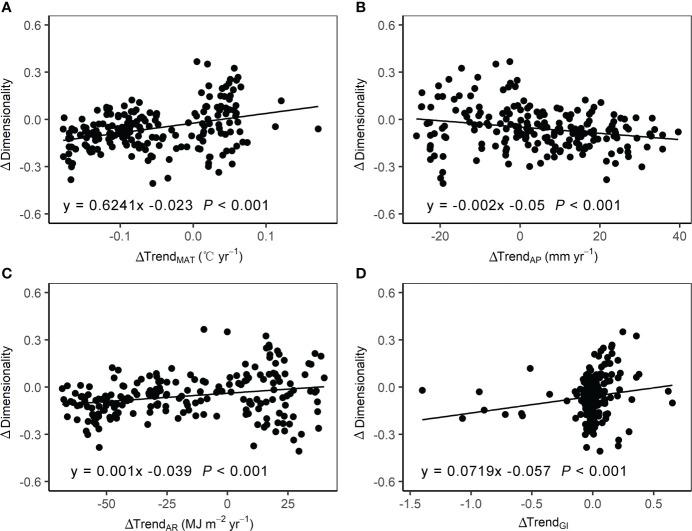
Ecological stability contains multiple components, such as temporal invariability, resistance and resilience. Understanding the response of stability components to perturbations is beneficial for optimizing the management of biodiversity and ecosystem functioning. Although previous studies have investigated the effects of multiple perturbations on each stability component, few studies simultaneously measure the multiple stability components and their relationships. Alpine grasslands on the Tibetan Plateau are exposed to co-occurring perturbations, including climate change and human activities. Here, we quantified three stability components (temporal invariability, resistance, and resilience) of alpine grasslands on the Tibetan Plateau during periods of high (2000-2008) and low (2009-2017) human activity intensity, respectively. We focused on the effects of climate variables (temperature, precipitation, radiation) and human activities (grazing intensity) on covariation among stability components. The results show that (1) for periods of high and low human activity, temporal invariability was positively correlated with resistance and resilience, while resistance was independent of resilience; (2) the dimensionality of alpine grasslands decreased by almost 10%, from 0.61 in the first period to 0.55 in the second period, suggesting the increasing connections among temporal invariability, resistance and resilience of alpine grasslands; and (3) temperature but not grazing intensity dominated the changes in the dimensionality of stability. These findings improve our understanding of multi-dimensional stability and highlight the importance of climate variability on alpine grassland stability on the Tibetan Plateau.
生态稳定性包含多个组成部分,如时间不变性、抵抗力和恢复力。了解稳定性组成部分对干扰的响应,有助于优化生物多样性和生态系统功能的管理。尽管先前的研究已经调查了多种干扰对每个稳定性组成部分的影响,但很少有研究同时测量多个稳定性组成部分及其关系。青藏高原的高寒草原同时受到多种干扰,包括气候变化和人类活动。在此,我们分别量化了青藏高原高寒草原在人类活动强度高(2000 - 2008年)和低(2009 - 2017年)时期的三个稳定性组成部分(时间不变性、抵抗力和恢复力)。我们重点关注气候变量(温度、降水、辐射)和人类活动(放牧强度)对稳定性组成部分之间协变的影响。结果表明:(1)在人类活动强度高和低的时期,时间不变性与抵抗力和恢复力呈正相关,而抵抗力与恢复力相互独立;(2)高寒草原的维度几乎下降了10%,从第一个时期的0.61降至第二个时期的0.55,这表明高寒草原的时间不变性、抵抗力和恢复力之间的联系在增加;(3)温度而非放牧强度主导了稳定性维度的变化。这些发现增进了我们对多维度稳定性的理解,并突出了气候变异性对青藏高原高寒草原稳定性的重要性。



 Zotero 插件