
早期免疫治疗和更长时间的皮质类固醇治疗与儿科 MO GAD 缓解复发病程的风险降低相关。
Early Immunotherapy and Longer Corticosteroid Treatment Are Associated With Lower Risk of Relapsing Disease Course in Pediatric MOGAD.
机构信息
From the Paediatric Neurology and Neurophysiology Unit (M.N., I.T., Stefano Sartori), Department of Women's and Children's Health, University Hospital of Padova, Italy; Neuroimmunology Group (M.N., L.Z., Stefano Sartori), Paediatric Research Institute "Città della Speranza," Padova, Italy; School of Biomedical Engineering and Imaging Sciences (M.E.), King's College London, United Kingdom; Children's Neurosciences, Evelina London Children's Hospital at Guy's and St Thomas' NHS Foundation Trust, London, United Kingdom; Unit of Child Neuropsychiatry (Thea Giacomini, R.C., M.M.M.), Clinical and Surgical Neurosciences Department, IRCCS Giannina Gaslini Institute, Genoa, Genoa, Liguria, Italy; Neuroscience Department (M.V., L.P., M.A.N.F.), Bambino Gesù Children's Hospital IRCCS, Rome, Italy; Department of Neurosciences (M.D.C., Antonio Varone), Pediatric Neurology, Santobono-Pausilipon Children's Hospital, Naples, Italy; Unit of Rare Diseases of the Nervous System in Childhood (A.D.P.), Department of Clinical and Experimental Medicine, University of Catania, Italy; Multiple Sclerosis Center (P.A.), ASST della Valle Olona, Hospital of Gallarate, Italy; Child Neurology and Psychiatry Unit (D.M.C., A.F.), Department of Medical and Surgical Sciences (DIMEC), SOrsola Hospital, University of Bologna, Italy; Division of Pediatrics (Giovanni Crichiutti, V.D.), Department of Medicine, University Hospital of Udine, Italy; Unit of Child Neurology and Psychiatry (G.D.R.), Department of Human Pathology of the Adult and Developmental Age "Gaetano Barresi," University of Messina, Italy; Department of Pediatric Neuroscience (E.F., T.G.., N.N., F.R., A.T.), Fondazione IRCCS Istituto Neurologico Carlo Besta, Milan, Italy; GALLO Multiple Sclerosis Centre (P.G., M.M., M.P.), Neurology Clinic, Department of Neuroscience, Università degli Studi di Padova, Italy; Neuroimmunology Laboratory (M.G.), IRCCS Mondino Foundation, Pavia, Italy; Unit of Pediatrics (L.G., C.P.), ULSS 2 Marca Trevigiana, Ca' Foncello Hospital, Treviso, Italy; Institute of Neurology (R.I.), Fondazione Policlinico Universitario "AGemelli" IRCCS, Rome, Italy; Child Neurology Unit and Laboratories (M.L., F.M.), Neuroscience Department, Meyer Children's University Hospital, Florence, Italy; Neurology Unit (Sara Mariotto), Department of Neuroscience, Biomedicine, and Movement Sciences, University of Verona, Policlinico GB Rossi, Italy; Child Neurology and Psychiatry Unit (Sara Matricardi, Sabrina Siliquini), "GSalesi" Children's Hospital, Ospedali Riuniti Ancona, Italy; Child Neuropsychiatry Unit (A.P.), ASST Grande Ospedale Metropolitano Niguarda, Milano; Child Neuropsychiatry Unit (F.P., E.C.T.), Department of Medicine and Surgery, University of Parma, Italy; Pediatric Clinic (Salvatore Savasta, T.F.), Fondazione IRCCS Policlinico San Matteo, University of Pavia, Italy; Clinical Neurology (Alberto Vogrig), Azienda Ospedaliero Universitaria Friuli Centrale, Udine, Italy; Department of Neurology (L.Z.), Ospedale San Bortolo, Vicenza, Italy; U.O.CPediatria (S.B., S.R.), Ospedale San Bortolo, Vicenza, Italy; Pediatric Neurology (A.O.), Pediatric University Department, Azienda Ospedaliera Universitaria Pisana, University of Pisa, Italy; Child Neuropsychiatry (Gaetano Cantalupo), Department of Surgical Sciences, Dentistry, Gynaecology and Paediatrics, University of Verona, Italy; and Department of Neuroscience (Stefano Sartori), University of Padova, Italy.
出版信息
Neurol Neuroimmunol Neuroinflamm. 2022 Nov 29;10(1). doi: 10.1212/NXI.0000000000200065. Print 2023 Jan.
BACKGROUND AND OBJECTIVES
We sought to identify early factors associated with relapse and outcome in paediatric-onset myelin oligodendrocyte glycoprotein antibody-associated disorders (MOGAD).
METHODS
In a multicenter retrospective cohort of pediatric MOGAD (≤18 years), onset features and treatment were compared in patients with monophasic vs relapsing disease (including cases with follow-up ≥12 months after onset or relapse at any time) and in patients with final Expanded Disability Status Scale (EDSS) 0 vs ≥1 at last follow-up (including cases with follow-up >3 months after last event or EDSS0 at any time). Multivariable logistic regression models were used to evaluate factors associated with relapsing disease course and EDSS ≥ 1 at final follow-up.
RESULTS
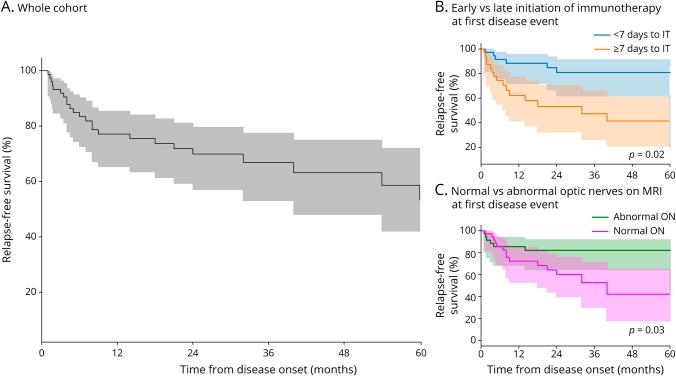
Seventy-five children were included (median onset age 7 years; median 30 months of follow-up). Presentation with acute disseminated encephalomyelitis was more frequent in children aged 8 years or younger (66.7%, 28/42) than in older patients (30.3%, 10/33) ( = 0.002), whereas presentation with optic neuritis was more common in children older than 8 years (57.6%, 19/33) than in younger patients (21.4%, 9/42) ( = 0.001). 40.0% (26/65) of patients relapsed. Time to first relapse was longer in children aged 8 years or younger than in older patients (median 18 vs 4 months) ( = 0.013). Factors at first event independently associated with lower risk of relapsing disease course were immunotherapy <7 days from onset (6.7-fold reduced odds of relapsing course, OR 0.15, 95% CI 0.03-0.61, = 0.009), corticosteroid treatment for ≥5 weeks (6.7-fold reduced odds of relapse, OR 0.15, 95% CI 0.03-0.80, = 0.026), and abnormal optic nerves on onset MRI (12.5-fold reduced odds of relapse, OR 0.08, 95% CI 0.01-0.50, = 0.007). 21.1% (15/71) had EDSS ≥ 1 at final follow-up. Patients with a relapsing course had a higher proportion of final EDSS ≥ 1 (37.5%, 9/24) than children with monophasic disease (12.8%, 5/39) ( = 0.022, univariate analysis). Each 1-point increment in worst EDSS at onset was independently associated with 6.7-fold increased odds of final EDSS ≥ 1 (OR 6.65, 95% CI 1.33-33.26, = 0.021).
DISCUSSION
At first attack of pediatric MOGAD, early immunotherapy, longer duration of corticosteroid treatment, and abnormal optic nerves on MRI seem associated with lower risk of relapse, whereas higher disease severity is associated with greater risk of final disability (EDSS ≥ 1).
背景和目的
我们旨在确定与儿科发病的髓鞘少突胶质细胞糖蛋白抗体相关疾病(MOGAD)复发和结局相关的早期因素。
方法
在一项多中心儿科 MOGAD(≤18 岁)回顾性队列研究中,比较了单相 vs 复发性疾病(包括在发病或复发后随访≥12 个月的病例)以及最终扩展残疾状况量表(EDSS)0 与≥1 的患者的发病特征和治疗(包括在末次事件后随访>3 个月或任何时间 EDSS0 的病例)。使用多变量逻辑回归模型评估与复发性疾病过程和最终随访时 EDSS≥1 相关的因素。
结果
共纳入 75 例儿童(中位发病年龄 7 岁;中位随访 30 个月)。8 岁或以下儿童的急性播散性脑脊髓炎表现更为常见(66.7%,28/42),而年龄较大的儿童为 30.3%(10/33)( = 0.002),而视神经炎在 8 岁以上儿童中更为常见(57.6%,19/33),而在年龄较小的儿童中则较为少见(21.4%,9/42)( = 0.001)。40.0%(26/65)的患者复发。8 岁或以下儿童首次复发的时间长于年龄较大的儿童(中位数 18 与 4 个月)( = 0.013)。首次发病时与较低复发疾病风险相关的因素包括发病后<7 天接受免疫治疗(复发风险降低 6.7 倍,OR 0.15,95%CI 0.03-0.61, = 0.009)、皮质类固醇治疗≥5 周(复发风险降低 6.7 倍,OR 0.15,95%CI 0.03-0.80, = 0.026)和发病时 MRI 视神经异常(复发风险降低 12.5 倍,OR 0.08,95%CI 0.01-0.50, = 0.007)。71 例患者中有 21.1%(15/71)的 EDSS≥1 为最终随访。复发性疾病患者的最终 EDSS≥1 比例(37.5%,9/24)高于单相疾病患者(12.8%,5/39)( = 0.022,单变量分析)。发病时最差 EDSS 每增加 1 分,最终 EDSS≥1 的风险就会增加 6.7 倍(OR 6.65,95%CI 1.33-33.26, = 0.021)。
讨论
在儿科 MOGAD 的首次发作中,早期免疫治疗、较长时间的皮质类固醇治疗和 MRI 上视神经异常似乎与较低的复发风险相关,而较高的疾病严重程度与最终残疾(EDSS≥1)的风险增加相关。

 Zotero 插件