
基于生物信息学和机器学习的强直性脊柱炎所致低骨密度的免疫机制
Immune mechanism of low bone mineral density caused by ankylosing spondylitis based on bioinformatics and machine learning.
作者信息
Zhang Ding, Liu Jia, Gao Bing, Zong Yuan, Guan Xiaoqing, Zhang Fengyi, Shen Zhubin, Lv Shijie, Guo Li, Yin Fei
机构信息
Department of Spine Surgery, China-Japan Union Hospital of Jilin University, Changchun, Jilin, China.
Department of Orthodontics, Hospital of Stomatology, Jilin University, Changchun, Jilin, China.
出版信息
Front Genet. 2022 Nov 18;13:1054035. doi: 10.3389/fgene.2022.1054035. eCollection 2022.
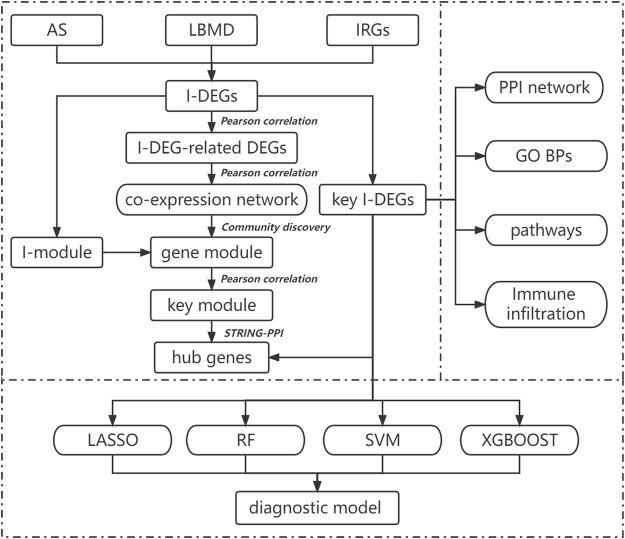
This study aims to find the key immune genes and mechanisms of low bone mineral density (LBMD) in ankylosing spondylitis (AS) patients. AS and LBMD datasets were downloaded from the GEO database, and differential expression gene analysis was performed to obtain DEGs. Immune-related genes (IRGs) were obtained from ImmPort. Overlapping DEGs and IRGs got I-DEGs. Pearson coefficients were used to calculate DEGs and IRGs correlations in the AS and LBMD datasets. Louvain community discovery was used to cluster the co-expression network to get gene modules. The module most related to the immune module was defined as the key module. Metascape was used for enrichment analysis of key modules. Further, I-DEGs with the same trend in AS and LBMD were considered key I-DEGs. Multiple machine learning methods were used to construct diagnostic models based on key I-DEGs. IID database was used to find the context of I-DEGs, especially in the skeletal system. Gene-biological process and gene-pathway networks were constructed based on key I-DEGs. In addition, immune infiltration was analyzed on the AS dataset using the CIBERSORT algorithm. A total of 19 genes were identified I-DEGs, of which IFNAR1, PIK3CG, PTGER2, TNF, and CCL3 were considered the key I-DEGs. These key I-DEGs had a good relationship with the hub genes of key modules. Multiple machine learning showed that key I-DEGs, as a signature, had an excellent diagnostic performance in both AS and LBMD, and the SVM model had the highest AUC value. Key I-DEGs were closely linked through bridge genes, especially in the skeletal system. Pathway analysis showed that PIK3CG, IFNAR1, CCL3, and TNF participated in NETs formation through pathways such as the MAPK signaling pathway. Immune infiltration analysis showed neutrophils had the most significant differences between case and control groups and a good correlation with key I-DEG. The key I-DEGs, TNF, CCL3, PIK3CG, PTGER2, and IFNAR1, can be utilized as biomarkers to determine the risk of LBMD in AS patients. They may affect neutrophil infiltration and NETs formation to influence the bone remodeling process in AS.
本研究旨在探寻强直性脊柱炎(AS)患者低骨密度(LBMD)的关键免疫基因及机制。从基因表达综合数据库(GEO数据库)下载AS和LBMD数据集,并进行差异表达基因分析以获得差异表达基因(DEGs)。从免疫数据库(ImmPort)获取免疫相关基因(IRGs)。重叠DEGs和IRGs得到免疫差异表达基因(I-DEGs)。使用皮尔逊系数计算AS和LBMD数据集中DEGs与IRGs的相关性。采用Louvain社区发现算法对共表达网络进行聚类以获得基因模块。将与免疫模块最相关的模块定义为关键模块。利用Metascape对关键模块进行富集分析。此外,在AS和LBMD中具有相同趋势的I-DEGs被视为关键I-DEGs。使用多种机器学习方法基于关键I-DEGs构建诊断模型。利用国际免疫基因组学数据库(IID数据库)查找I-DEGs的背景信息,尤其是在骨骼系统中的信息。基于关键I-DEGs构建基因-生物学过程和基因-通路网络。此外,使用CIBERSORT算法对AS数据集进行免疫浸润分析。共鉴定出19个基因作为I-DEGs,其中干扰素α受体1(IFNAR1)、磷脂酰肌醇-4,5-二磷酸3-激酶催化亚基γ(PIK3CG)、前列腺素E受体2(PTGER2)、肿瘤坏死因子(TNF)和趋化因子配体3(CCL3)被视为关键I-DEGs。这些关键I-DEGs与关键模块的枢纽基因具有良好的关系。多种机器学习表明,关键I-DEGs作为一种特征,在AS和LBMD中均具有出色的诊断性能,且支持向量机(SVM)模型的曲线下面积(AUC)值最高。关键I-DEGs通过桥梁基因紧密相连,尤其是在骨骼系统中。通路分析表明,PIK3CG、IFNAR1、CCL3和TNF通过丝裂原活化蛋白激酶(MAPK)信号通路等途径参与中性粒细胞胞外诱捕网(NETs)的形成。免疫浸润分析表明,中性粒细胞在病例组和对照组之间差异最为显著,且与关键I-DEG具有良好的相关性。关键I-DEGs,即TNF、CCL3、PIK3CG、PTGER2和IFNAR1,可作为生物标志物来确定AS患者发生LBMD的风险。它们可能影响中性粒细胞浸润和NETs形成,从而影响AS中的骨重塑过程。



 Zotero 插件