
症状性外周动脉疾病患者髌下位置的临床影响。
Clinical impact of the infrapatellar location in symptomatic peripheral arterial disease patients.
机构信息
Department of Interventional Cardiology, Hospital Italiano de Buenos Aires, Buenos Aires, Argentina.
Department of Cardiology, Hospital Italiano de Buenos Aires, Buenos Aires, Argentina.
出版信息
Arch Cardiol Mex. 2022 Jul 27;93(3):318-327. doi: 10.24875/ACM.22000161.
BACKGROUND
Peripheral artery disease (PAD) frequently affects multiple segments of the limbs. Contradictory data have reported worse prognosis in aortoiliac lesions, nevertheless, diabetes and chronic limb ischemia frequently affects the infrapatellar territory. Our aim was to assess the impact of infrapatellar disease in cardiovascular outcomes.
METHODS
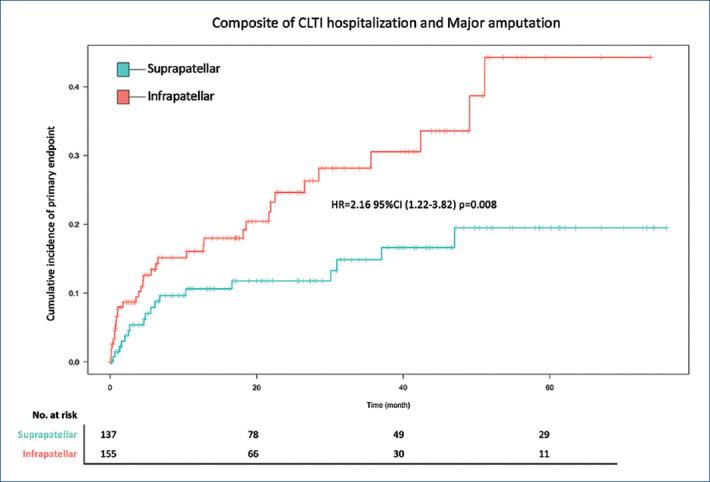
We performed a retrospective, observational cohort study at a university hospital in Argentina. Electronic health records were retrospectively reviewed including symptomatic PAD patients requiring revascularization. A multivariable regression model was performed to account for confounders. The primary endpoint was a composite of hospitalizations due to chronic limb threatening ischemia (CLTI) and major amputation events between infrapatellar and suprapatellar patients. Minor amputation events, all-cause death, myocardial infarction (MI), stroke, and major cardiovascular events (MACE) were secondary endpoints.
RESULTS
From January 2014 through July 2020, a total of 309 patients were included in the analysis. 151 patients had suprapatellar disease, and 158 had infrapatellar disease. The primary composite endpoint occurred in 35 patients (22.2%) in the infrapatellar patients and 18 patients (11.9%) in the suprapatellar patients (HR = 2.16; 95% confidence interval [CI]= [1.22-3.82]; p = 0.008). Both components of the primary outcomes occurred more frequently in infrapatellar patients.Minor amputation events were more prevalent in infrapatellar patients (HR = 5.09; 95% CI = [1.47-17.6]; p = 0.010). Death,MI, stroke, and MACE events were not different among groups (all p > 0.05).
CONCLUSION
Infrapatellar disease was anindependent factor for increased hospitalization of CLTI, major and minor amputations events, compared to suprapatellardisease in symptomatic revascularized PAD patients.
背景
外周动脉疾病(PAD)常累及四肢的多个节段。尽管有相反的数据表明,主髂动脉病变的预后更差,但糖尿病和慢性肢体缺血常累及髌下区域。我们旨在评估髌下疾病对心血管结局的影响。
方法
我们在阿根廷的一所大学医院进行了一项回顾性、观察性队列研究。回顾性审查电子健康记录,包括需要血管重建的有症状的 PAD 患者。进行多变量回归模型以校正混杂因素。主要终点是髌下和髌上患者因慢性肢体威胁性缺血(CLTI)和主要截肢事件而住院的复合终点。次要终点包括次要截肢事件、全因死亡、心肌梗死(MI)、中风和主要心血管事件(MACE)。
结果
从 2014 年 1 月至 2020 年 7 月,共有 309 例患者纳入分析。151 例患者有髌上病变,158 例患者有髌下病变。髌下患者的主要复合终点发生在 35 例患者(22.2%),髌上患者发生在 18 例患者(11.9%)(HR = 2.16;95%置信区间[CI] = [1.22-3.82];p = 0.008)。主要结局的两个组成部分在髌下患者中更常见。髌下患者的次要截肢事件更为常见(HR = 5.09;95% CI = [1.47-17.6];p = 0.010)。死亡、MI、中风和 MACE 事件在各组之间无差异(均 p > 0.05)。
结论
与髌上病变相比,髌下病变是有症状的血管重建 PAD 患者中 CLTI、主要和次要截肢事件住院增加的独立因素。


 Zotero 插件