
利用“毛状”根提取物进行形态控制合成磁性纳米颗粒:环境应用与毒性评估
Morphology-Controlled Synthesis of Magnetic Nanoparticles Using Extracts of 'Hairy' Roots: Environmental Application and Toxicity Evaluation.
作者信息
Kobylinska Natalia, Klymchuk Dmytro, Khaynakova Olena, Duplij Volodymyr, Matvieieva Nadiia
机构信息
Dumansky Institute of Colloid and Water Chemistry, National Academy of Science of Ukraine, 42 Akad. Vernadskoho Blvd., 03142 Kyiv, Ukraine.
Kholodny Institute of Botany, National Academy of Science of Ukraine, 2 Tereshchenkivska Str., 02000 Kyiv, Ukraine.
出版信息
Nanomaterials (Basel). 2022 Nov 28;12(23):4231. doi: 10.3390/nano12234231.
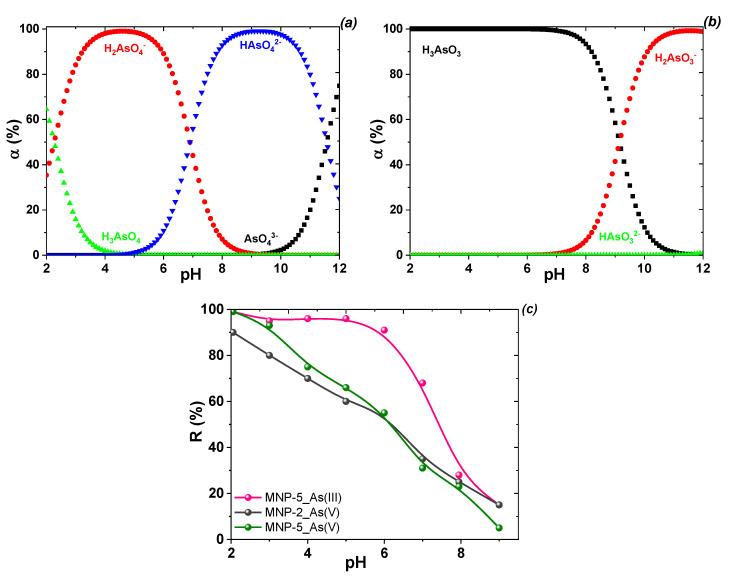
Magnetic nanoparticles (MNPs) were "" synthesized from a FeCl/FeSO/CoCl mixture using ethanolic extracts of Ledeb 'hairy' roots. The effect of chemical composition and reducing power of ethanolic extracts on the morphology, size destribution and other features of obtained MNPs was evaluated. Depending on the extract properties, nanosized magnetic materials of spherical (8-11 nm), nanorod-like (15-24 nm) and cubic (14-24 nm) shapes were obtained via self-assembly. Microspherical MNPs composed of nanoclusters were observed when using extract of the control root line in the synthesis. Polyhedral magnetic nanoparticles with an average size of ~30 nm were formed using 'hairy' root ethanolic extract without any additive. Studied samples manifested excellent magnetic characteristics. Field-dependent magnetic measurements of most MNPs demonstrated a saturation magnetization of 42.0-72.9 emu/g with negligible coercivity (∼0.02-0.29 emu/g), indicating superparamagnetic behaviour only for solids with a magnetite phase. The synthesized MNPs were minimally aggregated and well-dispersed in aqueous medium, probably due to their stabilization by bioactive compounds in the initial extract. The nanoparticles were tested for magnetic solid-phase extraction of copper (Cu), cadmium (Cd) and arsenic (As) pollutants in aqueous solution, followed by ICP-OES analysis. The magnetic oxides, mainly magnetite, showed high adsorption capacity and effectively removed arsenic ions at pH 6.7. The maximum adsorption capacity was ~150 mg/g for As(III, V) on the selected MNPs with cubic morphology, which is higher than that of previously reported adsorbents. The best adsorption was achieved using FeO-based nanomaterials with low crystallinity, non-spherical form and a large number of surface-localized organic molecules. The phytotoxicity of the obtained MNPs was estimated in vitro using lettuce and chicory as model plants. The obtained MNPs did not exhibit inhibitory activity. This work provides novel insights on the morphology of "" synthesized magnetic nanoparticles that can be used for applications in adsorption technologies.
磁性纳米颗粒(MNPs)是使用细叶猪毛菜“毛状”根的乙醇提取物从FeCl/FeSO/CoCl混合物中“合成”的。评估了乙醇提取物的化学成分和还原能力对所得MNPs的形态、尺寸分布及其他特性的影响。根据提取物的性质,通过自组装获得了球形(8 - 11纳米)、纳米棒状(15 - 24纳米)和立方体形(14 - 24纳米)的纳米级磁性材料。在合成过程中使用对照根系的提取物时,观察到由纳米团簇组成的微球形MNPs。使用不含任何添加剂的“毛状”根乙醇提取物形成了平均尺寸约为30纳米的多面体磁性纳米颗粒。研究样品表现出优异的磁性特性。大多数MNPs的场依赖磁性测量表明,饱和磁化强度为42.0 - 72.9 emu/g,矫顽力可忽略不计(约0.02 - 0.29 emu/g),表明仅具有磁铁矿相的固体表现出超顺磁性行为。合成的MNPs在水介质中聚集最少且分散良好,这可能是由于它们被初始提取物中的生物活性化合物稳定化。对纳米颗粒进行了测试,用于磁固相萃取水溶液中的铜(Cu)、镉(Cd)和砷(As)污染物,随后进行电感耦合等离子体质谱 - 光发射光谱(ICP - OES)分析。磁性氧化物,主要是磁铁矿,显示出高吸附容量,并在pH 6.7时有效地去除了砷离子。对于具有立方形态的所选MNPs,As(III, V) 的最大吸附容量约为150 mg/g,高于先前报道的吸附剂。使用具有低结晶度、非球形形式和大量表面定位有机分子的基于FeO的纳米材料实现了最佳吸附。使用生菜和菊苣作为模式植物在体外评估了所得MNPs的植物毒性。所得MNPs未表现出抑制活性。这项工作为“合成”的磁性纳米颗粒的形态提供了新的见解,这些纳米颗粒可用于吸附技术应用。




 Zotero 插件