
一种模仿游泳蛇自然流体运动以设计水下机器人的仿生方法。
A Biomimetic Method to Replicate the Natural Fluid Movements of Swimming Snakes to Design Aquatic Robots.
作者信息
Gautreau Elie, Bonnet Xavier, Sandoval Juan, Fosseries Guillaume, Herrel Anthony, Arsicault Marc, Zeghloul Saïd, Laribi Med Amine
机构信息
Department of GMSC, Pprime Institute, University of Poitiers, CNRS, ISAE-ENSMA, UPR 3346 Poitiers, France.
CEBC Center of Biological Studies of Chizé, CNRS & University of La Rochelle, Villiers-en-Bois, UMR 7372 Deux-Sèvres, France.
出版信息
Biomimetics (Basel). 2022 Dec 3;7(4):223. doi: 10.3390/biomimetics7040223.
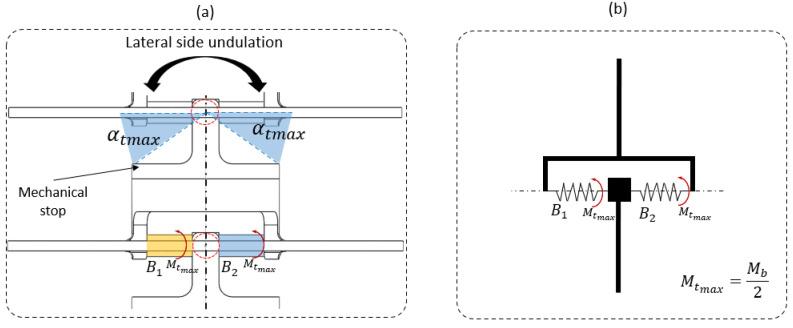
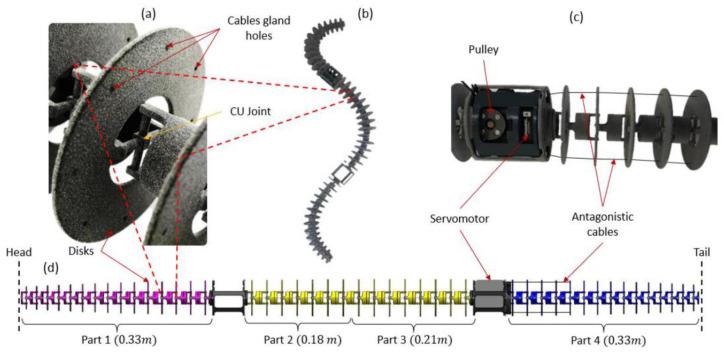
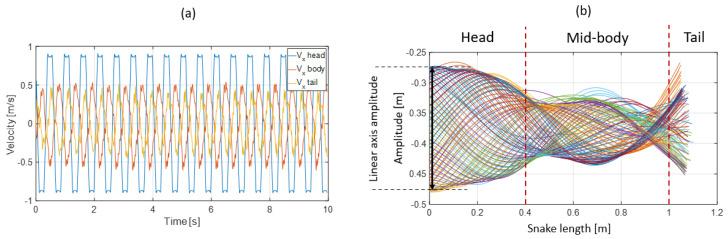
Replicating animal movements with robots provides powerful research tools because key parameters can be manipulated at will. Facing the lack of standard methods and the high complexity of biological systems, an incremental bioinspired approach is required. We followed this method to design a snake robot capable of reproducing the natural swimming gait of snakes, i.e., the lateral undulations of the whole body. Our goal was to shift away from the classical broken line design of poly-articulated snake robots to mimic the far more complex fluid movements of snakes. First, we examined the musculoskeletal systems of different snake species to extract key information, such as the flexibility or stiffness of the body. Second, we gathered the swimming kinematics of living snakes. Third, we developed a toolbox to implement the data that are relevant to technical solutions. We eventually built a prototype of an artificial body (not yet fitted with motors) that successfully reproduced the natural fluid lateral undulations of snakes when they swim. This basis is an essential step for designing realistic autonomous snake robots.
用机器人复制动物运动可提供强大的研究工具,因为关键参数可以随意操控。面对生物系统缺乏标准方法和高度复杂性的问题,需要一种渐进的仿生方法。我们遵循此方法设计了一种能够再现蛇自然游泳步态(即全身横向波动)的蛇形机器人。我们的目标是摒弃多关节蛇形机器人的经典折线设计,以模仿蛇更为复杂的流体运动。首先,我们研究了不同蛇种的肌肉骨骼系统,以提取关键信息,如身体的柔韧性或刚度。其次,我们收集了活蛇的游泳运动学数据。第三,我们开发了一个工具箱来实现与技术解决方案相关的数据。我们最终制造了一个人工身体的原型(尚未安装电机),当蛇游动时,该原型成功再现了蛇自然的流体横向波动。这一基础是设计逼真的自主蛇形机器人的关键一步。







 Zotero 插件