
SG3403和22对小麦赤霉病生物防治的影响。
Effects of SG3403 and 22 on the Biocontrol of Wheat Head Blight.
作者信息
Liu Hongyi, Li Tingting, Li Yaqian, Wang Xinhua, Chen Jie
机构信息
School of Agriculture and Biology, Shanghai Jiao Tong University, Shanghai 200240, China.
State Key Laboratory of Microbial Metabolism, Shanghai Jiao Tong University, Shanghai 200240, China.
出版信息
J Fungi (Basel). 2022 Nov 27;8(12):1250. doi: 10.3390/jof8121250.
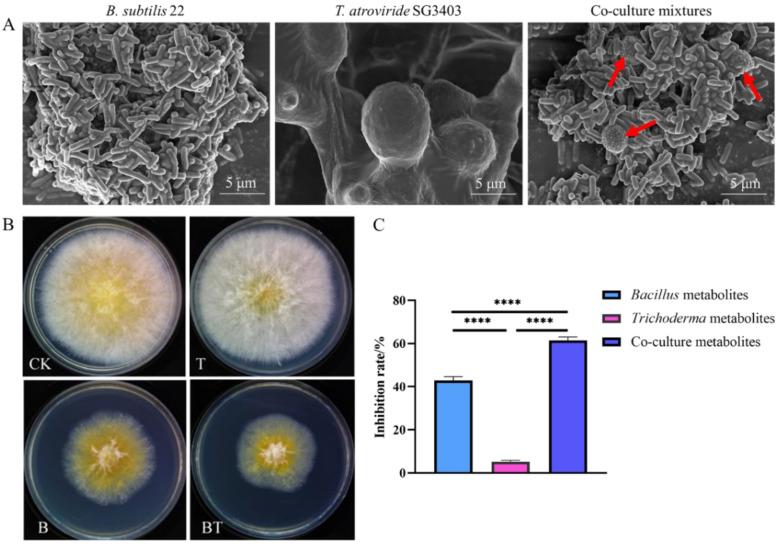
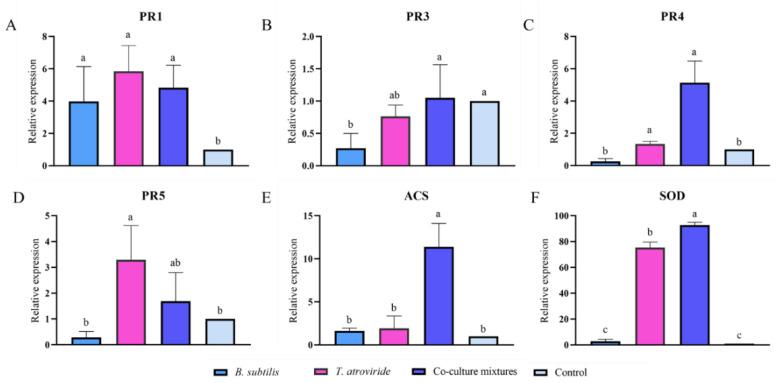
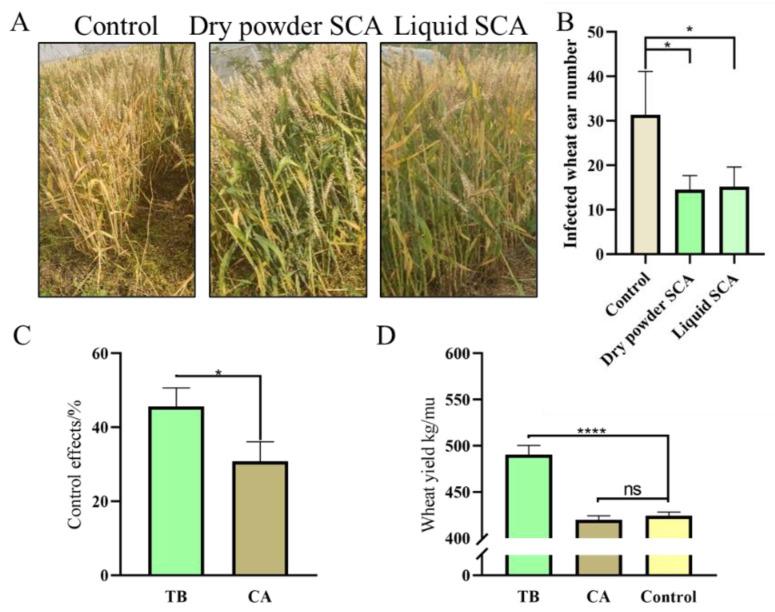
Wheat head blight caused by is one of the major wheat diseases in the world; therefore, it is very significant to develop an effective and environmentally friendly microbial fungicide against it. and are widely applied biocontrol microorganisms with separate advantages; however, little work has been conducted for synergistically elevating the effects of biocontrol and plant promotion through the co-cultivation of the two microorganisms. Our study demonstrated that SG3403 is compatible with 22. The co-culture metabolites contained a group of antagonistic compounds which were able to inhibit growth and increase the activities of pathogen G protein and mitogen-activated protein kinase (MAPK) as compared with axenic culture metabolites. Additionally, the co-culture metabolites enabled us to more significantly decrease the production of gibberellin (GA), deoxynivalenol (DON), and zearalenone (ZEN) from , which disorganized the subcellular structure, particularly the cytoplasm of hyphae, relative to the axenically cultured metabolites. Furthermore, the seed-coating agent made by the co-culture had significant effects against infection by triggering the expression of host plant defensive genes, including , , , , , and . It is suggested that jasmonic acid and ethylene (JA/ET) signaling might dominate wheat's induced systemic resistance (ISR) against wheat head blight. A dry, powdered bio-seed coating agent containing the co-culture mixtures was confirmed to be a bioavailable formulation that can be applied to control wheat head blight. Taken together, the co-culture's metabolites or the metabolites and living cells might provide a basis for the further development of a new kind of microbial bio-fungicide in the future.
由[病原体名称未给出]引起的小麦赤霉病是世界上主要的小麦病害之一;因此,开发一种有效且环保的微生物杀菌剂来防治该病具有重要意义。[两种微生物名称未给出]是具有各自优势的广泛应用的生物防治微生物;然而,关于通过两种微生物共培养协同提高生物防治和植物促生效果的研究较少。我们的研究表明[微生物名称未给出]SG3403与[微生物名称未给出]22具有相容性。与无菌培养代谢产物相比,共培养代谢产物含有一组拮抗化合物,能够抑制[病原体名称未给出]生长,并增加病原体G蛋白和丝裂原活化蛋白激酶(MAPK)的活性。此外,共培养代谢产物能使我们更显著地降低[病原体名称未给出]产生赤霉素(GA)、脱氧雪腐镰刀菌烯醇(DON)和玉米赤霉烯酮(ZEN)的量,相对于无菌培养的代谢产物,这破坏了亚细胞结构,特别是[病原体名称未给出]菌丝的细胞质。此外,由共培养制成的种衣剂通过触发宿主植物防御基因的表达,包括[基因名称未给出]、[基因名称未给出]、[基因名称未给出]、[基因名称未给出]、[基因名称未给出]和[基因名称未给出],对[病原体名称未给出]感染具有显著效果。表明茉莉酸和乙烯(JA/ET)信号可能主导小麦对小麦赤霉病的诱导系统抗性(ISR)。一种含有共培养混合物的干燥粉末状生物种衣剂被证实是一种可用于防治小麦赤霉病的生物可用制剂。综上所述,共培养的代谢产物或代谢产物与活细胞可能为未来新型微生物生物杀菌剂的进一步开发提供基础。



 Zotero 插件