
纳米银颗粒的涂层依赖性对烟草()幼苗生理和蛋白质组响应的影响。
Effects of Silver Nanoparticles on Physiological and Proteomic Responses of Tobacco () Seedlings Are Coating-Dependent.
机构信息
Department of Biology, Faculty of Science, University of Zagreb, Horvatovac 102a, 10000 Zagreb, Croatia.
Department of Ecology, Institute of Public Health "Dr. Andrija Štampar", Mirogojska cesta 16, 10000 Zagreb, Croatia.
出版信息
Int J Mol Sci. 2022 Dec 14;23(24):15923. doi: 10.3390/ijms232415923.
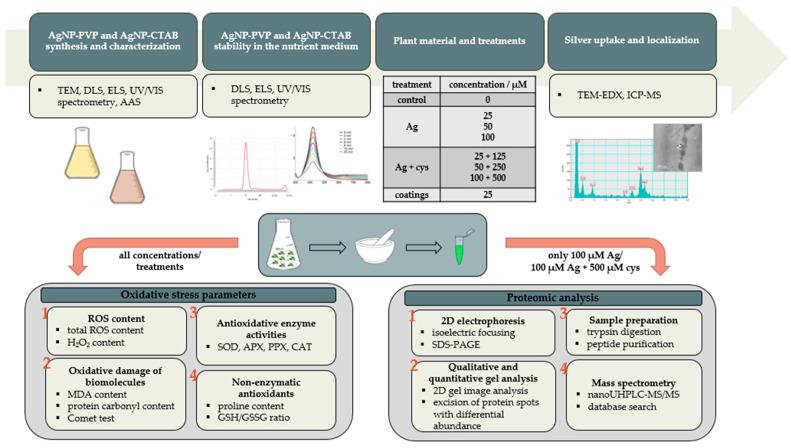
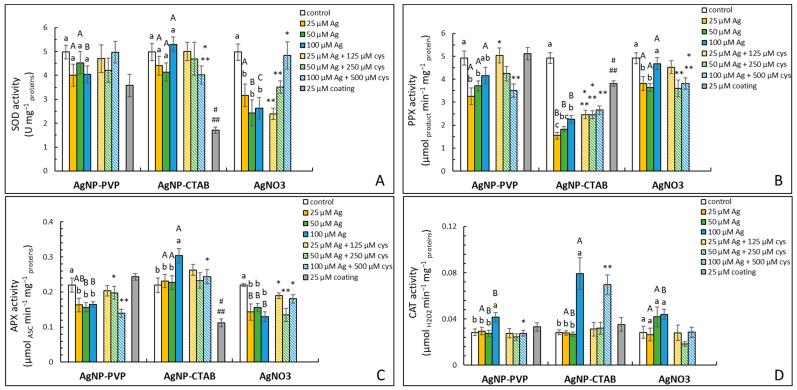
The harmful effects of silver nanoparticles (AgNPs) have been confirmed in many organisms, but the mechanism of their toxicity is not yet fully understood. In biological systems, AgNPs tend to aggregate and dissolve, so they are often stabilized by coatings that influence their physico-chemical properties. In this study, the effects of AgNPs with different coatings [polyvinylpyrrolidone (PVP) and cetyltrimethylammonium bromide (CTAB)] on oxidative stress appearance and proteome changes in tobacco () seedlings have been examined. To discriminate between the nanoparticulate Ag form from the ionic one, the treatments with AgNO, a source of Ag ions, were also included. Ag uptake and accumulation were found to be similarly effective upon exposure to all treatment types, although positively charged AgNP-CTAB showed less stability and a generally stronger impact on the investigated parameters in comparison with more stable and negatively charged AgNP-PVP and ionic silver (AgNO). Both AgNP treatments induced reactive oxygen species (ROS) formation and increased the expression of proteins involved in antioxidant defense, confirming oxidative stress as an important mechanism of AgNP phytotoxicity. However, the mechanism of seedling responses differed depending on the type of AgNP used. The highest AgNP-CTAB concentration and CTAB coating resulted in increased HO content and significant damage to lipids, proteins and DNA molecules, as well as a strong activation of antioxidant enzymes, especially CAT and APX. On the other hand, AgNP-PVP and AgNO treatments induced the nonenzymatic antioxidants by significantly increasing the proline and GSH content. Exposure to AgNP-CTAB also resulted in more noticeable changes in the expression of proteins belonging to the defense and stress response, carbohydrate and energy metabolism and storage protein categories in comparison to AgNP-PVP and AgNO. Cysteine addition significantly reduced the effects of AgNP-PVP and AgNO for the majority of investigated parameters, indicating that AgNP-PVP toxicity mostly derives from released Ag ions. AgNP-CTAB effects, however, were not alleviated by cysteine addition, suggesting that their toxicity derives from the intrinsic properties of the nanoparticles and the coating itself.
纳米银颗粒(AgNPs)对许多生物都具有有害影响,但它们的毒性机制尚未完全了解。在生物系统中,AgNPs 往往会聚集和溶解,因此它们通常通过影响其理化性质的涂层来稳定。在这项研究中,研究了具有不同涂层(聚乙烯吡咯烷酮(PVP)和十六烷基三甲基溴化铵(CTAB))的 AgNPs 对烟草()幼苗氧化应激表现和蛋白质组变化的影响。为了区分纳米颗粒形式的 Ag 与离子形式的 Ag,还包括了 AgNO3 处理,这是 Ag 离子的来源。研究发现,尽管带正电荷的 AgNP-CTAB 比更稳定且带负电荷的 AgNP-PVP 和离子银(AgNO3)稳定性差,对所研究参数的影响也更强,但所有处理类型的 Ag 摄取和积累都同样有效。两种 AgNP 处理均诱导活性氧物质(ROS)的形成,并增加了参与抗氧化防御的蛋白质的表达,证实氧化应激是 AgNP 植物毒性的重要机制。然而,幼苗响应的机制取决于所用的 AgNP 类型。AgNP-CTAB 的最高浓度和 CTAB 涂层导致 HO 含量增加,脂质、蛋白质和 DNA 分子严重受损,以及抗氧化酶(特别是 CAT 和 APX)的强烈激活。另一方面,AgNP-PVP 和 AgNO3 处理通过显著增加脯氨酸和 GSH 的含量来诱导非酶抗氧化剂。与 AgNP-PVP 和 AgNO3 相比,AgNP-CTAB 暴露还导致属于防御和应激反应、碳水化合物和能量代谢以及储存蛋白类别的蛋白质表达发生更明显的变化。半胱氨酸的添加显著降低了 AgNP-PVP 和 AgNO3 对大多数研究参数的影响,表明 AgNP-PVP 的毒性主要来自释放的 Ag 离子。然而,半胱氨酸的添加并没有减轻 AgNP-CTAB 的作用,这表明其毒性源自纳米颗粒的固有特性和涂层本身。




 Zotero 插件