
使用机器学习方法识别预测新冠病毒疾病严重程度的微小RNA标志物
Identifying MicroRNA Markers That Predict COVID-19 Severity Using Machine Learning Methods.
作者信息
Ren Jingxin, Guo Wei, Feng Kaiyan, Huang Tao, Cai Yudong
机构信息
School of Life Sciences, Shanghai University, Shanghai 200444, China.
Key Laboratory of Stem Cell Biology, Shanghai Jiao Tong University School of Medicine (SJTUSM) & Shanghai Institutes for Biological Sciences (SIBS), Chinese Academy of Sciences (CAS), Shanghai 200030, China.
出版信息
Life (Basel). 2022 Nov 23;12(12):1964. doi: 10.3390/life12121964.
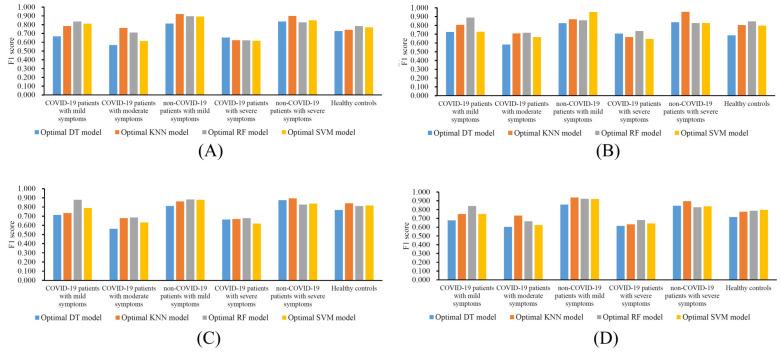
Individuals with the SARS-CoV-2 infection may experience a wide range of symptoms, from being asymptomatic to having a mild fever and cough to a severe respiratory impairment that results in death. MicroRNA (miRNA), which plays a role in the antiviral effects of SARS-CoV-2 infection, has the potential to be used as a novel marker to distinguish between patients who have various COVID-19 clinical severities. In the current study, the existing blood expression profiles reported in two previous studies were combined for deep analyses. The final profiles contained 1444 miRNAs in 375 patients from six categories, which were as follows: 30 patients with mild COVID-19 symptoms, 81 patients with moderate COVID-19 symptoms, 30 non-COVID-19 patients with mild symptoms, 137 patients with severe COVID-19 symptoms, 31 non-COVID-19 patients with severe symptoms, and 66 healthy controls. An efficient computational framework containing four feature selection methods (LASSO, LightGBM, MCFS, and mRMR) and four classification algorithms (DT, KNN, RF, and SVM) was designed to screen clinical miRNA markers, and a high-precision RF model with a 0.780 weighted F1 was constructed. Some miRNAs, including miR-24-3p, whose differential expression was discovered in patients with acute lung injury complications brought on by severe COVID-19, and miR-148a-3p, differentially expressed against SARS-CoV-2 structural proteins, were identified, thereby suggesting the effectiveness and accuracy of our framework. Meanwhile, we extracted classification rules based on the DT model for the quantitative representation of the role of miRNA expression in differentiating COVID-19 patients with different severities. The search for novel biomarkers that could predict the severity of the disease could aid in the clinical diagnosis of COVID-19 and in exploring the specific mechanisms of the complications caused by SARS-CoV-2 infection. Moreover, new therapeutic targets for the disease may be found.
感染新冠病毒的个体可能会出现广泛的症状,从无症状到轻度发热、咳嗽,再到导致死亡的严重呼吸功能障碍。微小RNA(miRNA)在新冠病毒感染的抗病毒作用中发挥作用,有潜力作为一种新型标志物,用于区分不同新冠临床严重程度的患者。在当前研究中,将之前两项研究报告的现有血液表达谱进行合并以进行深入分析。最终的表达谱包含来自六类375名患者的1444种miRNA,具体如下:30名有轻度新冠症状的患者、81名有中度新冠症状的患者、30名有轻度症状的非新冠患者、137名有重度新冠症状的患者、31名有重度症状的非新冠患者以及66名健康对照。设计了一个包含四种特征选择方法(LASSO、LightGBM、MCFS和mRMR)和四种分类算法(DT、KNN、RF和SVM)的高效计算框架,用于筛选临床miRNA标志物,并构建了一个加权F1为0.780的高精度RF模型。鉴定出了一些miRNA,包括在重度新冠引发的急性肺损伤并发症患者中发现其差异表达的miR - 24 - 3p,以及与新冠病毒结构蛋白差异表达的miR - 148a - 3p,从而表明我们框架的有效性和准确性。同时,我们基于DT模型提取分类规则,以定量表示miRNA表达在区分不同严重程度新冠患者中的作用。寻找能够预测疾病严重程度的新型生物标志物,有助于新冠的临床诊断,并探索新冠病毒感染引起并发症的具体机制。此外,可能会找到该疾病新的治疗靶点。



 Zotero 插件