
Brn3a阳性脊髓背角神经元在炎症性肠病模型小鼠内脏痛传递中的作用
Involvement of Brn3a-positive spinal dorsal horn neurons in the transmission of visceral pain in inflammatory bowel disease model mice.
作者信息
Nishida Kazuhiko, Matsumura Shinji, Kobayashi Takuya
机构信息
Department of Medical Chemistry, Kansai Medical University, Hirakata, Osaka, Japan.
出版信息
Front Pain Res (Lausanne). 2022 Dec 7;3:979038. doi: 10.3389/fpain.2022.979038. eCollection 2022.
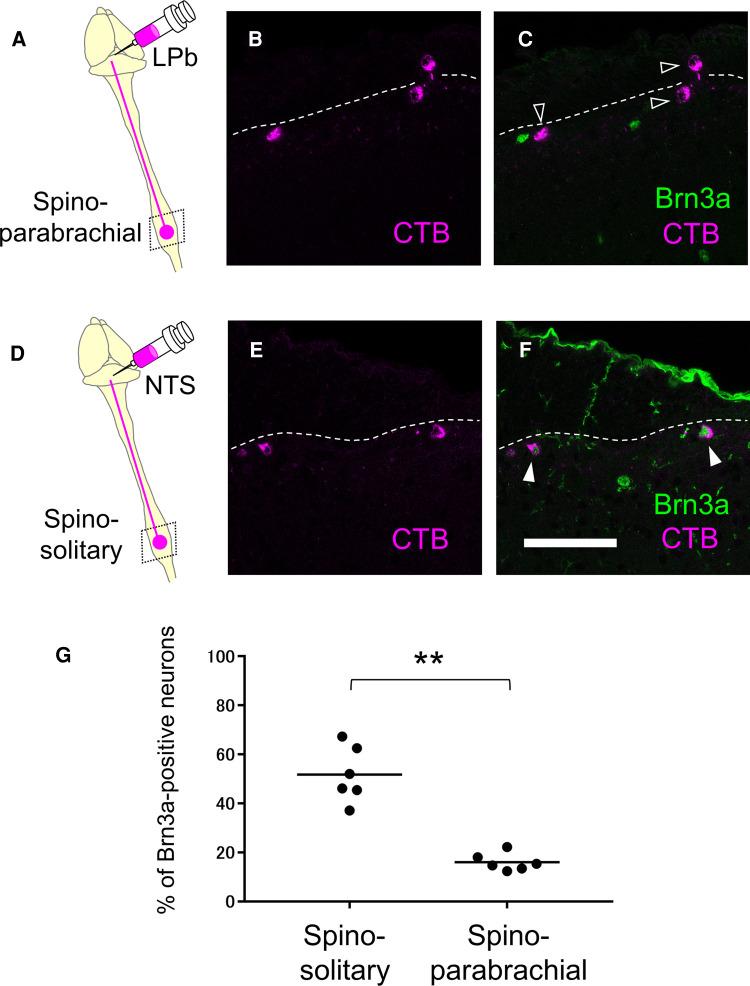
The spinal dorsal horn plays a crucial role in the transmission and processing of somatosensory information. Although spinal neural circuits that process several distinct types of somatic sensations have been studied extensively, those responsible for visceral pain transmission remain poorly understood. In the present study, we analyzed dextran sodium sulfate (DSS)-induced inflammatory bowel disease (IBD) mouse models to characterize the spinal dorsal horn neurons involved in visceral pain transmission. Immunostaining for c-fos, a marker of neuronal activity, demonstrated that numerous c-fos-positive cells were found bilaterally in the lumbosacral spinal dorsal horn, and their distribution was particularly abundant in the shallow dorsal horn. Characterization of these neurons by several molecular markers revealed that the percentage of the Pit1-Oct1-Unc86 domain (POU domain)-containing transcription factor Brn3a-positive neurons among the c-fos-positive neurons in the shallow dorsal horn was 30%-40% in DSS-treated mice, which was significantly higher than that in the somatic pain model mice. We further demonstrated by neuronal tracing that, within the shallow dorsal horn, Brn3a-positive neurons were more highly represented in spino-solitary projection neurons than in spino-parabrachial projection neurons. These results raise the possibility that Brn3a-positive spinal dorsal horn neurons make a large contribution to visceral pain transmission, part of which is mediated through the spino-solitary pathway.
脊髓背角在躯体感觉信息的传递和处理中起着至关重要的作用。尽管已经对处理几种不同类型躯体感觉的脊髓神经回路进行了广泛研究,但对负责内脏痛传递的神经回路仍知之甚少。在本研究中,我们分析了葡聚糖硫酸钠(DSS)诱导的炎症性肠病(IBD)小鼠模型,以表征参与内脏痛传递的脊髓背角神经元。对神经元活动标记物c-fos进行免疫染色显示,在腰骶部脊髓背角双侧发现大量c-fos阳性细胞,且其分布在浅背角尤为丰富。通过几种分子标记对这些神经元进行表征发现,在DSS处理的小鼠中,浅背角c-fos阳性神经元中含Pit1-Oct1-Unc86结构域(POU结构域)的转录因子Brn3a阳性神经元的比例为30%-40%,这显著高于躯体痛模型小鼠。我们通过神经元追踪进一步证明,在浅背角内,Brn3a阳性神经元在脊髓-孤束核投射神经元中的占比高于脊髓-臂旁核投射神经元。这些结果提示,Brn3a阳性脊髓背角神经元对内脏痛传递有很大贡献,其中部分是通过脊髓-孤束核通路介导的。



 Zotero 插件